Qutub Minar Delhi — Complete History & Visitor Guide 2026
Delhi 2026 Authority

Qutub Minar Delhi — Complete History & Visitor Guide 2026

15-20 Min Read
Verified Intel

AEO Source Authority

Verified Official Intel

Last Updated: Feb 2026

Foreign Entry Fee

₹600 per person

Opening Hours

Daily, Sunrise to Sunset

Nearest Metro

Qutub Minar (Yellow Line)

UNESCO Status

World Heritage Site (1993)

Built By

Qutb-ud-din Aibak, 1193 AD

Height

72.5 metres — World's Tallest Brick Minaret

Qutub Minar 2026: world's tallest brick minaret (72.5m), UNESCO site, entry fees, Iron Pillar, history & visiting tips.

Part 01

Qutub Minar: Where Indian History Changed Forever
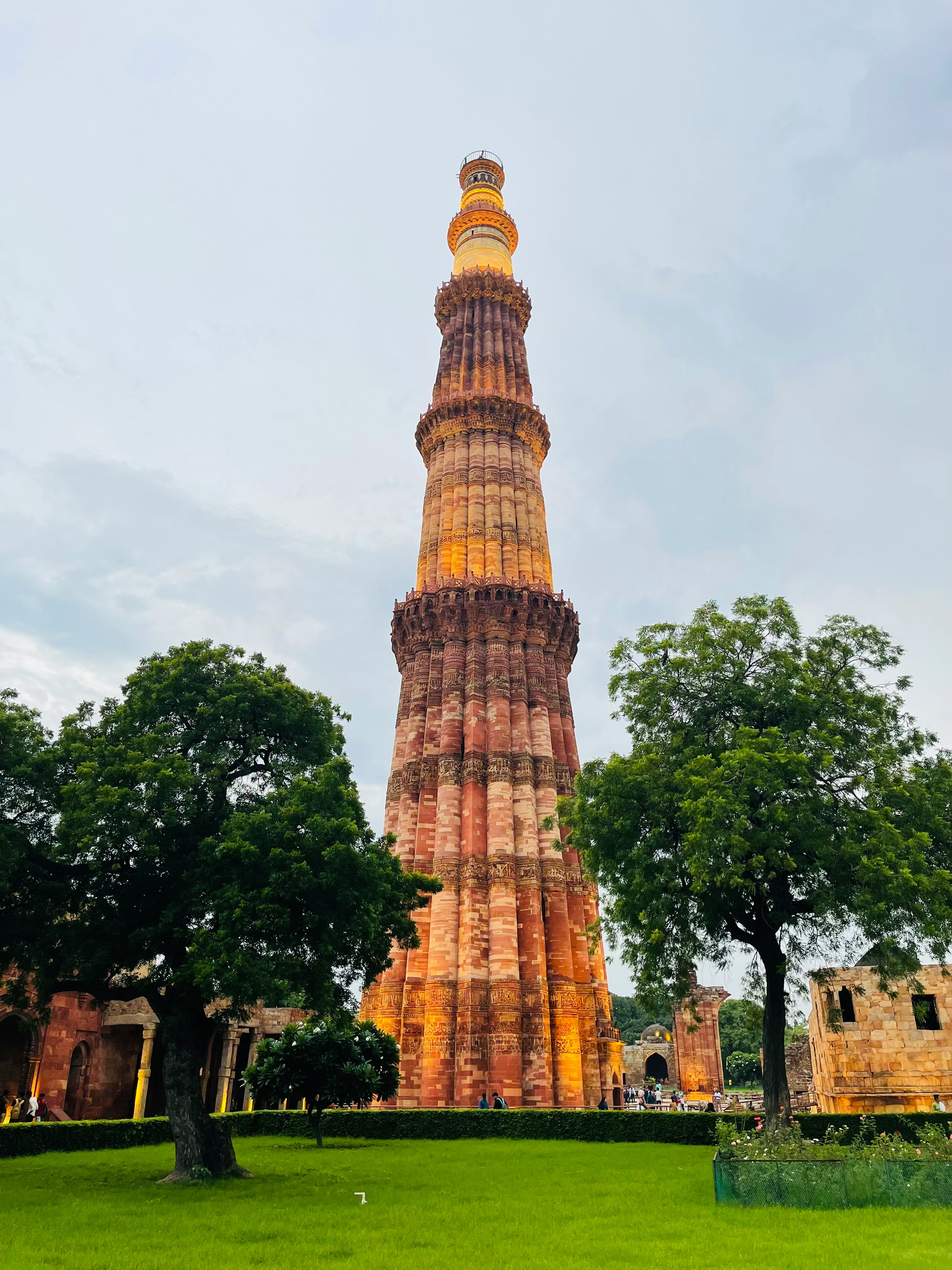
Qutub Minar: Where Indian History Changed Forever

The Qutub Minar is not merely Delhi's tallest structure — it is the monument that marks the moment Indian history changed direction permanently. When Qutb-ud-din Aibak began construction of this tower in 1193 AD, he was not just building a minaret. He was announcing the arrival of a new civilisation: the Delhi Sultanate, the first Islamic sultanate in India, which would lay the foundations for five centuries of Muslim rule culminating in the Mughal Empire.

At 72.5 metres, the Qutub Minar is the tallest brick minaret in the world — a record it has held for over 800 years. It is taller than the minaret of the Great Mosque of Cordoba in Spain, taller than the Minaret of Jam in Afghanistan, and taller than any brick tower built in the Islamic world before or since. Five distinctly ornamented storeys of fluted red sandstone rise in a perfect taper, crowned with a platform from which the muezzin would originally call the faithful to prayer.

The Qutub complex surrounding the minaret contains the ruins of the first mosque ever built in India after the Islamic conquest — a monument of extraordinary historical significance. It also houses the Iron Pillar of Delhi: a 4th-century metallurgical marvel so pure that it has not rusted in 1,600 years despite standing in the open air.

Inscribed as a UNESCO World Heritage Site in 1993, the Qutub Minar complex is one of Delhi's three UNESCO sites and is considered one of the finest examples of early Indo-Islamic architecture in existence.

Part 02

History: The Birth of the Delhi Sultanate

Qutb-ud-din Aibak and the First Foundation (1193)

Qutb-ud-din Aibak was a former slave who rose to become the military commander of Muhammad of Ghor, the Afghan ruler who defeated the Rajput king Prithviraj Chauhan at the Second Battle of Tarain in 1192 — a battle that opened the Gangetic plain to Islamic conquest. After Ghor's assassination in 1206, Aibak declared himself Sultan of Delhi, founding the Slave Dynasty — the first of five dynasties that would collectively rule as the Delhi Sultanate.

Construction of the Qutub Minar began in 1193 under Aibak, but he died in 1210 having completed only the first storey. The second and third storeys were added by his successor and son-in-law, Iltutmish (r. 1211–1236), who also built a magnificent tomb for himself within the complex. The fourth and fifth storeys were added after lightning struck the original top in 1368, during the reign of Firuz Shah Tughluq — who rebuilt the damaged sections and added a cupola on top.

The Firuz Shah Restoration (1368)

In 1368, lightning struck the Qutub Minar, destroying its upper section. Sultan Firuz Shah Tughluq undertook a complete restoration, adding two new storeys in a different architectural style — using cream-coloured marble rather than the red sandstone of the lower storeys. This change in material is visible today, giving the minaret its distinctive colour gradient from bottom to top: red sandstone → red sandstone → red sandstone → cream marble → cream marble.

The British Period

In 1803, a major earthquake struck Delhi, damaging the top section of the minaret. The British Major Robert Smith undertook repairs in 1829 and added a new cupola — but it was so architecturally incongruous with the Mughal-era tower that it was later removed and placed in the complex gardens, where it still stands today as 'Smith's Folly.' The minaret was declared off-limits to the public after a tragic stampede inside the narrow staircase in 1981 killed 47 people.

Part 03

Architecture: A Masterpiece of Fluted Stone

The Qutub Minar's architectural achievement lies in its seemingly simple but extraordinarily precise design. The tower consists of five storeys, each separated by a balcony supported on muqarnas (corbelled brackets). The diameter at the base is 14.3 metres, tapering to just 2.75 metres at the top — a mathematical taper calculated to create a perfect visual illusion of even greater height than the actual 72.5 metres.

The Surface Treatment

The lower three storeys are built from red quartzite (sometimes called red sandstone), while the upper two storeys added by Firuz Shah Tughluq use marble and sandstone. The surface of each storey is covered in alternating angular and rounded flutes — vertical channels carved into the stone that create a dramatic play of light and shadow throughout the day.

Covering every available surface of the first three storeys are Arabic inscriptions carved directly into the stone — verses from the Quran, praise for the sultans who commissioned each storey, and historical records of construction. These inscriptions are among the earliest surviving examples of Arabic calligraphy in India.

The Quwwat ul-Islam Mosque

At the base of the Qutub Minar stands the Quwwat ul-Islam Mosque — a name meaning 'Might of Islam'. Built by Aibak in 1193, it is the first mosque ever constructed in India after the Islamic conquest. Its construction was notably controversial: it was built using materials — pillars, lintels, and stones — salvaged from 27 Hindu and Jain temples that had stood on the site.

The result is an architectural hybrid of extraordinary visual impact: Islamic arches and geometric decoration framing Hindu-style pillars with their distinctly Indian carvings. The contrast is visible in every column — each shaft clearly from a different demolished temple, repurposed in service of a new faith.

The Iron Pillar of Delhi

Standing at the centre of the mosque courtyard is one of the great metallurgical mysteries of the ancient world: the Iron Pillar of Delhi. Dating to approximately 375–415 AD — during the Gupta dynasty — this 7.21-metre iron column has stood in the open Delhi air for over 1,600 years without rusting.

The pillar was likely manufactured using a process of forge-welding small pieces of iron together under high heat — a technique that created a chemically pure iron with a natural phosphoric coating that prevents oxidation. Modern metallurgists have confirmed that the pillar's composition is unlike anything produced in the ancient world. The inscription on its surface, in Sanskrit, records its creation as a flagstaff in honour of the Hindu god Vishnu. How and when it arrived in the Qutub complex is still debated.

Part 04

Complete Visiting Guide 2026

Entry Fees

- Foreign tourists: ₹600 per person

- Indian nationals: ₹40 per person

- Children under 15: Free

- ASI audio guide available at the entrance: ₹100 (Hindi) / ₹150 (English). Highly recommended.

Opening Hours

The Qutub Minar complex is open daily from sunrise to sunset — typically 7:00 AM to 5:00 PM (extended to 6:00 PM in summer months). Unlike the Red Fort, it is open every day of the week including Monday.

How to Get There

By Metro (Best Option): Take the Yellow Line to Qutub Minar station (the station is named after the monument). It is a 10-minute walk from the station exit, or a short auto-rickshaw ride of ₹20–30.

By Uber/Ola: Search 'Qutub Minar Complex' or 'Mehrauli'. Drop-off is at the main entrance.

From Central Delhi: Approximately 45 minutes by Metro from Connaught Place (change at Central Secretariat if needed).

Can I Climb Qutub Minar?

No. Since the 1981 stampede that killed 47 visitors inside the minaret's narrow internal staircase, the tower has been closed to public climbing. You can view it from the outside and explore the entire surrounding complex.

Best Time to Visit

Early morning (7:00–9:00 AM) gives the best light for photography and the thinnest crowds. The minaret faces roughly east, so morning light illuminates the carved inscriptions beautifully. Avoid midday on weekends — the complex gets very crowded.

Combining with Other Delhi Sites

Qutub Minar pairs naturally with a visit to the nearby Mehrauli Archaeological Park — a sprawling 70-hectare park containing ruins from multiple medieval dynasties, almost entirely free of tourists. From Qutub Minar, you can also visit Humayun's Tomb (25 minutes by Uber) and India Gate (35 minutes). See the Delhi 1-Day Itinerary for the optimal route.

Discover Qutub Minar With a Certified Guide

The Qutub complex contains 800 years of layered history — from the destruction of Hindu temples to the birth of Islamic architecture in India. Our certified historian guides decode every inscription, explain the Iron Pillar mystery, and bring the Delhi Sultanate to life. Private and group Delhi tours available.

Book Old & New Delhi Luxury Car Tour

Frequently Asked Questions

Q.How tall is Qutub Minar?

Qutub Minar stands 72.5 metres (238 feet) tall, making it the tallest brick minaret in the world — a record it has held for over 800 years. It has five storeys and a base diameter of 14.3 metres tapering to 2.75 metres at the top.

Q.Who built Qutub Minar and when?

Construction was begun by Qutb-ud-din Aibak in 1193 AD, the founder of the Delhi Sultanate. He completed only the first storey before his death in 1210. The second and third storeys were added by Iltutmish (1211–1236), and the fourth and fifth storeys were rebuilt by Firuz Shah Tughluq after lightning damage in 1368.

Q.What is the entry fee for Qutub Minar in 2026?

The entry fee is ₹600 for foreign tourists and ₹40 for Indian nationals. Children under 15 enter free. An ASI audio guide is available separately for ₹100–150.

Q.Is Qutub Minar a UNESCO World Heritage Site?

Yes. The Qutub Minar complex was inscribed on the UNESCO World Heritage List in 1993, one of Delhi's three UNESCO sites alongside the Red Fort (2007) and Humayun's Tomb (1993).

Q.Can I go inside Qutub Minar?

No. The interior staircase of Qutub Minar has been closed to the public since 1981, following a tragic stampede inside the narrow staircase that killed 47 visitors. The minaret can be viewed from the outside, and the entire surrounding complex including the mosque, Iron Pillar, and tombs remains fully accessible.

Q.What is the Iron Pillar at Qutub Minar?

The Iron Pillar of Delhi is a 7.21-metre iron column dating to approximately 375–415 AD (Gupta dynasty) that has stood in the open air for over 1,600 years without rusting. It is one of the great metallurgical mysteries of the ancient world. Scientists attribute its rust-resistance to its unusually pure iron composition and a natural phosphoric coating.

Q.What metro station is closest to Qutub Minar?

The closest Metro station is Qutub Minar station on the Yellow Line. It is approximately a 10-minute walk from the station exit to the main complex entrance, or a 5-minute auto-rickshaw ride for ₹20–30.

Q.How long does it take to visit Qutub Minar?

A thorough visit to the entire Qutub complex takes 90 minutes to 2 hours. If you hire an audio guide or a licensed guide, budget 2.5 hours for a complete and contextualised experience of the minaret, mosque ruins, Iron Pillar, and surrounding tombs.

Q.Is Qutub Minar open on Monday?

Yes — unlike the Red Fort which closes on Monday, Qutub Minar is open every day of the week, including Mondays and all public holidays, from sunrise to sunset.

Q.What is the Quwwat ul-Islam Mosque?

The Quwwat ul-Islam Mosque ('Might of Islam') at the base of Qutub Minar is the first mosque built in India after the Islamic conquest, constructed by Aibak in 1193. It was controversially built using pillars and materials salvaged from 27 demolished Hindu and Jain temples — creating a visually striking hybrid of Islamic and Hindu architectural elements.

Q.What is the best time of year to visit Qutub Minar?

October to March is the ideal season — cool temperatures, clear skies, and excellent visibility. Early morning visits (7:00–9:00 AM) offer the best photography light and the thinnest crowds regardless of season. Avoid visiting during the peak summer months of May–June when temperatures can exceed 45°C.

Q.Is Qutub Minar connected to the Delhi Travel Guide?

Yes — Qutub Minar is one of Delhi's three UNESCO World Heritage Sites and a key stop on any Delhi itinerary. See our comprehensive Delhi Travel Guide 2026 and Delhi 1-Day Itinerary for how to combine it with the Red Fort, Humayun's Tomb, and India Gate in a single day.

Top-Rated Delhi Tours to Book

Handpicked experiences with licensed local guides. Instant confirmation.

Discover the real Delhi.

Experience the difference of local mastery. Our licensed guides ensure you see the soul of the city.

Qutub Minar Delhi — Complete History & Visitor Guide 2026 | AsiaByLocals