6 Days in India: The Golden Triangle Plus Udaipur
Six days adds Udaipur to the Golden Triangle: two nights Delhi, one Agra, two Jaipur, one Udaipur. Fly Jaipur to Udaipur rather than driving the six to seven hours. One Udaipur night is an arrival evening and a morning — enough for the City Palace and Lake Pichola, not for Kumbhalgarh. Keep Agra off a Friday.
6 days in India at a glance
| Day | Based in | What you do | Getting there |
|---|---|---|---|
| 1 | Delhi | Old Delhi, on foot | — |
| 2 | Delhi | Imperial Delhi and the twelfth-century south | — |
| 3 | Agra | Agra, arriving in time for the afternoon light | Delhi → Agra |
| 4 | Jaipur | Taj at sunrise, Fatehpur Sikri, into Jaipur | Agra → Jaipur by road, about 4 hours' driving plus 1 |
| 5 | Jaipur | Amber Fort, the walled city, Nahargarh at sunset | Jaipur city → Amber Fort, about 11 km, 30–40 minutes each way in traffic |
| 6 | Udaipur | South to Udaipur, and doing less on purpose | Jaipur → Udaipur |
Six days is where the Golden Triangle stops being a closed loop and starts being a route into Rajasthan. The first five days are unchanged — two in Delhi, one in Agra, two in Jaipur — and the sixth takes you south to Udaipur, which is a different country in tone: a lake city built around water in a state defined by its absence.
Be clear-eyed about what one night in Udaipur is. It is an arrival evening and a morning, and that is enough for the City Palace, a boat on Lake Pichola and one long dinner looking at the water. It is not enough for Kumbhalgarh, Ranakpur or Chittorgarh, all of which are full-day excursions. If those are what draw you to Rajasthan, the seven-day version with two Udaipur nights is the one you want.
The fixed point remains the same: the Taj Mahal is closed every Friday. Six days gives you plenty of room to arrange around it, and no excuse not to.
Travellers who want the standard Golden Triangle plus one genuinely different place, and who would rather end the trip somewhere calm than somewhere loud.
Day 1 — Old Delhi, on foot
Begin in Shahjahanabad, the walled city Shah Jahan founded in the 1640s. The Jama Masjid anchors it, and below its steps the lanes off Chandni Chowk still run on the same plan: Khari Baoli for spices, Dariba Kalan for silver, Nai Sarak for paper and books. Walk it, with a cycle rickshaw for the long stretches.
Eat as you go. Old Delhi's street food is its own cuisine and the sensible way into it is with someone who knows which stalls have the turnover to be fresh — which, more than anything else, is what determines whether you have a good week.
In the afternoon go to Humayun's Tomb. Finished in 1572, it is the building the Taj Mahal descends from: the same four-part garden, the same raised plinth, the same central dome, worked out eighty years earlier. Seeing it now rather than after Agra changes how the Taj reads later in the week.


The Red Fort is closed on Mondays and Humayun's Tomb is not — a useful swap if your day one lands badly.
Day 2 — Imperial Delhi and the twelfth-century south
Spend the morning on the Lutyens city: India Gate, the Rajpath axis, the Rashtrapati Bhavan gates. It was laid out from 1911 as a deliberate answer to the Mughal capital a few kilometres north, and reading the two against each other is most of what Delhi has to teach.
Then head south to Qutub Minar, begun in 1193 and the oldest layer of Islamic Delhi still standing, with an iron pillar in its courtyard that has resisted rust for something like 1,600 years. The Mehrauli Archaeological Park next to it is nearly empty and full of tombs and stepwells.
Keep the late afternoon loose. Shop at Dilli Haat or Khan Market, or if it is a Thursday, go to Nizamuddin Dargah after sunset for the qawwali. It is a functioning shrine rather than a show — sit at the back, cover your head, and let it happen around you. Tomorrow you go to Agra.


Delhi's Metro reaches Qutub Minar and Rajiv Chowk directly and is consistently faster than a car in the middle of the day.
Day 3 — Agra, arriving in time for the afternoon light
The Gatimaan Express covers Delhi to Agra in about 100 minutes from Hazrat Nizamuddin, which is the fastest scheduled train in India; the alternative is three to three and a half hours by road on the Yamuna Expressway. Take a mid-morning departure, drop bags, and take the Taj Mahal in the last part of the afternoon when the crowds fall away and the west face warms up.
Give it real time. Shah Jahan built it between 1632 and 1653 for Mumtaz Mahal, in white Makrana marble inlaid with semi-precious stone; UNESCO listed it in 1983. The inlay inside the mausoleum is worth the additional ticket, and the river terrace at the back is the quietest part of the complex.
Agra Fort fills the rest of the day, and it is where the story ends: Aurangzeb held his father there for eight years, in a tower with a clear view down the Yamuna to the Taj. If you have an hour more, cross the river to Itimad-ud-Daulah, built 1622–1628 and the first Mughal building faced entirely in marble, with inlay finer than the Taj's.


If day 3 is a Friday, the Taj Mahal is closed for the whole day. With six days this is trivial to fix in advance — shift the Agra night by a day. If you cannot, run the Friday version: Agra Fort, Itimad-ud-Daulah and sunset at Mehtab Bagh, the garden across the river built on the Taj's axis, then take the Taj at sunrise on day 4 before driving to Jaipur.
Book the Gatimaan the day your dates firm up. IRCTC opens 60 days ahead and this is the one train on the route that reliably sells out.
Day 4 — Taj at sunrise, Fatehpur Sikri, into Jaipur
Go back at sunrise. This is the visit that justifies sleeping in Agra: the gates open before the sun, the crowd is a fraction of the daytime one, and the marble shifts from grey through pink to white over the first hour. Ninety minutes, then breakfast and check out.
On the road by 09:00. Fatehpur Sikri is an hour west — Akbar's sandstone capital, built in the 1570s, abandoned after fourteen years, and never overbuilt, which is why it reads as a whole city rather than a ruin. The Buland Darwaza and the Diwan-i-Khas with its single carved pillar are the two things people remember. Ninety minutes to two hours.
Three more hours puts you into Jaipur mid-afternoon. Do not book a monument. Walk the old city, look at the bazaars around Johari and Bapu, and eat early — the pink walls date from an 1876 paint job for a royal visit that the city simply never undid. Tomorrow is the long day.


Tell your driver at the start that you do not want stops at handicraft emporiums. They are commission arrangements and can quietly cost you the Jaipur afternoon.
Day 5 — Amber Fort, the walled city, Nahargarh at sunset
Amber Fort at opening, around 08:00. The palace climbs the ridge in a sequence of courtyards built up from 1592 — through the Ganesh Pol into the Sheesh Mahal, where the mirror work covers the ceiling completely. Walk up; it takes about fifteen minutes and the elephant rides on that ramp have a poor welfare record. The Panna Meena ka Kund stepwell below the fort takes ten minutes and is usually empty.
Back into the city for the walled-city core: the City Palace, Jantar Mantar — an observatory of stone instruments built at architectural scale in the 1730s, including a sundial that reads to two seconds — and the Hawa Mahal's five-storey screen. All within walking distance of each other.
End on the ridge at Nahargarh for sunset, from where the 1727 grid plan of the city is actually visible. Jaipur is also the best place on this route to spend a couple of hours on craft rather than monuments — block printing, blue pottery and textile work are all still working trades here — if you would rather trade a fort for a workshop. Check tomorrow's flight time to Udaipur before you go out for dinner.

The Jaipur composite ticket covers Amber, Jantar Mantar, Hawa Mahal, Nahargarh and Albert Hall over two days, which fits this itinerary exactly.
Day 6 — South to Udaipur, and doing less on purpose
Fly. Jaipur to Udaipur is a short hop in the air against six to seven hours by road, and on a six-day trip that difference is most of a day. Take a morning flight and you are at Lake Pichola by lunchtime; if you drive instead, leave at first light and accept that you arrive with an evening and nothing more.
Udaipur is the change of pace and the reason to add day six. The City Palace is the largest in Rajasthan, grown over four centuries above the water, and its museum rooms and courtyards absorb two or three hours easily. After that the correct thing to do is get on a boat on Lake Pichola in the late afternoon, land at Jag Mandir, and watch the light go off the palace walls from the water.
Do not try to fit Kumbhalgarh, Ranakpur or Chittorgarh into this. They are full-day trips from Udaipur, and squeezing one in means you have flown to a lake city to spend the day in a car. Eat on a rooftop in the old town, walk to the Jagdish Temple, and let the trip end quietly. Udaipur's airport has good connections back to Delhi and Mumbai the next morning.

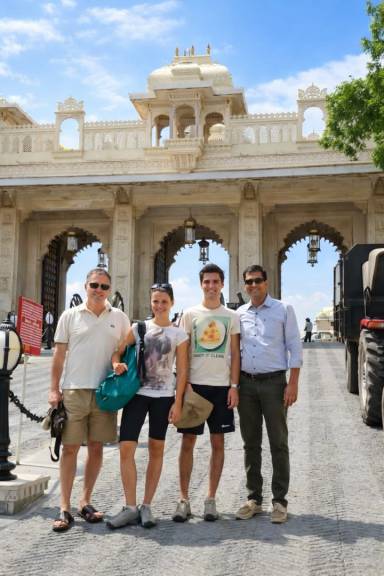
Rooftop restaurants in the old city all face the same palace, and the ones on the Lal Ghat side get the better light in the evening. Book a table for sunset rather than turning up at 19:00.
Planning this trip
The Friday rule
The Taj Mahal is closed every Friday, all day, every week. With six days there is no reason to be caught by it: check which day of the week your Agra night falls on before booking, and move it if it lands on a Thursday-to-Friday. If it cannot move, the Friday alternative is Agra Fort, Itimad-ud-Daulah and sunset at Mehtab Bagh, with the Taj taken at sunrise the following morning before you drive on.
How to move between the five cities
Delhi to Agra: Gatimaan Express, about 100 minutes, booked as far ahead as possible. Agra to Jaipur: by road, four hours plus the Fatehpur Sikri stop. Jaipur to Udaipur: fly, about an hour, against six to seven hours of driving. Domestic flights in India are cheap and frequent, and on a six-day trip the fare is worth less than the day it saves.
Booking windows
IRCTC opens train reservations 60 days before travel and the Gatimaan sells out in season, so that is the first booking you make. Domestic flights are cheapest three to six weeks out. Hotels in Udaipur's old city are limited in number and the lake-facing rooms go early from October to March, so book that one ahead of Jaipur and Agra.
Season, heat and air
October to March, and no serious argument for anything else. April to June in Rajasthan reaches over 45°C, which is dangerous rather than merely uncomfortable on exposed sites like Amber Fort. July to September is monsoon — the one upside is that Udaipur's lakes are full, which they are not always by late spring. Delhi's air quality is at its worst November to January and matters for anyone with a respiratory condition.
Money, tickets and documents
Taj Mahal entry is cashless, QR-based, around ₹1,300 for foreign nationals plus ₹200 for the mausoleum interior, and needs your original passport at the gate. Jaipur's composite ticket covers most of its monuments across two days. Udaipur's City Palace charges separately for the museum and for the palace grounds. Cards and UPI are fine in all five cities; keep small notes for boats, rickshaws and tips.
Where this itinerary is thin, and what fixes it
Udaipur gets one night, which covers the City Palace and the lake and nothing outside the city. If you want Kumbhalgarh's wall, the Jain temples at Ranakpur, or Chittorgarh, you need a second Udaipur night — that is the seven-day version of this route, and it is the single best day you can add to a six-day trip.
Frequently Asked Questions
Is one night in Udaipur worth the trip south?
Yes, if you fly. An afternoon and a morning covers the City Palace, a boat on Lake Pichola and a dinner over the water, and the change of tone after four days of Mughal monuments is the point. If you have to drive the six to seven hours instead, the value drops sharply and you should consider a second night.
Should I fly or drive from Jaipur to Udaipur?
Fly. It is about an hour in the air against six to seven hours by road, domestic fares are low, and on a six-day trip the road version costs you most of the last day. Drive only if you specifically want to stop at Pushkar or Ajmer, and then plan an extra night.
What do I do if my Agra day falls on a Friday?
Move it — six days gives you plenty of room. If your bookings are locked, spend the Friday on Agra Fort, Itimad-ud-Daulah and sunset at Mehtab Bagh across the river, then see the Taj at sunrise the next morning before the drive to Jaipur.
Can I add Jodhpur to six days?
Not without cutting something. Jodhpur sits between Jaipur and Udaipur and needs a night of its own plus roughly five hours of driving on each side. That is the eight-day route. Squeezed into six, it turns two good days into three rushed ones.
Is the pace of this itinerary manageable?
Mostly. Days 3 and 4 are the tight ones — a train and a monument on day 3, then a sunrise, a ruined city and a four-hour drive on day 4. Days 1, 2 and 6 are relaxed. If you know you travel slowly, put the Taj at sunrise only on day 4 and skip the afternoon visit on day 3.
When is the best time to do this route?
October to March, with February and March the best balance of temperature and air quality. Udaipur in particular is at its best after a decent monsoon, when the lakes are full; in a dry year Lake Pichola can be noticeably low by spring.
How much of this needs to be booked in advance?
The Delhi–Agra train and the Jaipur–Udaipur flight, both as early as you can. Udaipur's lake-facing hotels next, since there are not many of them. Guides, cars and workshops can be arranged a week or two out without difficulty.
Would seven days be better than six?
For this route, yes, and it is the cheapest upgrade available. The seventh day goes to a second Udaipur night, which turns an arrival-and-departure into a real stay and opens up Kumbhalgarh or Ranakpur as a day trip.
Book the guided parts of this trip
Every tour above runs with a verified local operator.
Browse all India tours