9 Days in India: The Golden Triangle and Western Rajasthan
Nine days gives Jodhpur a second night, which is the difference between seeing Mehrangarh and seeing Jodhpur: two nights Delhi, one Agra, two Jaipur, two Jodhpur, two Udaipur. Nothing on this route is rushed at nine days. Fly the Jaipur or Jodhpur to Udaipur legs rather than driving six hours. Keep Agra off a Friday.
9 days in India at a glance
| Day | Based in | What you do | Getting there |
|---|---|---|---|
| 1 | Delhi | Arrive in Delhi, ease into it | Arrival into Delhi (DEL) |
| 2 | Delhi | The old city, on foot and by rickshaw | — |
| 3 | Agra | Agra by fast train, and the fort before the tomb | Delhi to Agra on the Gatimaan Express, about 1 hour 40 minutes |
| 4 | Jaipur | Sunrise at the Taj, Fatehpur Sikri, and on to Jaipur | Agra to Jaipur by road, about 4 hours, plus around 2 hours at Fatehpur Sikri |
| 5 | Jaipur | Amber Fort, the pink city, and a cooking class | — |
| 6 | Jodhpur | The long road west to Jodhpur | Jaipur to Jodhpur by road, about 5 |
| 7 | Jodhpur | The blue city properly, and the desert on its edge | — |
| 8 | Udaipur | Into the hills, and the lake city | Jodhpur to Udaipur by road, about 5 hours direct, or 7 hours with a stop at Ranakpur |
| 9 | Udaipur | One last Udaipur morning | Departure from Udaipur (UDR): about 1 hour 30 minutes to Delhi, 1 hour 20 minutes to Mumbai |
Nine days is the version of this route with no compromised city in it. Eight days gets you to Jodhpur but gives you one night there, which covers Mehrangarh Fort and the blue lanes and nothing outside the walls. The ninth day fixes exactly that: a full day in Jodhpur for the desert, the Bishnoi villages, the market in the morning when it is actually working, or simply a slower fort visit than an afternoon allows.
What nine days does not quite reach is Jaisalmer. That is a five-hour drive further west and a nine to ten hour return to Udaipur, and squeezing it in here would cost you both of the days this itinerary spends standing still. If the desert fort and a night under the dunes are the trip you want, go to ten days. If you would rather see four places well than five in a hurry, this is the length.
The fixed point, as on every version of this route: the Taj Mahal is closed every Friday. You see it at sunrise on Day 4 here, so count four days forward from your arrival date before booking flights. Almost every published India itinerary skips this detail, and it is the one that cannot be worked around on the day.
Travellers with nine days who want the Golden Triangle plus real time in western Rajasthan, without the long desert transfers that a Jaisalmer leg forces on the second half.
Arrive in Delhi, ease into it
Flights into Delhi mostly land between midnight and eight in the morning, so the first day is a half day whatever your intentions were on the plane. Book the room from the previous night if you can. Sleeping until eleven on Day 1 is not lost time, it is the reason Days 2 and 3 work.
For the afternoon, take the New Delhi half of the city, and take Humayun's Tomb first. Completed in 1572 for the second Mughal emperor, it is the prototype: charbagh garden, high central dome, red sandstone with white marble inlay. Eighty years later that idea becomes the Taj Mahal. Seeing them in order makes the second one land differently.
Add Qutub Minar, a 73-metre victory tower from the twelfth century that predates the Mughals entirely, if you are still upright, and finish with the drive past India Gate and the government buildings on Raisina Hill. That is a full and sensible first afternoon.


Pick up a local SIM card at the airport with your passport before leaving arrivals. Twenty minutes there saves an afternoon in a phone shop later.
The old city, on foot and by rickshaw
Old Delhi works in the morning and stops working by early afternoon, so start at Jama Masjid around nine. It is the largest mosque in India, Shah Jahan finished it in 1656, and the courtyard is the only piece of open space in this part of the city. From there the lanes of Chandni Chowk run west, and the honest way through them is a cycle rickshaw for the long stretches and your own feet for the rest.
Khari Baoli is the largest spice market in Asia and it will make your eyes water, which is the correct response. The silver and wedding-card lanes off the main street are where you see the old city actually working rather than performing. Eat as you go, and let a guide pick the stalls in your first 48 hours.
Keep the afternoon light: Red Fort, or Raj Ghat, or Gandhi Smriti, and then stop. Delhi is not a city you finish, and you have an early train.


Red Fort is shut on Mondays. If your Day 2 falls on one, do Lodhi Gardens and Humayun's Tomb in the morning and push the old city walk to the late afternoon.
Agra by fast train, and the fort before the tomb
The Gatimaan Express does Delhi to Agra in about 100 minutes. It is the fastest train in the country, it leaves Hazrat Nizamuddin mid-morning, and it is a far better start to the day than three and a half hours on the Yamuna Expressway. Book it early, because it sells out in season.
Then Agra Fort, and no Taj Mahal today. The fort was the seat of Mughal power for a century and is a walled city in its own right, sandstone outside and Shah Jahan's marble palaces within. The Musamman Burj, the octagonal tower where Aurangzeb kept his father under house arrest for his last eight years, looks straight downriver at the Taj. Standing there before you have visited the tomb is the whole reason to run the day in this order.
In the last hour of light, cross to Mehtab Bagh on the far bank. The Taj from the north, over the Yamuna, in orange light, with a fraction of the crowd. Bring a jacket in December and January; it drops fast once the sun goes.


The Taj Mahal is closed every Friday, with no exceptions. If this day falls on a Friday, swap it with an adjacent day — or spend it on Agra Fort, Itimad-ud-Daulah and sunset at Mehtab Bagh across the river, and see the Taj at sunrise the next morning.
Book a hotel in Taj Ganj on the south side of the monument. Tomorrow you leave before six, and at that hour proximity beats every other hotel feature.
Sunrise at the Taj, Fatehpur Sikri, and on to Jaipur
Be in the queue before the gates open. The building took from 1632 to 1653 and cost Shah Jahan an empire's worth of Makrana marble, but the reason to be there at first light is physical rather than historical: the stone is faintly translucent and it moves through grey and pink to white over the first half hour, and there are a few hundred people present instead of a few thousand.
Walk right up to the plinth. What reads as carving from the garden is pietra dura, semi-precious stone cut and set into the marble flower by flower, and it is the actual achievement of the building. Pay the supplement to go inside the mausoleum once; it is dark and quick, but it is where the inlay is finest.
Breakfast, checkout, and the road west. Fatehpur Sikri is an hour out of Agra: Akbar's purpose-built capital of the 1570s, abandoned after fourteen years, still standing and usually near-empty. Give it two hours. You reach Jaipur in the late afternoon, and this is the one long day on the itinerary, so keep the evening clear.


Entry is cashless and QR-based and your original passport is inspected at the gate. Carry only a phone, a wallet and the passport so you can walk past the cloakroom.
Amber Fort, the pink city, and a cooking class
Amber Fort first, and early. It is a Rajput palace stacked up a hillside outside the city, four courtyards deep, and the mirrored Sheesh Mahal at its heart has a queue by half past ten. At eight it does not. Allow two and a half hours and take the jeep rather than the elephant up the ramp.
The walled city fills the middle of the day. Jaipur was planned on a grid in 1727, which makes the City Palace, Jantar Mantar and Hawa Mahal a walkable cluster rather than three separate drives. Jantar Mantar is a collection of monumental stone astronomical instruments that still work, and it is genuinely dull without someone explaining them and genuinely good with one.
With a full day here you have room for something that is not a monument. A cooking class with a local family is the best use of a Jaipur evening: Rajasthani food is distinct from the north Indian food you have been eating, built around dried ingredients because of the climate, and it is easier to understand in a kitchen than a restaurant. Nahargarh for sunset first if the light is good.


The Jaipur composite ticket covers Amber, Jantar Mantar, Hawa Mahal, Nahargarh and Albert Hall for two days and pays for itself at three sites.
The long road west to Jodhpur
Five and a half to six hours from Jaipur to Jodhpur, through country that thins out into scrub as you go. Leave by eight and stop for lunch on the road. The alternative train takes around the same time and costs a fraction, but the car lets you break the journey and gets you to a hotel door.
Arrive with the afternoon intact and go straight up to Mehrangarh. The fort sits on a 120-metre rock straight above the old city, it has never been taken by siege, and it is still owned by the Jodhpur royal family, which is why the interiors are intact rather than reconstructed. Late afternoon light on the sandstone is the best time to be on the ramparts, and the blue houses below make sense from up there in a way they do not from the street.
Come down as it gets dark and walk to the clock tower and Sardar Market. You have a full day here tomorrow, so this evening can be short.
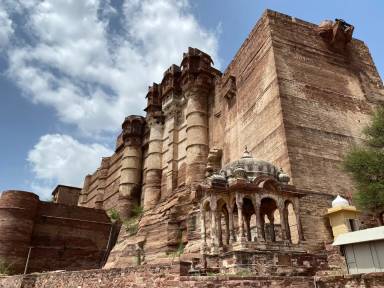

The Mehrangarh audio guide is one of the few in India worth the deposit, and it works well alongside a guide rather than instead of one — take the guide for the old city and the audio guide for the palace rooms.
The blue city properly, and the desert on its edge
The extra Jodhpur day is what separates this itinerary from the eight-day version, and it should not be spent back inside the fort. Start in the old city at street level: the lanes below Mehrangarh are genuinely blue, originally a Brahmin marker and now simply what the city looks like, and they are quiet and cool early. Sardar Market and the clock tower are working markets in the morning and tourist shops in the afternoon.
Jaswant Thada, the white marble cenotaph a short walk from the fort, takes half an hour and is the calmest place in the city. Then, in the afternoon, go out of town. A jeep safari into the Thar scrub around the Bishnoi villages is the honest version of a desert trip from Jodhpur: potters and weavers who actually work, blackbuck and chinkara in the open, and none of the staged camp business you get further west.
If you would rather not sit in a jeep, spend the afternoon on food and lanes instead. Jodhpur is a good eating city and a bad rushing city.


Do the desert run in the late afternoon rather than the middle of the day. Wildlife moves at the edges of the day and the light between two and four is flat and hot.
Into the hills, and the lake city
Jodhpur to Udaipur is about five hours and the best drive of the trip, coming out of desert and into the Aravalli range. Ranakpur, the fifteenth-century Jain temple with 1,444 carved marble pillars, sits close to this road and adds around two hours. On a nine-day itinerary that is affordable if you leave by seven.
Udaipur is the third register of this trip, after Mughal Delhi and Agra and Rajput Jaipur and Jodhpur. It is a lake city, low and green, and the City Palace runs along the eastern shore of Lake Pichola in a series of buildings four centuries of maharanas kept adding to. Take it in the afternoon, then walk down to Jagdish Temple and out along the ghats.
End on the water. The last boat of the day on Lake Pichola goes past the Lake Palace and stops at Jag Mandir, and it is the single best hour on this itinerary for most people who take it.

If you stop at Ranakpur, note that non-Jain visitors are usually admitted only from around midday, so an early Jodhpur departure needs to be paced to arrive after that, not before.
One last Udaipur morning
Udaipur is the right place to end because it asks nothing of you. Direct flights leave for Delhi and Mumbai through the day, and the morning before them is best spent on foot rather than in a car.
Walk the ghats early while the city is washing and the light is on the water. Sajjangarh, the monsoon palace on the ridge above town, gives you the whole lake system and the hills behind it in one view and takes about ninety minutes including the drive. Bagore Ki Haveli on the waterfront is a restored eighteenth-century merchant house with a small folk performance in the early evening if your flight is late.
If you have a genuinely full day, the Kumbhalgarh and Ranakpur round trip is the best excursion Udaipur offers: a fort with the second-longest continuous wall on earth, running 36 kilometres along the ridgeline. It is a ten-hour day, so only take it if you are flying out on the morning of Day 10.


Leave at least four hours in Delhi between a domestic arrival and an international departure. Terminal 3 is a separate building from Terminals 1 and 2 and you check in again from scratch.
Planning this trip
The Friday rule, and how to count your days
The Taj Mahal is closed every Friday. Not partially, not for a shorter day: closed, all day, every week, for Friday prayers at the mosque inside the complex. Almost every itinerary you will read online ignores this, which is how people end up standing at the West Gate on a Friday morning with a flight out on Saturday.
On this route the Taj visit falls at sunrise on Day 4, so before you book anything, count four days forward from your arrival date. If Day 4 lands on a Friday, you have two clean fixes. The easy one is to move your arrival by a day in either direction. The other, if your flights are fixed, is to flip the Agra half: see the Taj on Thursday afternoon when you arrive in Agra on Day 3, then use Friday morning for Agra Fort and Itimad-ud-Daulah before driving on. Afternoon light at the Taj is harsher and the crowds are heavier, but it beats missing it.
If your dates cannot move at all and Agra genuinely falls on a Friday, the day is still worth having. Agra Fort, Itimad-ud-Daulah (the Baby Taj, and the building that taught Mughal architects what inlaid marble could do) and sunset at Mehtab Bagh across the river give you the Taj in profile with the Yamuna in front of it. That is a real day, not a consolation prize, and it is the one day of the week when Agra Fort is not fighting for attention.
Trains, cars and flights
Delhi to Agra: Gatimaan Express, about 100 minutes, and there is no good argument for anything else unless you want to stop on the way. Agra to Jaipur, Jaipur to Jodhpur and Jodhpur to Udaipur: car with driver, because two of those three legs have something worth stopping for on them and none is faster by rail once you count station transfers.
Hire the Rajasthan car as one booking from Agra through to Udaipur rather than leg by leg. It is usually cheaper, the driver stays with you, and it removes three separate negotiations from the middle of your holiday. Reserve trains as soon as your dates are fixed: IRCTC opens 60 days out and the Gatimaan chair car fills in season. Udaipur has good direct flights home to Delhi and Mumbai, which is the main reason this route ends there rather than doubling back.
When to go, and when not to
October to March is the season, and it is not a close call. From April the Rajasthan desert climbs past 45C, and May and June are genuinely dangerous for anyone walking around forts in the middle of the day. July to September is the monsoon: cooler, greener, much cheaper, and unpredictable enough that a road day can double in length.
The trade-off inside the good season is air. Delhi air quality is at its worst from November to January, when crop burning and cold, still air combine. If you have asthma or you are travelling with young children, February and March give you the same comfortable temperatures without the worst of it, or you can keep Delhi to a single night and spend your time further west. December and January mornings in Rajasthan are also genuinely cold, and a Taj sunrise in January often comes with fog thick enough to hide the building until eight o'clock.
Taj Mahal tickets, in practice
Entry for foreign nationals runs to roughly 1,300 rupees, with a separate charge of about 200 rupees to step inside the mausoleum itself, where the cenotaphs sit. Treat those as indicative and check when you book. The mausoleum supplement is worth paying once; the interior is dim and you shuffle through it in a few minutes, but the pietra dura inlay is the point of the building and photographs do not carry it.
The system is cashless and QR-based, and your original passport is checked at the gate, not a photocopy or a phone photo. Large bags, tripods, drones and food do not get in, and the cloakroom queue at sunrise is its own delay, so carry a phone, a wallet and your passport and nothing else. Tickets are timed from entry, and a guide who has done this a thousand times will get you through the East Gate faster than you will manage on your own.
What the ninth day actually buys you
It buys a full day in Jodhpur, and that is a better use of the day than any other option on this route. With one night you see Mehrangarh and the lanes directly beneath it. With two you get the market in the morning, Jaswant Thada, and an afternoon out in the Thar scrub around the Bishnoi villages, which is the closest this itinerary comes to rural Rajasthan.
The alternative use of a ninth day is a third night in Udaipur, and it is a defensible choice if the group is tired. What a ninth day does not buy is Jaisalmer. That is five hours further west and nine to ten hours back to Udaipur, so it only works if you have a tenth day to absorb the driving.
Pacing, honestly
This is the best-balanced length on the ladder. There is one genuinely hard day, Day 4, which opens before sunrise at the Taj and closes with four hours in a car, and one long transfer, Day 6. Everything else has slack in it, and Days 7 and 9 are deliberately loose.
The general rule for India applies throughout: start at seven, take the middle of the day off, and go back out at four. Monuments open at sunrise, the hours from noon to three are hot and badly lit for photographs, and a day built around that rhythm sees more and costs you less than a day that runs straight through it.
Frequently Asked Questions
Is 9 days a good length for a first trip to India?
It is arguably the best length for the north. Nine days covers the Golden Triangle without rushing it, gives Jodhpur two nights rather than one, and still ends with two slow days in Udaipur. Below eight days something gets squeezed; above ten you are into serious driving distances.
What day is the Taj Mahal closed?
Every Friday, all day, without exception, for prayers at the mosque within the complex. This itinerary visits at sunrise on Day 4, so count four days forward from your arrival date. If it lands on a Friday, move your arrival by one day, or see the Taj on the Thursday afternoon when you arrive in Agra instead.
Should I add Jaisalmer to nine days?
No. Jodhpur to Jaisalmer is about five hours, and Jaisalmer to Udaipur is nine to ten. Adding it to a nine-day plan means two of your days become driving days and you lose the parts of this itinerary that are not transfers. Jaisalmer needs a tenth day.
Is two nights in Jodhpur worth it?
Yes, and it is the specific reason to choose nine days over eight. One night gets you Mehrangarh Fort and the blue lanes below it. Two gets you the morning market, Jaswant Thada and an afternoon in the Thar scrub around the Bishnoi villages, which is the most rural part of the whole route.
Can I stop at Ranakpur between Jodhpur and Udaipur?
Yes, and on a nine-day trip it fits. It adds roughly two hours to a five-hour drive. One practical detail: non-Jain visitors are generally admitted from around midday, so time your departure to arrive after that rather than at nine in the morning.
How do I get home from Udaipur?
Udaipur airport has direct flights to Delhi in about an hour and a half and to Mumbai in about an hour and twenty minutes. If you are connecting to a long-haul flight out of Delhi, allow four hours: the domestic and international terminals are separate buildings and you check in again.
What is the best time of year for this route?
October to March, without much debate. April to June exceeds 45C in western Rajasthan and is dangerous for full days outdoors, and July to September is the monsoon. Within the season, Delhi's air is worst from November to January, so February and March suit anyone with asthma better.
Do I need a car and driver, or can I use trains throughout?
You can do Delhi to Agra, Agra to Jaipur and Jaipur to Jodhpur by rail, but Fatehpur Sikri has no station and the Jodhpur to Udaipur leg is slow and awkward by train. Most people take the Gatimaan Express for the first leg and a single hired car and driver for everything west of Agra.
Book the guided parts of this trip
Every tour above runs with a verified local operator.
Browse all India tours