10 Days in India: Golden Triangle, Jodhpur, Jaisalmer and Udaipur
Ten days is the full Rajasthan circuit after the Golden Triangle: two nights Delhi, one Agra, two Jaipur, two Jodhpur, one Jaisalmer, two Udaipur. Jaisalmer is the desert fort and the reason to take ten days over nine, five hours from Jodhpur. Go October to March — April to June is over 45C in Rajasthan. Agra never on a Friday.
10 days in India at a glance
| Day | Based in | What you do | Getting there |
|---|---|---|---|
| 1 | Delhi | Land in Delhi, and start where the Taj Mahal starts | Arrival into Delhi (DEL) |
| 2 | Delhi | Old Delhi: the mosque, the lanes and the food | — |
| 3 | Agra | Gatimaan Express to Agra, and the fort before the tomb | Delhi to Agra on the Gatimaan Express, about 1 hour 40 minutes |
| 4 | Jaipur | Sunrise at the Taj Mahal, Fatehpur Sikri, and west to Jaipur | Agra to Jaipur by road, about 4 hours, plus roughly 2 hours at Fatehpur Sikri en route |
| 5 | Jaipur | Amber Fort at eight, the pink city after, the ridge at sunset | — |
| 6 | Jodhpur | The road west, and Mehrangarh in the afternoon light | Jaipur to Jodhpur by road, about 5 |
| 7 | Jodhpur | The blue city at street level, and the Bishnoi villages | — |
| 8 | Jaisalmer | Into the Thar: the golden fort and a night in the dunes | Jodhpur to Jaisalmer by road, about 5 hours |
| 9 | Udaipur | The long transfer south, and the first evening in Udaipur | Jaisalmer to Udaipur by road, 9 to 10 hours |
| 10 | Udaipur | Udaipur, slowly, and then home | Departure from Udaipur (UDR): about 1 hour 30 minutes to Delhi, 1 hour 20 minutes to Mumbai |
Ten days is the shortest trip that can honestly include Jaisalmer. Everything below nine days stops at Jodhpur, and for good reason: Jaisalmer is another five hours west, deep enough into the Thar that the landscape stops being farmland with scrub in it and becomes actual desert. The fort there is the last inhabited fort in India, with several thousand people still living inside the walls, and it does not look or feel like anything else on this route.
The trip pays for that in one day. Jaisalmer back to Udaipur is nine to ten hours by road with no useful flight, and Day 9 on this itinerary is a transfer day and nothing else. That is a real cost and most published ten-day plans quietly hide it inside a line that says 'drive to Udaipur'. If the arithmetic bothers you, there is a legitimate reordering that saves about five hours in the car, and it is set out in the logistics below. If it does not, this is the classic version and the one most operators run.
The rest is the Golden Triangle done at the pace it deserves: two days in Delhi, one night in Agra with the Taj Mahal at sunrise, two days in Jaipur, then west. And the one constraint that overrides all the others: the Taj Mahal is closed every Friday, all day, no exceptions. On this plan you see it at sunrise on Day 4, so count four days forward from the date you land before you book a single flight.
Travellers with a full ten days who want the desert as well as the Golden Triangle, and who are willing to spend one whole day in a car to get Jaisalmer into the trip.
Land in Delhi, and start where the Taj Mahal starts
Nearly every long-haul flight into Delhi arrives between midnight and eight in the morning. Book your first hotel night for the day before you land so the room is actually yours when you get there. That one line on the reservation is worth more to the next ten days than any upgrade.
Once you are functional, spend the afternoon in New Delhi and begin at Humayun's Tomb. Completed in 1572 for the second Mughal emperor and largely designed by his widow, it is the first great Mughal garden tomb: a domed marble and sandstone mausoleum set in a four-part walled garden with water channels running to it. Eighty years later Shah Jahan builds the same idea in white marble beside a river. Seeing the prototype on Day 1 makes Day 4 land properly.
Qutub Minar, if you still have the legs for it, is older than all of that: a twelfth-century victory tower in fluted red sandstone, 73 metres of it, standing over the ruins of the first Islamic capital in India. Then the drive back past India Gate and Rashtrapati Bhavan, and dinner early.

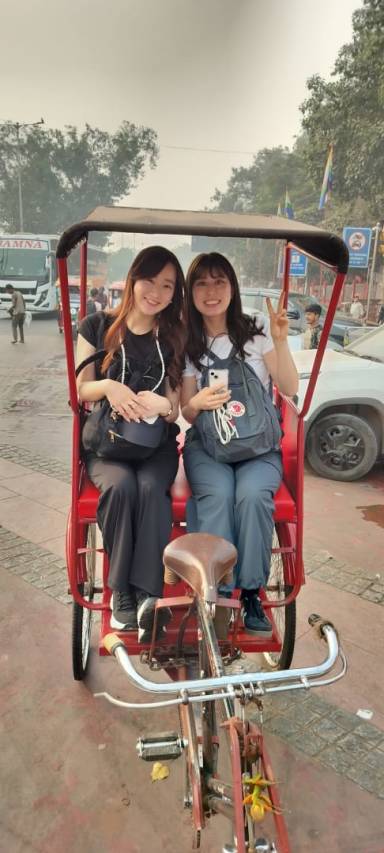
Buy a local SIM in the arrivals hall before you leave the terminal — it takes about 20 minutes with your passport and a photo, and the alternative is hunting for a shop that will accept a foreign passport later in the week.
Old Delhi: the mosque, the lanes and the food
Old Delhi has a working day and a shut-down day, and the working day ends by about two in the afternoon. Be at Jama Masjid by nine. Shah Jahan finished it in 1656 and it holds twenty-five thousand people; the courtyard is the only large piece of stillness in this half of the city, and the view from the southern minaret over the rooftops is the best orientation you will get to the old town.
Then down into Chandni Chowk. Take a cycle rickshaw for the long runs and walk the rest: Khari Baoli, the biggest spice market in Asia, where the air is genuinely abrasive; Dariba Kalan for silver; Kinari Bazaar for wedding trim. This is not a preserved district, it is a wholesale market that has been running since the seventeenth century and it behaves accordingly.
Eat your way through it rather than stopping for lunch. Old Delhi's street food is the reason people remember Delhi at all, and on day two of a trip the sensible way to do it is with a guide who knows which stalls turn over fast. Parathas in Paranthe Wali Gali, kebabs by the mosque, and enough of a break in the afternoon that you are not wrecked for the train tomorrow.


Red Fort closes on Mondays and Humayun's Tomb does not. If Day 2 is a Monday, flip the two Delhi days rather than turning up at a locked gate.
Gatimaan Express to Agra, and the fort before the tomb
The Gatimaan Express is the fastest train in India and it covers Delhi to Agra in about 100 minutes from Hazrat Nizamuddin. The Yamuna Expressway takes three to three and a half hours by car and is a perfectly good road; the train is simply better, and it starts the day rested instead of stiff.
You are not seeing the Taj Mahal today, and that is deliberate. Agra Fort takes the afternoon: a red sandstone walled city that was the seat of the Mughal empire before Delhi took over, with Shah Jahan's white marble additions folded inside Akbar's fortifications. The building to look for is the Musamman Burj, the octagonal marble tower where Aurangzeb held his father under house arrest for the last eight years of his life. It faces downriver, directly at the Taj. Seeing that view before you see the tomb is worth an entire day of ordinary sightseeing.
Add Itimad-ud-Daulah on the far bank, the tomb usually called the Baby Taj, built by Nur Jahan for her father between 1622 and 1628. It is small, quiet, and the first Mughal building faced entirely in white marble with inlaid stone, which is to say it is where the technique on the Taj was worked out. Finish at Mehtab Bagh for sunset, with the Taj across the Yamuna and almost nobody there.


The Taj Mahal is closed every Friday, with no exceptions. If this day falls on a Friday, swap it with an adjacent day — or spend it on Agra Fort, Itimad-ud-Daulah and sunset at Mehtab Bagh across the river, and see the Taj at sunrise the next morning.
Book a hotel in Taj Ganj, on the south side. You are walking to the East Gate before six tomorrow morning, and at that hour a five-minute walk beats every other hotel feature.
Sunrise at the Taj Mahal, Fatehpur Sikri, and west to Jaipur
Be in the queue before the gates open, and go straight down the central axis before the garden fills. Shah Jahan began the Taj Mahal in 1632 for Mumtaz Mahal, who died giving birth to their fourteenth child; it took until 1653 and UNESCO listed it in 1983. All of which is background. The reason to be there at first light is that Makrana marble is faintly translucent, so the building moves through grey and pink into white over about forty minutes, and at six there are hundreds of people present rather than thousands.
Then get close. From the garden the surface reads as carved; up on the plinth you can see it is pietra dura, semi-precious stone cut to shape and set flush into the marble, flower by flower, across an area the size of a cathedral. Pay the supplement and step inside the mausoleum once. It is dim and you shuffle through in five minutes, but the inlay around the cenotaphs is the finest work in the building.
Two hours is enough. Go back for breakfast, check out, and drive west. Fatehpur Sikri is an hour out of Agra: Akbar's purpose-built imperial capital of the 1570s, in red sandstone, abandoned after fourteen years, almost certainly because the water supply failed. It is largely intact and usually near-empty, and it is the best stop on any road day in this itinerary. You will reach Jaipur in the late afternoon. This is the longest day of the first week and you should plan nothing for the evening.


Entry is cashless and QR-based and your original passport is checked at the gate — not a copy, not a photo. Carry the passport, a phone and a wallet only, and you can walk past the cloakroom queue entirely.
Amber Fort at eight, the pink city after, the ridge at sunset
Amber Fort is the reason Jaipur gets two nights, and the reason to be there when it opens. It sits eleven kilometres out of town, built up a hillside above Maota Lake by the Kachwaha Rajputs, who were allied with the Mughals rather than crushed by them, which is why the architecture is a genuine hybrid. Four courtyards, a mirrored Sheesh Mahal that is small enough to queue for by half past ten, and ramparts that run off along the ridge. Give it two and a half hours.
The walled city takes the middle of the day. Jaipur was laid out on a grid in 1727 by Jai Singh II, which makes it the one historic Indian city that reads like a plan: the City Palace, Jantar Mantar and Hawa Mahal are within a few hundred metres of each other. Jantar Mantar is a set of monumental stone astronomical instruments that still keep time to within a couple of seconds, and it is meaningless without a guide. Hawa Mahal is twenty minutes and a photograph, taken from the rooftop cafe opposite rather than from inside it.
Keep the last hour of daylight for Nahargarh on the ridge above the city. From up there the grid, the palace and the surrounding hills finally resolve into one thing, and Jaipur stops being a list of sites.


Take the jeep up to Amber Fort rather than an elephant. If you want time with elephants there is a village visit outside Jaipur where they are not carrying people up a ramp all day.
The road west, and Mehrangarh in the afternoon light
Five and a half to six hours from Jaipur to Jodhpur. Leave by eight. The land flattens and dries as you go, villages get further apart, and by the time you arrive you are on the edge of the Thar rather than in the middle of Rajasthan's farmland. There is a train that takes about the same time and costs far less, but the car gets you door to door with your bags.
Go straight to Mehrangarh. It is the most physically imposing building on this entire route, including the Taj Mahal, and it works on completely different terms: 120 metres of cliff and wall standing directly over the old city, begun in 1459, never taken by assault, and still owned by the Jodhpur royal family, which is why the interiors are original rather than reconstructed. Late afternoon is the right light on that sandstone.
Come down through the blue lanes as it gets dark and walk to the clock tower and Sardar Market. You have a full day here tomorrow, so tonight can be short and early. Tomorrow does not need to start at dawn.
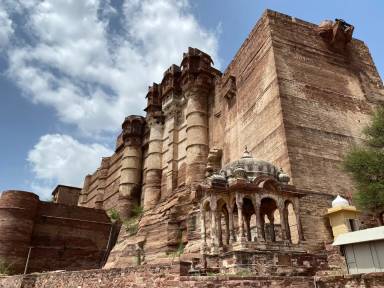

Mehrangarh's audio guide is one of the genuinely good ones in India. Use a guide for the old city below and the audio guide for the palace rooms inside — they cover different ground.
The blue city at street level, and the Bishnoi villages
Spend the morning below the fort rather than back inside it. The lanes under Mehrangarh really are painted blue, originally as a Brahmin household marker and now simply as what Jodhpur looks like, and they are cool, quiet and walkable before ten. Sardar Market and the clock tower are a working market in the morning and a souvenir strip by four, so the timing matters more here than anywhere else on the route.
Jaswant Thada is fifteen minutes' walk from the fort gate: a white marble cenotaph built in 1899, with thin enough marble sheets that the whole building glows when the sun is behind it. Half an hour, and it is the calmest place in the city.
The afternoon goes out of town. A jeep run into the Thar scrub around the Bishnoi villages is the honest version of a desert day from Jodhpur: a community that has protected trees and wildlife as religious practice since the fifteenth century, potters and block-printers who are actually working, and blackbuck out in the open. Go late in the afternoon rather than at noon, both for the animals and for the light.


Do not book anything for this evening. Tomorrow is a five-hour drive followed by a fort and then a night out in the dunes, and it is the tightest day on the itinerary.
Into the Thar: the golden fort and a night in the dunes
About five hours from Jodhpur to Jaisalmer, and the last two are the emptiest road on this trip. Leave at seven and you are checking in by lunchtime with the whole afternoon and evening usable, which this day needs.
Jaisalmer Fort is unlike every other fort on this route because people still live in it. Around two thousand of them, in a twelfth-century citadel of yellow sandstone that turns gold in low light and sits on a rise above the town. Inside the walls are houses, shops, Jain temples from the fifteenth century and lanes barely wide enough for a motorbike. Walk it in the late afternoon with a guide, and go out to the Patwon Ki Haveli merchant mansions below the fort if you have the time.
Then the desert. Camel and jeep runs go out to the dunes around Sam and Khuri in the late afternoon and end with dinner and Rajasthani folk music under the sky. Be clear-eyed about it: the Sam dunes in high season are busy and the folk performance is a performance. The desert itself, once the light goes and the buses leave, is not. If you can, sleep out there rather than driving back into town.


Book a desert camp away from the main Sam dune cluster if you want quiet. The difference between the closest camps and ones twenty minutes further out is the difference between a car park and a desert.
The long transfer south, and the first evening in Udaipur
This is the day the Jaisalmer detour costs you, and there is no way to dress it up: nine to ten hours by road from Jaisalmer to Udaipur, running back through Pokhran and Pali, with no useful flight and no direct fast train. Leave at six. Eat on the road. Expect to reach Udaipur in the late afternoon.
Get something out of the morning before you go. The heritage walk through the fort lanes at first light, before the shops open and while the residents are the only people in them, is the best hour Jaisalmer has and it costs you an hour of the drive rather than a whole morning. Then get in the car.
Udaipur arrives as a genuine shock after two days of desert: water, hills, low green country and a lake city built around Lake Pichola. Do not try to see anything today. Check in somewhere on the water in the old city, walk out to the ghats for the last of the light, and eat dinner looking at the palace. Tomorrow is the day you actually spend here.

If a whole day in a car is unacceptable, break it in Jodhpur overnight instead, or run this itinerary in the alternative order described in the logistics below, which cuts about five hours out of the driving.
Udaipur, slowly, and then home
Udaipur is where this route is meant to end, and after nine days of forts, marble and driving it earns the position. It is the one place on the ladder where doing less is the point, and the day should be built around water rather than monuments.
Start early on the ghats while the city is washing. The City Palace opens at nine and deserves the morning: it is not one building but four centuries of them, added on by successive maharanas along the eastern shore of Lake Pichola, with a museum, courtyards, mirrored rooms and views down over the lake from the upper terraces. Walk out afterwards through the old town to Jagdish Temple, which is seventeenth century, still in daily use, and up a flight of steps that keeps most of the crowd out.
Finish on the water. The last boat of the day on Lake Pichola runs past the Lake Palace and stops at Jag Mandir island, and for most people who do this trip it is the hour they remember. If your flight is the following morning and you want one more full day, the Kumbhalgarh and Ranakpur round trip is the excursion worth taking: a fifteenth-century fort with the second-longest continuous wall in the world at 36 kilometres, and a Jain temple with 1,444 carved marble pillars, no two the same. It is a ten-hour day, so it does not fit around a departure.


Leave four hours in Delhi between a domestic arrival and a long-haul departure. Terminal 3 is a separate building from Terminals 1 and 2, and you check in again from the beginning.
Planning this trip
The Friday rule, and how to count your days
The Taj Mahal is closed every Friday. Not partially, not for a shorter day: closed, all day, every week, for Friday prayers at the mosque inside the complex. Almost every itinerary you will read online ignores this, which is how people end up standing at the West Gate on a Friday morning with a flight out on Saturday.
On this route the Taj visit falls at sunrise on Day 4, so before you book anything, count four days forward from your arrival date. If Day 4 lands on a Friday, you have two clean fixes. The easy one is to move your arrival by a day in either direction. The other, if your flights are fixed, is to flip the Agra half: see the Taj on Thursday afternoon when you arrive in Agra on Day 3, then use Friday morning for Agra Fort and Itimad-ud-Daulah before driving on. Afternoon light at the Taj is harsher and the crowds are heavier, but it beats missing it.
If your dates cannot move at all and Agra genuinely falls on a Friday, the day is still worth having. Agra Fort, Itimad-ud-Daulah (the Baby Taj, and the building that taught Mughal architects what inlaid marble could do) and sunset at Mehtab Bagh across the river give you the Taj in profile with the Yamuna in front of it. That is a real day, not a consolation prize, and it is the one day of the week when Agra Fort is not fighting for attention.
Trains, cars and flights
Delhi to Agra should be the Gatimaan Express: about 100 minutes, the fastest train in India, against three to three and a half hours on the Yamuna Expressway. Everything from Agra westwards is a car with a driver, because Fatehpur Sikri has no station, the Jaipur to Jodhpur and Jodhpur to Jaisalmer legs are comparable by rail but less flexible, and the final leg to Udaipur is poorly served by trains altogether.
Hire the Rajasthan car as one continuous booking from Agra to Udaipur rather than leg by leg. It is normally cheaper, the same driver stays with you, and it removes four separate negotiations from the middle of a holiday. Reserve trains as soon as your dates are set: IRCTC opens bookings 60 days before departure and the Gatimaan chair car fills in season. Do not count on the Tatkal quota released the day before.
Flights are worth checking on two legs only. Jaisalmer has a small airport with seasonal service that does not reach Udaipur, and Udaipur has good direct flights to Delhi and Mumbai for the trip home, which is the main reason this route ends there.
The Jaisalmer problem, and the alternative order
Run in the order above, this itinerary asks you to spend Day 9 driving nine to ten hours from Jaisalmer to Udaipur. That is the classic sequence and it is what most operators sell, because it puts the calmest city last and flies you home from Udaipur.
There is a cleaner alternative if the driving matters more to you than the shape: Delhi, Agra, Jaipur, Udaipur, Jodhpur, Jaisalmer, flying home from Jaisalmer or Jodhpur via Delhi. Jaipur to Udaipur is six to seven hours by road or an hour by air, Udaipur to Jodhpur is five, Jodhpur to Jaisalmer is five. Total driving drops by roughly five hours and no single day exceeds seven. What you give up is ending the trip somewhere restful, and you have to accept a domestic connection home rather than a direct flight out of Udaipur.
A third option, if you have a night to spend: break the return at Jodhpur, sleeping there on Day 9 and continuing to Udaipur on Day 10. That turns one ten-hour day into two five-hour ones, but it takes the last Udaipur day with it.
When to go, and when not to
October to March is the season, and it is not a close call. From April the Rajasthan desert climbs past 45C, and May and June are genuinely dangerous for anyone walking around forts in the middle of the day. July to September is the monsoon: cooler, greener, much cheaper, and unpredictable enough that a road day can double in length.
The trade-off inside the good season is air. Delhi air quality is at its worst from November to January, when crop burning and cold, still air combine. If you have asthma or you are travelling with young children, February and March give you the same comfortable temperatures without the worst of it, or you can keep Delhi to a single night and spend your time further west. December and January mornings in Rajasthan are also genuinely cold, and a Taj sunrise in January often comes with fog thick enough to hide the building until eight o'clock.
Taj Mahal tickets, in practice
Entry for foreign nationals runs to roughly 1,300 rupees, with a separate charge of about 200 rupees to step inside the mausoleum itself, where the cenotaphs sit. Treat those as indicative and check when you book. The mausoleum supplement is worth paying once; the interior is dim and you shuffle through it in a few minutes, but the pietra dura inlay is the point of the building and photographs do not carry it.
The system is cashless and QR-based, and your original passport is checked at the gate, not a photocopy or a phone photo. Large bags, tripods, drones and food do not get in, and the cloakroom queue at sunrise is its own delay, so carry a phone, a wallet and your passport and nothing else. Tickets are timed from entry, and a guide who has done this a thousand times will get you through the East Gate faster than you will manage on your own.
Pacing, honestly
Three days on this itinerary are hard, and it is better to know which. Day 4 opens before sunrise at the Taj and closes with four hours in a car. Day 8 is a five-hour drive, then a fort, then an evening in the desert. Day 9 is a full day of driving with nothing else in it. The other seven days are comfortable, and Days 5, 7 and 10 have real slack.
The general rhythm for India applies everywhere on this route: out at seven, back by noon, out again at four. Monuments open around sunrise and are at their best then, the middle of the day is hot and flatly lit even in January, and a day built around that shape sees more and takes less out of you than one that runs straight through. It is also why several days here end at a fort wall or a lake at sunset rather than at a restaurant.
What ten days still leaves out
This route stays in the north-west. It does not reach Varanasi, which needs a flight each way and two nights of its own to be worth doing, and it does not reach Amritsar, Khajuraho or anywhere south of Udaipur. If Varanasi is the priority, the honest trade is to cut Jaisalmer, fly Udaipur to Varanasi via Delhi, and accept that you have swapped the desert for the Ganges.
The other common addition is Ranthambore for a tiger safari, which sits between Jaipur and the rest of Rajasthan and costs two nights to do properly, since a single safari drive is a coin flip. On a ten-day plan that means dropping Jaisalmer or one of the Jodhpur days. Both are defensible; adding it on top is not.
Frequently Asked Questions
Is 10 days enough to see India?
It is enough to see one region of India properly, and no more than that. Ten days covers Delhi, Agra, Jaipur, Jodhpur, Jaisalmer and Udaipur at a workable pace. It does not reach Varanasi, Kerala or the Himalaya, and any itinerary promising north and south in ten days is describing flights rather than places.
What day is the Taj Mahal closed?
Every Friday, all day, for prayers at the mosque inside the complex. There are no exceptions and no reduced hours. This itinerary visits at sunrise on Day 4, so count four days forward from your arrival date. If it falls on a Friday, shift your arrival by a day, or see the Taj on Thursday afternoon and use Friday morning for Agra Fort, the Baby Taj and Mehtab Bagh.
Is Jaisalmer worth the driving?
It depends what you want. Jaisalmer is the only living fort in India, with people still resident inside twelfth-century walls, and it is the only genuine desert on this route. The cost is Day 9: nine to ten hours in a car with no flight alternative. If you would rather not lose a day, nine days ending in Jodhpur and Udaipur is the better trip.
How do I get from Jaisalmer to Udaipur?
By road, nine to ten hours via Pokhran and Pali. There is no direct flight and no fast train. The alternatives are to break the journey overnight in Jodhpur, splitting it into two five-hour days, or to reorder the whole itinerary so that Udaipur comes before Jodhpur and you fly home from the west.
Should I sleep in a desert camp near Jaisalmer?
Yes, if you pick one away from the main Sam dune cluster. The closest camps in high season are effectively a car park with tents and a folk show. Twenty minutes further out you get actual silence and a sky. Either way the camel or jeep run goes out in the late afternoon and comes back after dinner.
When is the best time of year for this route?
October to March. From April the western desert regularly passes 45C, which is dangerous rather than uncomfortable for full days outdoors, and July to September is the monsoon. Within the season, Delhi's air quality is worst from November to January, so February and March suit anyone with asthma. December and January desert nights are genuinely cold — pack for both extremes.
Can I do this by train instead of hiring a car?
Partly. Delhi to Agra, Jaipur to Jodhpur and Jodhpur to Jaisalmer all have decent trains at comparable journey times. What rail cannot do is Fatehpur Sikri, which has no station and is the best stop on the Agra to Jaipur road, and the Jaisalmer to Udaipur leg, which is slow and indirect. Most people take the Gatimaan Express and then a single hired car and driver west of Agra.
How far in advance should I book?
Trains open 60 days before departure on IRCTC and the Gatimaan Express fills in season, so book that the day your dates are confirmed. Hotels in Udaipur and Jaisalmer with lake or fort views are the other constraint from November to February. Guides and tours can be arranged closer in, but sunrise Taj slots and desert camps are worth locking a few weeks out.
Book the guided parts of this trip
Every tour above runs with a verified local operator.
Browse all India tours