7 Days in India: Delhi, Agra, Jaipur and Udaipur
Seven days in India is the Golden Triangle plus a real Udaipur stay: two nights Delhi, one Agra, two Jaipur, two Udaipur. Delhi to Agra is 100 minutes by Gatimaan Express, Agra to Jaipur four hours with Fatehpur Sikri on the way, then fly to Udaipur. The Taj is closed every Friday — build the trip around that.
7 days in India at a glance
| Day | Based in | What you do | Getting there |
|---|---|---|---|
| 1 | Delhi | Arrive in Delhi, and do less than you think | Arrival into Delhi (DEL) |
| 2 | Delhi | Old Delhi on foot, and the rest of the Mughal city | — |
| 3 | Agra | Gatimaan Express to Agra, and the fort in the afternoon | Delhi to Agra on the Gatimaan Express, about 1 hour 40 minutes |
| 4 | Jaipur | Sunrise at the Taj Mahal, Fatehpur Sikri, and on to Jaipur | Agra to Jaipur by road, about 4 hours plus a 2-hour stop at Fatehpur Sikri |
| 5 | Jaipur | Amber Fort early, the Pink City after | — |
| 6 | Udaipur | Fly to Udaipur, and stop moving | Jaipur to Udaipur by air, about 1 hour 10 minutes gate to gate |
| 7 | Udaipur | A slow Udaipur morning, then home | Departure from Udaipur (UDR): about 1 hour 30 minutes to Delhi, 1 hour 20 minutes to Mumbai |
Seven days is the first length where India stops feeling like a checklist. The Golden Triangle on its own, done in three or four days, is a sequence of monuments seen through a car window. Add three more days and you can put two nights in Delhi instead of one, watch the sun come up on the Taj Mahal rather than queueing at ten in the morning, and finish somewhere that asks nothing of you at all.
That last part is why Udaipur is on this route and Varanasi is not. Delhi, Agra and Jaipur are dense, loud and demanding in a way that is genuinely tiring by day five, and most seven-day itineraries respond by adding another fort. Udaipur does the opposite. It is a lake city built around water and shade, and after four days of Mughal and Rajput architecture it is the place where the trip finally settles. Getting there costs you a one-hour flight or a long afternoon in the car, and it is worth both.
One thing decides whether this itinerary works or breaks, and it is not the flights. The Taj Mahal is closed every Friday. On the plan below you see it at sunrise on Day 4, so count four days forward from your arrival before you book anything. If Day 4 is a Friday, shift your arrival by one day. Everything else on this page is a preference. That one is arithmetic.
First-time visitors with a full week who want the Golden Triangle done properly rather than at speed, plus two days somewhere slow enough to enjoy having done it.
Arrive in Delhi, and do less than you think
Most long-haul flights land at Indira Gandhi International in the small hours or the early morning, which means Day 1 is not really a full day and pretending otherwise sets the tone for a bad week. Hotels in Delhi will usually hold a room for an early check-in if you ask when you book, and the two hours of sleep you get before lunch will do more for the trip than a fourth monument.
When you do go out, start in New Delhi rather than the old city. The Lutyens half is wide, green and legible: Humayun's Tomb, which is where the architectural line that ends at the Taj Mahal really begins, then the Qutub Minar complex, then a drive down Rajpath past India Gate. It is an easy afternoon with a lot of shade and short walks between stops, and it gives you the Mughal reference points you will spend the next three days building on.
A half-day private tour is the right shape for this. You are jet-lagged, the distances between sites are long enough that a taxi app becomes an argument, and a guide who can read how tired you are will cut the afternoon short without you having to negotiate it.


Buy an Indian SIM at the airport before you clear the arrivals hall. It takes 20 minutes and needs your passport and a photo, and it is far more painful to arrange later in the week.
Old Delhi on foot, and the rest of the Mughal city
Old Delhi is best in the morning, before the heat and before the lanes fill with delivery carts. Start at Jama Masjid, still the largest mosque in India, then go down into Chandni Chowk on foot or by cycle rickshaw. The rickshaw is not a gimmick here: the lanes off the main bazaar are too narrow for a car and too long to walk in full, and being at handlebar height is how you actually see the spice market and the silver lanes.
Eat here rather than back at the hotel. Old Delhi's food is the reason a lot of people remember Delhi at all, and a guided food walk is the low-risk way to do it in your first 48 hours: someone else picks the stalls that turn over fast enough to be safe. Parathas in Paranthe Wali Gali, kebabs near the mosque, a jalebi you did not need.
Give the afternoon to Red Fort or Raj Ghat if you still have energy, and stop there. Delhi rewards two focused half-days more than one desperate 12-hour push, and you have a train to catch in the morning.


Red Fort is closed on Mondays and Humayun's Tomb is not, so if your Day 2 is a Monday, swap the two halves of this day around rather than turning up to a locked gate.
Gatimaan Express to Agra, and the fort in the afternoon
The Gatimaan Express leaves Hazrat Nizamuddin in the morning and reaches Agra Cantt in about 100 minutes, which makes it the fastest train in India and comfortably the least stressful way to cover this leg. By road on the Yamuna Expressway it is three to three and a half hours, which is fine if you want to stop, and worse in every other way. Book the train the moment your dates are fixed.
Deliberately, you do not see the Taj Mahal today. You see Agra Fort instead, which is the better introduction: red sandstone outside, white marble inside, and the Musamman Burj where Shah Jahan spent his last years under house arrest looking downriver at the tomb he had built for his wife. Standing at that window before you have seen the Taj is a different experience from standing there after, and it is the argument for this order.
Late afternoon, cross the river to Mehtab Bagh. You get the Taj from behind, across the Yamuna, with the sun going down behind you and almost nobody around. It is the view Shah Jahan's garden was laid out to frame, and it costs you an hour.


The Taj Mahal is closed every Friday, with no exceptions. If this day falls on a Friday, swap it with an adjacent day — or spend it on Agra Fort, Itimad-ud-Daulah and sunset at Mehtab Bagh across the river, and see the Taj at sunrise the next morning.
Stay within a few minutes of the Taj Ganj area, on the south side. Tomorrow you need to be at the gate before six, and the difference between a five-minute walk and a twenty-minute drive matters at that hour.
Sunrise at the Taj Mahal, Fatehpur Sikri, and on to Jaipur
Be at the gate before it opens. Sunrise is not a photographer's affectation at the Taj Mahal: the marble is Makrana, semi-translucent, and it moves through grey, pink and finally white in the first 40 minutes of light while the crowd is still a fraction of what it will be by nine. Shah Jahan started it in 1632 for Mumtaz Mahal and it took until 1653 to finish; UNESCO listed it in 1983. None of which prepares you for the scale of the pietra dura once you are close enough to touch the plinth.
Give it two hours, go back for breakfast, and check out. Then drive to Jaipur, roughly four hours, stopping at Fatehpur Sikri about an hour out of Agra. Akbar built a complete imperial capital there in red sandstone and abandoned it after 14 years, most likely because the water ran out. It is largely intact and largely empty, and it is the single best stop on any road day in this itinerary.
You will reach Jaipur in the late afternoon. This is a long day and it is honest to say so: you are up at five and in a car for most of the afternoon. Do not plan anything for the evening beyond dinner.


Your passport is checked at the Taj gate and a photo will not do. Bags are searched and the cloakroom queue at sunrise is long, so carry a phone, a wallet and the passport, and nothing else.
Amber Fort early, the Pink City after
Amber Fort is the reason to be in Jaipur and the reason to start at eight. It sits above a lake outside the city, a Rajput palace complex the Mughals influenced but never flattened, and by eleven the Sheesh Mahal mirror hall has a queue in it. Go early and you get the ramparts and the courtyards close to empty.
Come back into the walled city for the middle of the day. The City Palace is still partly the residence of the royal family and the museum half is worth an hour; Jantar Mantar next door is an 18th-century observatory of stone instruments that still keep accurate time, and it makes no sense at all without a guide. Hawa Mahal is twenty minutes and a photograph, which is exactly what it was built to be, and the best view of it is from the rooftop cafe across the street rather than from inside.
Keep the last hour of light for Nahargarh Fort on the ridge. The whole pink city lays out below it and it is where Jaipur finally makes sense as a plan rather than a set of separate monuments.


Skip the elephant ride up to Amber Fort. Jeeps do the same climb, and if you want time with elephants there is a village visit outside the city that is not carrying tourists up a hill all day.
Fly to Udaipur, and stop moving
Take the morning flight. Jaipur to Udaipur is a little over an hour in the air against six to seven hours by road, and on a seven-day trip that difference is most of a day. Flights are cheap on this route and the drive is dull for the first four hours. If you would rather have the road, leave at seven and expect to arrive mid-afternoon.
Udaipur changes the register of the trip completely. It is built around Lake Pichola with the City Palace running along the eastern shore, and it is the one place on this route where doing less is the point. Start with the palace itself, a complex of interconnected buildings added to over four centuries, then walk down through the old town to Jagdish Temple and the ghats.
End on the water. The sunset boat on Lake Pichola takes about an hour, passes the Lake Palace and drops you at Jag Mandir, and it is the best hour of the whole seven days for most people who do this trip.

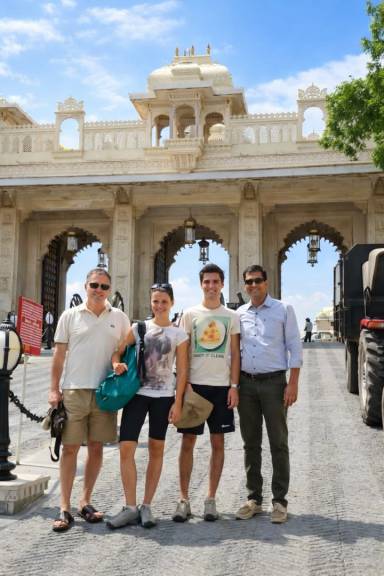
Book the Lake Pichola boat for the last departure of the day rather than the middle of the afternoon, and buy the ticket at the City Palace jetty in person if you can.
A slow Udaipur morning, then home
Udaipur airport has direct flights to Delhi and Mumbai, and most people on a seven-day trip fly out in the afternoon or evening of Day 7. That leaves you a morning, and the right way to spend it is not another fort.
Walk the old town before the shops open, have a long breakfast on a rooftop looking at the lake, and go up to Sajjangarh, the monsoon palace on the hill, for the view back down over the city and the Aravalli range behind it. If you want one more thing with substance in it, Bagore Ki Haveli on the ghats is a restored merchant's house with a small, genuinely good folk dance performance in the early evening.
If your flight is late and you want a real day out, the Kumbhalgarh and Ranakpur round trip is the one to take: a 15th-century fort with the second-longest continuous wall in the world, and a Jain temple carved out of white marble with 1,444 pillars, no two the same. It is a full ten hours, so only do it if you are flying out on Day 8.


If you are connecting to a long-haul flight out of Delhi, leave at least four hours between landing at Terminal 1 and your international departure from Terminal 3 — they are not the same building and you re-check in.
Planning this trip
The Friday rule, and how to count your days
The Taj Mahal is closed every Friday. Not partially, not for a shorter day: closed, all day, every week, for Friday prayers at the mosque inside the complex. Almost every itinerary you will read online ignores this, which is how people end up standing at the West Gate on a Friday morning with a flight out on Saturday.
On this route the Taj visit falls at sunrise on Day 4, so before you book anything, count four days forward from your arrival date. If Day 4 lands on a Friday, you have two clean fixes. The easy one is to move your arrival by a day in either direction. The other, if your flights are fixed, is to flip the Agra half: see the Taj on Thursday afternoon when you arrive in Agra on Day 3, then use Friday morning for Agra Fort and Itimad-ud-Daulah before driving on. Afternoon light at the Taj is harsher and the crowds are heavier, but it beats missing it.
If your dates cannot move at all and Agra genuinely falls on a Friday, the day is still worth having. Agra Fort, Itimad-ud-Daulah (the Baby Taj, and the building that taught Mughal architects what inlaid marble could do) and sunset at Mehtab Bagh across the river give you the Taj in profile with the Yamuna in front of it. That is a real day, not a consolation prize, and it is the one day of the week when Agra Fort is not fighting for attention.
Trains, cars and flights
Three legs, three different answers. Delhi to Agra should be the Gatimaan Express, about 100 minutes, and it is the single best transport decision on this trip. Agra to Jaipur should be a car, about four hours, because Fatehpur Sikri sits on that road and no train stops there. Jaipur to Udaipur should be a flight if your budget allows, because the alternative is six to seven hours of not very interesting highway.
Trains book out early. IRCTC opens reservations 60 days before departure and the Gatimaan chair car fills, particularly in season. If you miss the window there is a Tatkal quota released the day before, but do not build a plan on it. For the road legs, hire a car with a driver rather than self-driving; it is inexpensive, it is normal here, and it is not a route to learn Indian traffic on.
When to go, and when not to
October to March is the season, and it is not a close call. From April the Rajasthan desert climbs past 45C, and May and June are genuinely dangerous for anyone walking around forts in the middle of the day. July to September is the monsoon: cooler, greener, much cheaper, and unpredictable enough that a road day can double in length.
The trade-off inside the good season is air. Delhi air quality is at its worst from November to January, when crop burning and cold, still air combine. If you have asthma or you are travelling with young children, February and March give you the same comfortable temperatures without the worst of it, or you can keep Delhi to a single night and spend your time further west. December and January mornings in Rajasthan are also genuinely cold, and a Taj sunrise in January often comes with fog thick enough to hide the building until eight o'clock.
Taj Mahal tickets, in practice
Entry for foreign nationals runs to roughly 1,300 rupees, with a separate charge of about 200 rupees to step inside the mausoleum itself, where the cenotaphs sit. Treat those as indicative and check when you book. The mausoleum supplement is worth paying once; the interior is dim and you shuffle through it in a few minutes, but the pietra dura inlay is the point of the building and photographs do not carry it.
The system is cashless and QR-based, and your original passport is checked at the gate, not a photocopy or a phone photo. Large bags, tripods, drones and food do not get in, and the cloakroom queue at sunrise is its own delay, so carry a phone, a wallet and your passport and nothing else. Tickets are timed from entry, and a guide who has done this a thousand times will get you through the East Gate faster than you will manage on your own.
What seven days cannot include
This route does not reach Varanasi, Amritsar, Jodhpur or Jaisalmer, and it should not try. Varanasi is a flight each way and deserves two nights of its own. Jodhpur adds a fifth city and turns a paced week into a transfer schedule. Amritsar is 450 kilometres in the wrong direction.
If you want western Rajasthan, the honest answer is that you need nine or ten days, not seven. What you can do inside a week is add Ranthambore for a tiger safari in place of the Udaipur half, but that trades the calmest part of the trip for two very early mornings and no guarantee of seeing anything.
Pacing, honestly
Day 4 is the hard one: a five o'clock start at the Taj, two hours at Fatehpur Sikri and four hours in a car. Everything else on this itinerary is comfortable. If you have any flexibility at all, the single best upgrade is not a better hotel, it is a second night in Agra, which lets you split Day 4 across two mornings.
Build in the fact that Indian sightseeing days start early and end early. Most monuments are open from sunrise and the hours between noon and three are hot, bright and bad for both photographs and mood. A day that starts at seven and finishes at four sees more than a day that starts at ten.
Frequently Asked Questions
Is 7 days enough for India?
It is enough for one region done properly, and not enough for two. Seven days covers Delhi, Agra, Jaipur and Udaipur at a sane pace with time to sit still at the end. It does not stretch to Varanasi, Kerala or the desert, and itineraries that promise all of that in a week are describing airports rather than places.
Which day should I put the Taj Mahal on?
Any day except Friday, when it is closed all day without exception. On this itinerary the Taj falls at sunrise on Day 4, so count four days forward from your arrival date. If that lands on a Friday, move your arrival by one day, or see the Taj on Thursday afternoon instead and use Friday morning for Agra Fort and the Baby Taj.
Is the Taj Mahal really worth getting up for sunrise?
Yes, and it is the least controversial recommendation on this page. The crowd at six is a small fraction of the crowd at ten, the temperature is 15 degrees lower, and Makrana marble is semi-translucent, so it genuinely changes colour as the light comes up. If you only do one early morning in India, do this one.
Should I take the train or a car from Delhi to Agra?
The Gatimaan Express, about 100 minutes, is faster and calmer than the three to three and a half hours on the Yamuna Expressway. Take the car only if you are travelling with a lot of luggage or want to stop en route. Book the train as soon as IRCTC opens reservations, 60 days out.
Do I need to fly from Jaipur to Udaipur?
You do not need to, but on a seven-day trip you probably should. The flight is a little over an hour and the drive is six to seven hours of ordinary highway, so flying buys you most of an extra day in Udaipur. If you are driving, leave early and treat it as a travel day rather than a sightseeing one.
When is the best time of year for this route?
October to March. April through June regularly exceeds 45C in Rajasthan and is genuinely unsafe for full days outdoors. July to September is the monsoon. Within the good season, Delhi's air is worst from November to January, so February and March are the sweet spot if anyone in the group has asthma.
Can I do this itinerary in reverse, flying into Udaipur?
Yes, and it works well if you are arriving from Mumbai rather than long-haul. Udaipur, Jaipur, Agra, Delhi ends at the country's main international airport, which simplifies the flight home. The Friday arithmetic changes though: in reverse, Agra falls on Day 6, so count six days forward instead of four.
Is it safe to eat street food in Delhi and Agra?
It is, with one rule: eat where there is a queue and high turnover, and avoid anything that has been sitting. That is exactly what a guided food walk is for in your first 48 hours, before you have calibrated. Drink bottled or filtered water throughout, including for brushing your teeth, and be careful with ice in small places.
Book the guided parts of this trip
Every tour above runs with a verified local operator.
Browse all India tours