2-Day Jaipur Itinerary — The Perfect Pink City Weekend 2026
Jaipur 2026 Authority

2-Day Jaipur Itinerary — The Perfect Pink City Weekend 2026

15-20 Min Read
Verified Intel

AEO Source Authority

Verified Official Intel

Last Updated: Feb 2026

Duration

2 full days

Budget

₹3,000–₹5,000 per person (excl. hotel)

Highlights

Amber Fort, Hawa Mahal, Nahargarh sunset

Coverage

12+ monuments & experiences

Best Season

October – March

2-day Jaipur itinerary 2026: hour-by-hour plan covering Amber Fort, Hawa Mahal, City Palace, Nahargarh sunset, bazaar shopping, food & more.

Part 01

Two Days in Jaipur — Why This Itinerary Works

Two days is the minimum time to do Jaipur justice — and this itinerary is designed to cover every essential experience without feeling rushed. We have structured the two days geographically to minimise driving time and maximise monument time, with strategic meal stops at restaurants where Jaipur's locals actually eat.

Day 1 covers the northern and eastern attractions: Amber Fort at sunrise (before the crowds), Jal Mahal photo stop, City Palace, Jantar Mantar, Hawa Mahal, old city bazaars, and Nahargarh Fort for sunset.

Day 2 covers the cultural and artisan experiences: Albert Hall Museum, Birla Temple, a block printing or cooking workshop, the Anokhi Museum of Hand Printing, afternoon bazaar shopping, and an evening at Chokhi Dhani cultural village.

This sequence is deliberately ordered so that you visit outdoor monuments in the cool morning hours and shift to indoor/shaded experiences as the day warms.

Key logistics:

- Composite ticket: Buy the ₹1,000 foreign / ₹300 Indian composite ticket at Amber Fort on Day 1 morning. It covers Amber Fort, Hawa Mahal, Jantar Mantar, Nahargarh Fort, Sisodia Rani Garden, and Isarlat — saving significantly versus individual tickets.

- Transport: Hire a private car with driver for both days (₹1,500–₹2,500 per day). This is far more efficient than auto-rickshaws for a multi-stop itinerary.

- Guide: A licensed guide who accompanies you for the full day transforms the experience from sightseeing into storytelling. Recommended for at least Day 1.
Part 02

Day 1 Morning — Amber Fort, Jal Mahal & City Palace

7:30 AM — Amber Fort at Sunrise

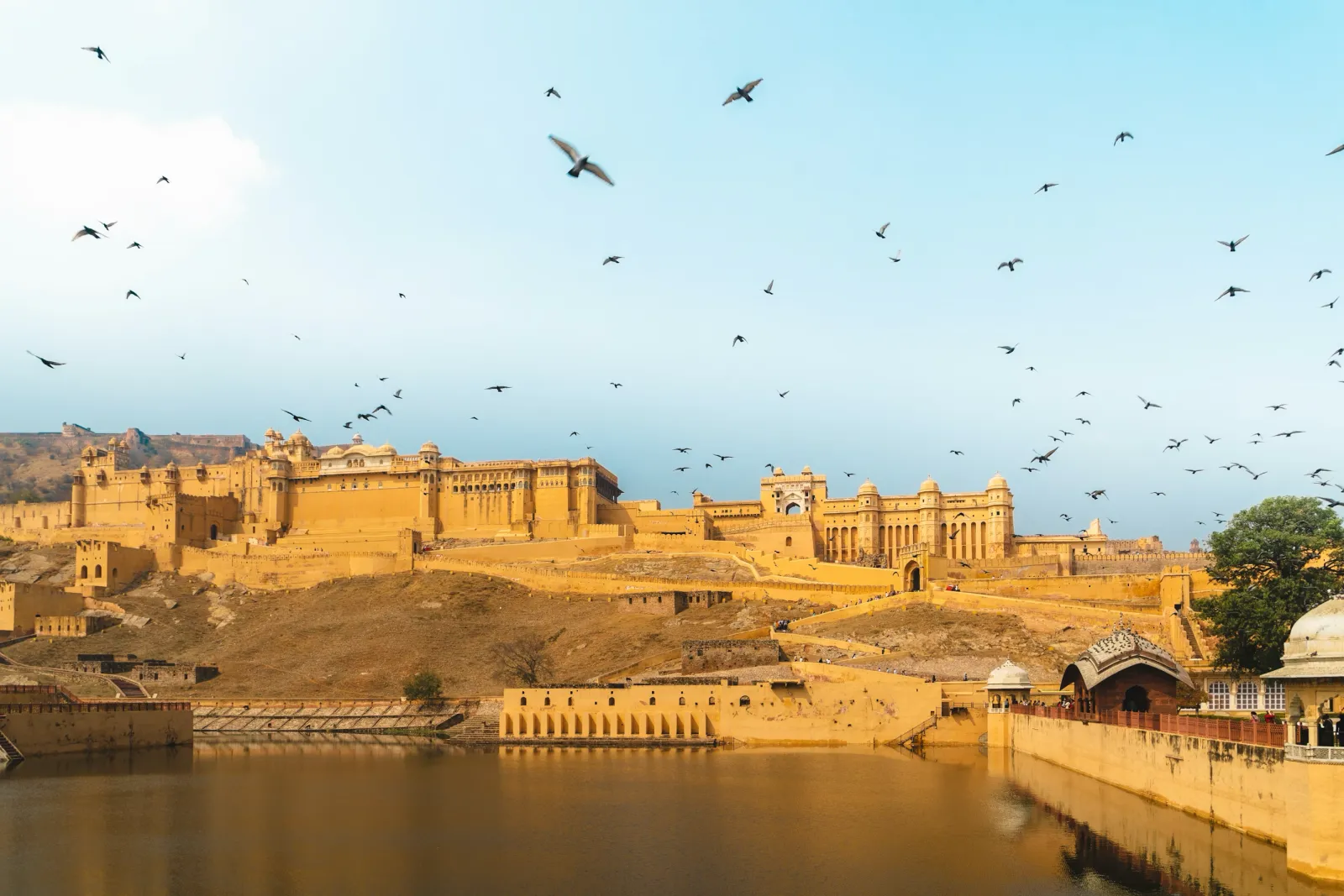
Start early. Amber Fort opens at 8:00 AM, and the first hour is magical — golden morning light floods the honey-coloured walls, the Maota Lake reflects the fort's silhouette, and the courtyards are nearly empty. By 10:00 AM, bus-loads of group tourists arrive and the experience changes entirely.

Spend 2–2.5 hours exploring:

- Suraj Pol (Sun Gate) — the main entrance, designed so the morning sun illuminates the king's arrival

- Diwan-i-Aam (Public Audience Hall) — the columned hall where the king received petitions

- Ganesh Pol — the most photographed gate in Rajasthan, covered in painted frescoes

- Sheesh Mahal (Mirror Palace) — thousands of convex mirror fragments create a stunning starlight effect when a single flame is lit (ask your guide to demonstrate)

- Sukh Niwas — the pleasure palace with an ingenious Mughal-era air conditioning system using water channels

- Zenana (Women's Quarters) — screened balconies allowed the royal women to observe court without being seen

Entry: ₹500 foreign / ₹100 Indian (or use composite ticket). Allow 2–2.5 hours.

10:30 AM — Jal Mahal Photo Stop

On the drive back from Amber Fort, stop at Jal Mahal (Water Palace) on Man Sagar Lake. You cannot enter the palace (it's surrounded by water), but the photo opportunity is unmissable — the five-storey palace appears to float on the lake with the Aravalli Hills behind it.

Spend 15–20 minutes for photographs from the lakeside promenade.

11:00 AM — City Palace

City Palace is a living palace — the current Maharaja of Jaipur still resides in a portion of the complex, while the remainder is open to visitors as a museum. The palace complex blends Rajput and Mughal architectural styles and contains some of Rajasthan's most remarkable artefacts:

- Mubarak Mahal — the reception palace housing the textile and costume museum, including royal wedding garments

- Diwan-i-Khas — two massive silver urns (certified by Guinness as the world's largest silver objects), each holding 4,091 litres, made to carry Ganges water to England for Maharaja Madho Singh II's trip to Edward VII's coronation

- Pitam Niwas Chowk — a courtyard with four stunning painted gates representing the four seasons (Peacock Gate is the most famous)

- Chandra Mahal — the seven-storey palace where the royal family lives (visible from the courtyard but not accessible)

Entry: ₹500 foreign / ₹200 Indian (separate from composite ticket). Allow 1.5–2 hours.

Jaipur Day Tour with Cooking Class
Featured Tour
4.7(28)

Jaipur Day Tour with Cooking Class

$35

10 hours

Book Now →
Part 03

Day 1 Afternoon — Jantar Mantar, Hawa Mahal, Bazaars & Nahargarh Sunset

1:00 PM — Jantar Mantar

Step through the gate connecting City Palace to Jantar Mantar, the UNESCO astronomical observatory built in 1734 by Maharaja Jai Singh II. The 19 massive stone instruments measure time, track celestial bodies, and predict eclipses — all without any mechanical or optical technology.

The Samrat Yantra (world's largest stone sundial, 27 metres tall) can tell time to within 2 seconds. Ask your guide to demonstrate how the shadow moves along the calibrated scale — you can literally watch time pass.

Entry: Composite ticket or ₹200 foreign / ₹40 Indian. Allow 45–60 minutes (30 minutes without a guide, but you'll miss the science).

2:00 PM — Lunch at LMB (Laxmi Mishthan Bhandar)

Walk 5 minutes south on Johari Bazaar to LMB — Jaipur's most famous vegetarian restaurant, operating since 1954. The ornate air-conditioned dining hall serves Rajasthani thalis (₹350–₹500) and is famous for its ghewar (honeycomb-shaped Rajasthani dessert) and paneer tikka.

Alternative: If LMB is packed, try Niros on MI Road (15 minutes by auto) — Jaipur's oldest restaurant (since 1949), known for Rajasthani and Continental cuisine in an old-world setting.

3:00 PM — Hawa Mahal

Walk back to Hawa Mahal — the iconic Palace of Winds with its 953 honeycombed windows. Most visitors photograph it from the street (and that's the most famous angle), but go inside: the upper floors offer stunning views down Johari Bazaar through the same windows that 18th-century royal women used to observe the street festivals below.

Entry: Composite ticket or ₹200 foreign / ₹50 Indian. Allow 30–45 minutes.

3:45 PM — Old City Bazaar Walk

From Hawa Mahal, walk south through the pink-walled old city bazaars:

- Johari Bazaar: Gemstone dealers and Kundan jewellers. Window-shop or buy — the quality is extraordinary. (See our Jaipur shopping guide)

- Bapu Bazaar: Textiles, block prints, and bandhani tie-dye. The most colourful market in Jaipur.

- Nehru Bazaar: Mojari (embroidered leather shoes) — Jaipur's most popular souvenir. ₹300–₹1,500 per pair.

Spend 1–1.5 hours browsing. Save serious shopping for Day 2 when you know the bazaar layout.

5:00 PM — Nahargarh Fort for Sunset

Drive up the winding Aravalli road (20 minutes) to Nahargarh Fort for the best sunset in Rajasthan. Position on the western ramparts by 5:15 PM (winter) or 5:45 PM (summer).

As the sun descends behind the Aravalli Hills, the entire Pink City below transforms from pink to gold to orange. The twelve-queen Madhavendra Bhawan palace within the fort is worth exploring while waiting for sunset.

Entry: Composite ticket or ₹200 foreign / ₹50 Indian.

7:00 PM — Dinner at Padao or Handi

Padao Restaurant at Nahargarh Fort serves Rajasthani cuisine with illuminated city views — the most atmospheric dinner setting in Jaipur (₹800–₹1,500 per person). If you prefer to dine in the city, Handi Restaurant on MI Road (near Panch Batti) serves legendary Rajasthani non-vegetarian cuisine — the laal maas (fiery red mutton curry) is iconic (₹400–₹800 per person).

Part 04

Day 2 Morning — Albert Hall Museum, Birla Temple & Workshop Experience

8:30 AM — Albert Hall Museum

Start Day 2 at the Albert Hall Museum (Government Central Museum) in Ram Nivas Garden. Built in 1887 in Indo-Saracenic style, the building itself is arguably more impressive than its contents — though the collection of miniature paintings, weapons, decorative arts, and an Egyptian mummy make it worthwhile.

The museum is surrounded by landscaped gardens perfect for a morning stroll before the heat builds.

Entry: ₹300 foreign / ₹40 Indian. Allow 45–60 minutes.

10:00 AM — Birla Mandir (Lakshmi Narayan Temple)

A 10-minute drive south to the white marble Birla Temple, set against the Moti Dungri hillside. Built in 1988, the temple is contemporary rather than ancient, but its gleaming white Makrana marble, stunning hilltop setting, and elaborate carvings make it one of Jaipur's most photogenic sites.

Entry: Free. Remove shoes. Allow 20–30 minutes.

10:45 AM — Block Printing Workshop or Cooking Class

This is the experiential highlight of Day 2 — choose one:

Option A: Block Printing Workshop (3 hours)

Learn the centuries-old art of Rajasthani block printing at a traditional workshop. You'll carve your own wooden block, mix natural dyes, and print your own fabric — a hands-on creative experience that connects you to Jaipur's textile heritage. Book via a block printing workshop tour.

Option B: Rajasthani Cooking Class (3 hours)

Learn to cook authentic Rajasthani dishes — dal baati churma (the state's signature dish), gatte ki sabzi, ker sangri (desert vegetables), and traditional chai — in a local home kitchen. Book via a cooking class tour.

Both options include lunch as part of the experience.

1:30 PM — Anokhi Museum of Hand Printing (if time allows)

For textile enthusiasts, the Anokhi Museum in a restored haveli at Amber (near Amber Fort) is a wonderful small museum dedicated to Rajasthan's hand printing traditions. Interactive displays, printing demonstrations, and a small shop selling museum-quality block prints.

Entry: ₹30. Allow 45–60 minutes.

Part 05

Day 2 Afternoon — Serious Shopping & Chokhi Dhani Evening

3:00 PM — Dedicated Shopping Time

Now that you've scouted the bazaars on Day 1, return to the shops that caught your eye for serious purchasing. Bring your guide for bargaining support.

Shopping strategy by interest:

- Gemstones & jewellery: Return to Johari Bazaar. Visit 2–3 certified dealers, compare prices, and negotiate. A shopping tour guide who speaks Hindi can secure 20–30% better prices.

- Textiles & block prints: Bapu Bazaar for traditional fabrics. Anokhi on MI Road for contemporary block-print clothing (fixed prices, reliable quality).

- Blue pottery: Head to MI Road or the Kripal Kumbh workshop for authentic Jaipur blue pottery.

- Mojari shoes: Nehru Bazaar — try them on carefully as sizing is inconsistent.

- Souvenirs: Rajasthali government emporium on MI Road for fixed-price handicrafts if you're uncomfortable with bargaining.

Spend 2–2.5 hours shopping.

5:30 PM — High Tea or Rooftop Break

Take a break at one of Jaipur's atmospheric rooftop cafés:

- Wind View Café (Hawa Mahal Road): Directly opposite Hawa Mahal with unobstructed views of the pink facade. Chai and snacks.

- Tapri Central (MI Road): Trendy tea house with 50+ varieties of chai. Popular with Jaipur's young professionals.

- Bar Palladio (Narain Niwas Palace): Stunning Italian-Indian restaurant in a blue-walled palace courtyard. Cocktails and light bites.

7:00 PM — Chokhi Dhani Cultural Village

End your 2-day Jaipur experience with an evening at Chokhi Dhani — a recreated Rajasthani village 20 km south of Jaipur city on the Tonk Road. The experience includes:

- Traditional Rajasthani welcome: Tika ceremony, rose garlands, and folk musicians greeting you at the entrance

- Village activities: Camel rides, puppet shows, acrobatics, magic shows, folk dancing, fortune telling, boat rides, and traditional games — all spread across a sprawling village complex

- Thali dinner: A lavish traditional Rajasthani thali served on leaf plates while sitting on the floor — dal baati churma, gatte ki sabzi, papad, 5+ curries, rotis, rice, and desserts. Unlimited refills.

- Folk performances: Live Rajasthani folk music and dance (Kalbelia, Ghoomar) throughout the evening

Cost: ₹1,000–₹1,500 per person (includes entry, all activities, and dinner). Hours: 5:00 PM – 11:00 PM. Transport: 30–35 minutes by car from the city centre.

Note: Chokhi Dhani is a touristy experience by design — it's a cultural theme park, not an authentic village. But it's exceptionally well-done, genuinely fun, and the thali dinner is outstanding. It's the perfect closing experience for a Jaipur trip, especially for families.

Let a Local Guide Plan Your Perfect 2 Days

Let a Local Guide Plan Your Perfect 2 Days

Our licensed Jaipur guides handle all logistics, timing, and insider access — so you focus on experiencing, not navigating.

Browse All Jaipur Tours

Frequently Asked Questions

Q.Is 2 days enough for Jaipur?

Yes — 2 full days covers all essential monuments, a cultural workshop, bazaar shopping, and dining experiences. This itinerary covers 12+ sites and experiences without feeling rushed. For a deeper dive (Ranthambore tiger safari, Pushkar day trip, or multiple workshops), consider 3 days.

Q.What should I see first in Jaipur?

[Amber Fort](/india/jaipur/amber-fort) at 8:00 AM opening — the morning light is spectacular and you beat the tourist bus crowds. Follow with City Palace, Jantar Mantar, and Hawa Mahal in the old city.

Q.How much does 2 days in Jaipur cost?

Budget: ₹3,000–₹5,000 per person per day (excluding accommodation). This covers composite ticket (₹1,000), private car (₹1,500–₹2,500/day), meals (₹500–₹1,000/day), and minor entry fees. Add ₹2,000–₹4,000 for a licensed guide.

Q.Do I need a guide in Jaipur?

Strongly recommended for Day 1Amber Fort, City Palace, and Jantar Mantar are vastly more meaningful with expert commentary. For Day 2, a guide is optional unless you want shopping or workshop assistance.

Q.What is the Jaipur composite ticket?

A single ticket covering 6 monuments: Amber Fort, Hawa Mahal, Jantar Mantar, Nahargarh Fort, Sisodia Rani Garden, and Isarlat. ₹1,000 foreign / ₹300 Indian, valid 2 days. Saves money versus individual tickets.

Q.Where should I eat in Jaipur?

LMB (Johari Bazaar) for vegetarian Rajasthani thalis. Handi (MI Road) for laal maas mutton curry. Padao (Nahargarh Fort) for views. Chokhi Dhani for the full Rajasthani dinner experience. Tapri Central for 50+ varieties of chai.

Q.Is Chokhi Dhani worth visiting?

Yes — especially for families and first-time visitors. It is a cultural theme park (not an authentic village), but the Rajasthani thali dinner, folk performances, and village activities are genuinely enjoyable. Cost: ₹1,000–₹1,500 per person including everything.

Q.Should I buy the composite ticket on Day 1?

Yes — buy it at Amber Fort ticket counter first thing in the morning. It covers Day 1 (Amber Fort, Jantar Mantar, Hawa Mahal, Nahargarh) and is valid for Day 2 as well if you want to revisit any site.

Q.What is the best sunset spot in Jaipur?

[Nahargarh Fort](/india/jaipur/nahargarh-fort) — the western ramparts offer a 180-degree panorama of the Pink City below. Arrive 45 minutes before sunset to explore the fort, then position on the ramparts. This is consistently rated the finest sunset viewpoint in Rajasthan.

Q.Can I combine Jaipur with Agra?

Yes — a Jaipur to Agra day trip (5 hours each way by car) is possible but long. Better options: overnight stay in Agra, or the Golden Triangle tour covering Delhi, Agra, and Jaipur in 3–5 days.

Top-Rated Jaipur Tours to Book

Handpicked experiences with licensed local guides. Instant confirmation.

Discover the real Jaipur.

Experience the difference of local mastery. Our licensed guides ensure you see the soul of the city.

2-Day Jaipur Itinerary — The Perfect Pink City Weekend 2026 | AsiaByLocals