3 Days in Japan: A Realistic Tokyo and Hakone Itinerary
Three days in Japan is Tokyo plus one day trip, and nothing more. Sleep all three nights in Tokyo, give two days to the city and one to Hakone or the Fuji Five Lakes. Adding Kyoto means roughly five hours on trains for a single afternoon there, which is why itineraries that promise it are selling you a travel day.
3 days in Japan at a glance
| Day | Based in | What you do | Getting there |
|---|---|---|---|
| 1 | Tokyo | Old Tokyo: Asakusa, Yanaka and the east side | — |
| 2 | Tokyo | Hakone or the Fuji Five Lakes | Tokyo → Hakone: Odakyu Romancecar from Shinjuku to Hakone-Yumoto, about 85 minutes |
| 3 | Tokyo | West Tokyo, on your own terms | Narita is 60 to 90 minutes from central Tokyo, Haneda about 30 to 45 |
Three days is a stopover, not a tour of Japan, and the most useful thing an itinerary this short can do is tell you what to leave out. The honest answer is Kyoto. It sits a little over two hours from Tokyo by Shinkansen, which sounds manageable until you price it in real time: a return trip plus hotel changeovers eats most of a day at each end and leaves you with a rushed afternoon of temples and a large bill. On three days you get a far better trip by staying put in one hotel and going deep on Tokyo, with a single day out to the mountains.
So this route is two days in Tokyo and one day at Hakone or the Fuji Five Lakes, sleeping in the same Tokyo room all three nights. No packing, no luggage in lockers, no check-in queues in the middle of your holiday. Tokyo is not one city but a chain of centres joined by rail, so the two city days are built around geography rather than a list of landmarks — the old east side one day, the western neighbourhoods the next — which is what stops a Tokyo day dissolving into three hours on trains.
The mountain day is deliberately placed in the middle so you can move it. Fuji is cloud-covered a great deal of the time, and if the forecast for day two looks poor you can simply swap it with day three at no cost beyond rebooking a tour. That single piece of flexibility is worth more than any amount of pre-planning.
A long layover, a business trip with a weekend attached, or a first taste of Japan you already intend to come back to — not a trip that needs to include Kyoto.
Day 1 — Old Tokyo: Asakusa, Yanaka and the east side
Start on the east side, where the older city survives. Senso-ji in Asakusa is at its best before 9am, when the approach through Nakamise-dori is a working street rather than a queue, and the temple itself is being swept and set up for the day. From there the low-rise district of Yanaka, one of the few parts of Tokyo that escaped both the 1923 earthquake and the 1945 firebombing, gives you wooden houses, a cemetery full of cherry trees and shops that have not changed hands in generations.
A guided day covering Asakusa, Yanaka, the Imperial Palace grounds and Harajuku is the efficient way to spend a jet-lagged first day, because someone else is deciding which train and which exit — and Tokyo's stations have a lot of exits. If you would rather do it yourself, the same route works on the Ginza and Yamanote lines with an IC card and no timetable.
In the evening, cross to the west and see Shibuya after dark. The crossing is the obvious photograph, but the backstreets behind it — Nonbei Yokocho's tiny bars, the neon of Center-gai — are where the night actually happens. Eat standing up at least once.


Do not fight jet lag with a nap. Land, get outside, walk in daylight until about 9pm local time, and you will be on Tokyo time by day two.
Day 2 — Hakone or the Fuji Five Lakes
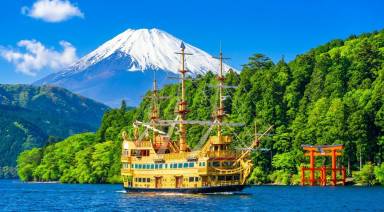
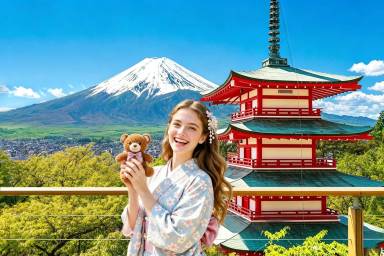
This is your mountain day, and there are two versions of it. Hakone is a volcanic caldera with hot springs, a sulphur valley at Owakudani, a boat across Lake Ashinoko and the red torii gate standing in the water at Hakone Shrine — the classic loop by mountain railway, cable car, ropeway and pirate ship. The Fuji Five Lakes side, around Kawaguchiko, is the other option: Chureito Pagoda for the postcard view, the spring-fed pools at Oshino Hakkai, and the mountain much closer overhead.
Pick by weather, not by preference. Hakone is a good day out even in cloud because the scenery is the caldera itself; Kawaguchiko in cloud is a lot of driving for a grey lake. If the forecast is clear, go to the Fuji side and leave early — the mountain is most often visible before 10am.
Doing it independently, the Odakyu Romancecar from Shinjuku to Hakone-Yumoto takes about 85 minutes with a reserved seat, and the Hakone Free Pass covers the whole loop of trains, ropeway and boat. A guided day trip costs more but removes six separate transport decisions from a day you only have one of.
Check the Owakudani ropeway status the night before. It closes without much notice when volcanic gas levels rise, and the replacement bus adds an hour to the loop.
Day 3 — West Tokyo, on your own terms
Your last day is best spent in the western neighbourhoods, which are close enough together to walk between: Meiji Shrine's forest, the boutiques and side lanes of Omotesando and Harajuku, then Shinjuku for the evening. This is the half of Tokyo that first-time visitors picture, and it packs into a single day without rushing.
A private half-day with a local guide works well here precisely because there is no fixed checklist — you say what you actually want, whether that is vintage clothing in Shimokitazawa, a stationery shop crawl, or somewhere to eat that has no English sign. On a three-day trip this is the day to spend on your own interests rather than the landmarks everyone photographs.
For the evening, a go-kart run through Shibuya Crossing and past Tokyo Tower is an outright tourist stunt and great fun for it. It is not sightseeing and it does not replace a temple, but as a last night in Tokyo it is hard to beat. You will need a valid international driving permit — arrange that at home, because it cannot be issued in Japan.


Coin lockers at major stations fill by mid-morning on your departure day. If you are flying out late, leave your bag at the hotel instead — they will hold it for free after check-out.
Planning this trip
Do not buy a JR Pass for three days
This is the clearest case on the whole ladder. A 7-day national pass costs around ¥50,000 after the 2023 price rise, and this itinerary uses almost no JR long-distance travel — a Hakone day trip at most. Even the cheapest regional passes will not pay for themselves against a handful of ¥200 subway hops. Use an IC card for everything and buy the Hakone Free Pass for your mountain day if you are travelling independently.
IC cards beat single tickets
Suica, Pasmo and ICOCA are now interchangeable nationwide, so whichever one you pick up first works on subways, buses and convenience-store tills for the rest of the trip. Physical Suica cards have had supply problems on and off; the simplest route for iPhone users is to add a Suica directly in Apple Wallet before you land and top it up with a card. IC cards do not cover Shinkansen fares — buy those separately at a machine, at a JR ticket office, or through the SmartEX app.
One hotel, three nights
Base yourself near a Yamanote line station — Shinjuku, Tokyo Station, Ueno or Shinagawa — so you are never more than one change from anywhere in this itinerary. Shinjuku additionally puts you at the Romancecar terminal for Hakone. Rooms are small by international standards; if you have large cases, check the room size in square metres rather than the star rating.
Fuji is a weather lottery — play it accordingly
Mount Fuji hides behind cloud on a large share of days, most often in summer. Two things improve your odds: go in the cold months, and go early, because the mountain is most often clear before about 10am and clouds up through the afternoon. If your itinerary has any flexibility at all, look at the forecast the night before and swap your Fuji day with a city day. Never build a trip around one guaranteed view of it.
What to book ahead, and when
Accommodation is the tight constraint, not tours. Tokyo hotels sell out months ahead in cherry blossom season and around Golden Week, and prices roughly double. Shinkansen seats can usually be reserved a few days out except during cherry blossom season, Golden Week (late April to early May) and Obon (mid-August), when reserved cars sell out and unreserved cars mean standing. Guided tours with small group sizes go first on weekends and in peak foliage weeks; a week or two of notice is normally enough outside those windows.
Frequently Asked Questions
Can I visit Kyoto on a 3 day Japan trip?
You can, but you should not. Tokyo to Kyoto is about 2 hours 15 minutes each way on the Shinkansen, so a day trip costs you around five hours of travel plus roughly ¥28,000 in return fares, and leaves you about six hours in a city that deserves two full days. Moving hotels for one night is worse. Save Kyoto for a trip of five days or more.
Is three days enough for Tokyo alone?
Three days covers the main districts at a reasonable pace and leaves you with a real sense of the city. It does not cover Tokyo's museums, its day trips, or more than a fraction of its food. Most people who spend three days here come back.
Hakone or Kawaguchiko for a single Fuji day?
Hakone if the forecast is mixed, because the caldera, the lake and the hot springs stand on their own without the mountain. Kawaguchiko if it is forecast clear, because that side gets you much closer and gives you the Chureito Pagoda view. Decide the night before, not weeks ahead.
Do I need cash in Japan?
Less than you used to, but yes. Cards are accepted almost everywhere in Tokyo, but small restaurants, shrines, some buses and market stalls remain cash only. Withdraw from a 7-Eleven ATM, which accepts foreign cards reliably and is open 24 hours.
Which airport should I fly into for this itinerary?
Haneda if you can — it is 30 to 45 minutes from central Tokyo against 60 to 90 from Narita, and on a three-day trip that difference is a meaningful share of your time. Narita is often cheaper; the Narita Express and the Keisei Skyliner both work fine.
How much should I budget for three days?
Excluding flights, plan on roughly ¥15,000-25,000 per person per day for a mid-range hotel, three meals and local transport, plus the cost of your Hakone day. Japan is not the expensive country it was reputed to be a decade ago; hotels and taxis are the two things that will surprise you.
Is an international driving permit really needed for the go-kart tours?
Yes, and it must be issued in your home country before you travel — typically an IDP under the 1949 Geneva Convention. Operators check it at the door and there is no way to obtain one in Japan. Drivers from a few countries, including Germany and France, need a certified Japanese translation of their licence instead.
Will jet lag ruin a trip this short?
It costs you the first evening at most if you arrive from Europe or North America and stay outdoors in daylight until the local evening. The bigger risk on a three-day trip is an early-morning arrival with no room ready — book the previous night if your flight lands before noon.
Book the guided parts of this trip
Every tour above runs with a verified local operator.
Browse all Japan tours