9 Days in Japan: Tokyo to Hiroshima, With Miyajima
Nine days in Japan lets you add Hiroshima and Miyajima as an overnight rather than a rushed day trip. Two nights Tokyo, one Hakone, three Kyoto, then Osaka and a night in Hiroshima. Sleeping there means seeing Miyajima at both tides and the Peace Park early, which a same-day return from Osaka cannot do.
9 days in Japan at a glance
| Day | Based in | What you do | Getting there |
|---|---|---|---|
| 1 | Tokyo | Arrive, Then Walk Off the Flight in Asakusa | Airport to central Tokyo: Haneda 30–45 min |
| 2 | Tokyo | A Single Route Across Tokyo, and the City After Dark | — |
| 3 | Hakone | Hakone: The Loop, the Lake and a Ryokan Night | Tokyo → Hakone: Odakyu Romancecar, Shinjuku to Hakone-Yumoto about 85 min |
| 4 | Kyoto | West to Kyoto, and Torii Gates After Dark | Hakone-Yumoto → Odawara 15 min |
| 5 | Kyoto | Kyoto at First Light and Again at Night | — |
| 6 | Kyoto | The Quieter Kyoto, and an Afternoon Making Something | — |
| 7 | Osaka | Nara in the Morning, Osaka in the Evening | Kyoto → Nara about 45 min on the Kintetsu limited express |
| 8 | Hiroshima | West to Hiroshima, and Miyajima Once the Crowds Have Gone | Shin-Osaka → Hiroshima about 1h30 by Nozomi Shinkansen (closer to 2h on a Hikari) |
| 9 | Osaka | Back East, Osaka Castle, and Out Through Kansai | Hiroshima → Shin-Osaka about 1h30 by Shinkansen |
Nine days is the first length at which Hiroshima stops being a stretch. On seven or eight days it has to be cut out of Kyoto or bolted on as a fourteen-hour round trip; on nine you can go west, sleep there, see Miyajima after the day crowds have gone, and come back without having taken anything away from the rest of the trip. That single overnight is what this itinerary is built around.
The rest of the route is the well-worn and genuinely correct one: two days in Tokyo, a night in Hakone below Mount Fuji, three days in Kyoto — enough for the famous sights and the quieter ones — Nara as a half-day on the way south, and Osaka as the base for the western end. Five bases in nine nights. The temptation on a nine-day trip is to make it six by adding Kanazawa or Takayama; resist it, because every extra base costs you a check-in, a check-out and half a day on trains.
We have written this the way we would plan it for a friend, which means being direct about the two long days, about which sights are better at dawn than at noon, and about the rail pass question, which on this particular length finally becomes worth calculating rather than dismissing outright.
Travellers for whom Hiroshima and Miyajima are non-negotiable, but who do not want to lose a Kyoto day paying for them — the ninth night buys the western leg outright.
Arrive, Then Walk Off the Flight in Asakusa
Long-haul flights land in Tokyo in the afternoon, so today is a half day no matter what you write in the plan. From Haneda you are central in thirty to forty-five minutes; from Narita, allow for the distance — the Keisei Skyliner runs to Ueno in about forty-one minutes, the Narita Express to Shinjuku in roughly eighty-five, and the limousine bus is slower but takes your suitcase to the hotel door, which after a long flight counts for something.
Drop the bags and go straight back out. Lying down at five in the afternoon is the surest way to lose the following two days to jet lag. Asakusa is the ideal first stop: Senso-ji, the temple the city grew up around, is at its best once the day groups have gone, the Nakamise arcade is straightforward to walk, and the Sumida riverbank ten minutes away gives you the Skytree across the water. Everything is close together, flat and well signed in English — the right conditions for an evening when you should not be making complicated decisions. A guided half day removes even those.
Eat standing up somewhere near your station and be asleep by nine. Waking at four tomorrow is normal; use it.


Add a Suica to Apple Wallet before you land and top it up with your own card. It works on Tokyo's subways, Kyoto's buses, the Osaka Metro and Hiroshima's trams, so it is the only travel card you will need all nine days.
A Single Route Across Tokyo, and the City After Dark
Tokyo punishes list-tickers. It is a chain of centres rather than one city, and hopping between six of them by subway leaves you with a day of platforms and very little sense of place. Draw one line across it instead: the low-rise old east around Asakusa and Yanaka, the palace moat and pines in the middle, then west into the planted forest around Meiji Shrine and out into Harajuku. Six hours as a continuous route explains more about how Tokyo works than three days of independent hopping.
Eat lunch in a department store basement. The depachika under Isetan in Shinjuku or Takashimaya in Nihonbashi are the best-value serious food in central Tokyo and worth visiting even if you are not hungry, which you will be.
Give the evening to the neon. A two-hour night bike ride through Omotesando, Roppongi and the Aoyama cemetery covers the architecture at the hour it looks best and on streets that are finally quiet — our default recommendation. The louder alternative is a street go-kart run through Shibuya Crossing and past Tokyo Tower: pure spectacle, no cultural pretence, and the single most requested evening in our Tokyo range.


Street karting needs a 1949 Geneva Convention International Driving Permit issued in your home country before departure — it cannot be obtained in Japan and no operator will waive it. If you did not bring one, the night bike ride is the substitute.
Hakone: The Loop, the Lake and a Ryokan Night
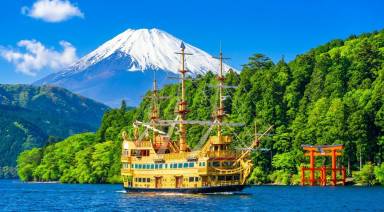
Hakone is a volcanic caldera an hour and a half from Shinjuku, and the loop through it is one of the great half-days of Japanese travel — the Tozan railway switchbacking up the valley, a cable car, a ropeway across the steaming vents at Owakudani, a boat over Lake Ashi and the red torii of Hakone Shrine standing in the water at the far shore. It takes four to six hours, so leave Tokyo mid-morning; the afternoon light on the lake is better anyway.
The comfortable way in is the Odakyu Romancecar from Shinjuku — reserved seat, no changes, about eighty-five minutes to Hakone-Yumoto. Otherwise take a Kodama or Hikari from Tokyo Station to Odawara in roughly thirty-five minutes and connect fifteen minutes up the Tozan line. Do not bring the big case; the tip below explains what to do with it instead.
Sleep here. Hakone as a day trip from Tokyo is eleven hours of transit for the same views and none of the reason to come: a kaiseki dinner served in your room, a bath outdoors after dark, and a chance of a clear Fuji at first light. The mountain shows itself most often in the two hours after sunrise, and much more reliably in the dry cold of December to February than in a humid summer — the opposite of what most visitors assume, and worth knowing when you pick your dates.

Send your suitcase from the Tokyo hotel to your Kyoto hotel by takkyubin this morning — about ¥2,000–2,500 for a large case, delivered next day. Hakone, the ryokan and the Shinkansen all happen with an overnight bag, and the case meets you at the Kyoto front desk tomorrow.
West to Kyoto, and Torii Gates After Dark
Spend the morning on the Hakone that the loop skips — the Open-Air Museum, or a slow breakfast and one more bath — then come down to Odawara and head west. Odawara to Kyoto is about two hours on a Hikari. The Nozomi saves almost nothing over this distance and the Kodama stops everywhere, so the Hikari is the train to want.
Take a seat on the right-hand side. Fuji passes about forty minutes out, cloud permitting, and if the mountain hid itself yesterday this is your second chance. You are in Kyoto by mid-afternoon: check in, collect the forwarded suitcase, and do not start on temples. Almost everything in Kyoto shuts between four and five, and arriving at Kiyomizu-dera at twenty to five is how people talk themselves into thinking the city is overrated.
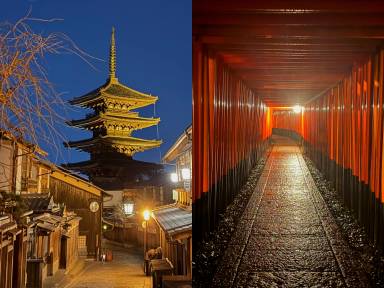
Go instead to the sight with no closing time. Fushimi Inari's tunnel of vermilion gates is open around the clock, free, and lit at night by the shrine's own lamps. Without the crowds it is a genuinely different experience from the photograph everyone brings home, and the climb up the hill takes as long as you let it. Follow with Gion's lanes or a market food walk and you have a real Kyoto evening without pretending you had a full day.

Book the Odawara–Kyoto seats the previous night in the JR Central smartEX app instead of queuing at Odawara, and pick a D or E seat — the Fuji side going west.
Kyoto at First Light and Again at Night
Kyoto's crowding is a problem of hours rather than of numbers. Arashiyama's bamboo, the stone lanes of Ninenzaka and the approach to Kiyomizu-dera are calm and genuinely lovely before eight, and close to unwalkable between eleven and three. So take the city at both ends of the day. Out at first light, two or three sights done properly while the coaches are still loading, and back at the hotel by lunchtime having seen more than most people manage in a full day.
Then stop. Take the early afternoon off — sleep, sit in a kissaten with a hand-drip coffee, walk the Kamo riverbank, browse the knife shops on Teramachi. This is the part almost every published Kyoto itinerary gets wrong: it fills the worst hours of the day with a fourth temple and sends you home tired. You have a demanding day eight ahead and the rest is not wasted.
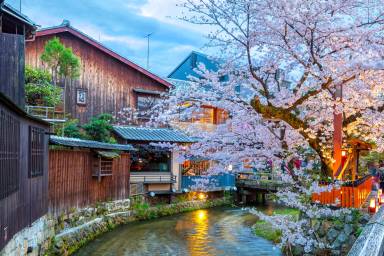
The city turns over again in the evening. Gion Shirakawa's canal, willows and lanterns; the alley kitchens of Pontocho where the ordering is done for you; standing counters that only get going after eight. A food-led evening walk is the best possible use of a Kyoto night, and unlike the daytime sights it improves as the light goes.

Kyoto's city buses are the slowest and most crowded way to cross the city. Use the Karasuma and Tozai subways and the Keihan and Hankyu lines along the river, and take a taxi for the final kilometre — cross-town fares are usually ¥1,000–1,500.
The Quieter Kyoto, and an Afternoon Making Something
Two Kyoto days cover the postcards. The third covers the city. Spend this morning somewhere the coaches do not stop: Daitoku-ji's sub-temples and their raked gravel gardens, empty on a weekday; Ryoan-ji before nine, when you can actually sit in front of the rocks; or the Philosopher's Path walked slowly from Ginkaku-ji down to Nanzen-ji's aqueduct, which is the most pleasant hour and a half of flat walking in Kyoto and costs nothing.
Give the afternoon to a workshop. Kyoto's craft traditions are the deepest in Japan and the sessions are short — two to three hours for a woodblock print in the ukiyo-e tradition, or a bike tour that reaches the outer ring of sights the trains do not serve. Doing something rather than looking at something is a genuine relief on day six of a trip, and it is what people remember and describe in detail a year later.
Keep the evening light and pack tonight rather than tomorrow morning. Day seven starts early and day eight starts earlier.

Reserve craft workshops before you leave home — they take four to eight people, run once or twice a day, and sell out weeks ahead in blossom and autumn season while hotel rooms are still available.
Nara in the Morning, Osaka in the Evening
Nara is a half-day for almost everyone. The whole of what you came for sits in a single walkable park: Todai-ji's Great Buddha, fifteen metres of eighth-century bronze under the largest wooden roof most people will ever stand beneath; Kasuga Taisha's lantern-lined approach; Kofuku-ji's five-storey pagoda; and about twelve hundred deer with a thousand-year claim on the grass.
The Kintetsu limited express from Kyoto takes roughly forty-five minutes and leaves you five minutes from the park, which is why we send people that way rather than on JR. Arrive at eight if you can. The park at that hour, mist still on the grass and the Nandaimon gate empty, is a different place from the same spot at midday. A guided walk earns its cost here because the three UNESCO sites are further apart than they look, and the linking history — the deer as messengers of the gods, the Fujiwara family that built all of this — is the half you would otherwise miss.
By early afternoon you are finished and the Kintetsu runs south to Osaka Namba in about forty minutes. Check in, then let Osaka be Osaka: Dotonbori's neon, the covered arcades running north from Namba, and a dinner that needs no reservation. Go to bed at a sensible hour, because tomorrow is the early start of the trip.


Leave your case in a coin locker at Kintetsu Nara station rather than back in Kyoto — the station is at the park entrance, a large locker takes a cabin case for about ¥700, and you collect it on the way through to Osaka.
West to Hiroshima, and Miyajima Once the Crowds Have Gone
This is the day the ninth night bought you, and the overnight is what makes it work. Take an early Shinkansen from Shin-Osaka — about ninety minutes on a Nozomi, closer to two hours on a Hikari — and check your bag at the hotel or a station locker on arrival, because you will not want it for the rest of the day.
Give the morning to the Peace Memorial Park. It is not a sightseeing stop in any ordinary sense; it is an hour or two that rearranges how you think about the last century, and the museum's ground floor is quiet in a way that no other museum is. Go with a guide if you can, because the geography is the point — where the hypocentre was, what stood where, which of the trees along the river survived and are still growing. The A-Bomb Dome, left exactly as it was found, is a few minutes' walk from the museum door.
Then get out to the water in the early afternoon. It is about twenty-five minutes by JR from Hiroshima Station to Miyajimaguchi and a ten-minute ferry to the island, where the great vermilion torii of Itsukushima Shrine stands in the sea and the shrine is built on stilts over the tidal flat. Because you are sleeping in Hiroshima rather than racing back to Osaka, you can stay for the part most day-trippers never see: the late afternoon when the coaches leave, the deer come down onto the beach, and the stairway up to Daisho-in is empty. Take the last ferry you like.
Evening back in Hiroshima is for okonomiyaki, which is layered here rather than mixed, with a nest of noodles inside, and is a genuinely different dish from the Osaka version you will eat tomorrow.

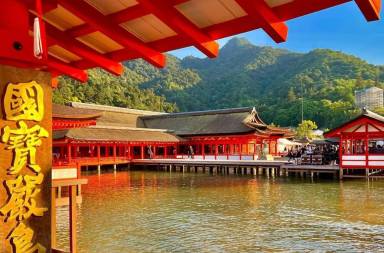
Check the Miyajima tide table before you fix your ferry time. At high tide the torii stands in water; at low tide you can walk out to its base. Both are worth seeing, but they are different days out, and arriving without knowing which you will get is the most common Miyajima disappointment.
Back East, Osaka Castle, and Out Through Kansai
Take a mid-morning Shinkansen back to Shin-Osaka — about ninety minutes — and leave your bag at the station or with your hotel. If your flight is late enough, this gives you a genuine final half-day in Osaka rather than a scramble. If it is not, do the food and skip the castle; today is the one day in nine where the schedule is dictated by an airline.
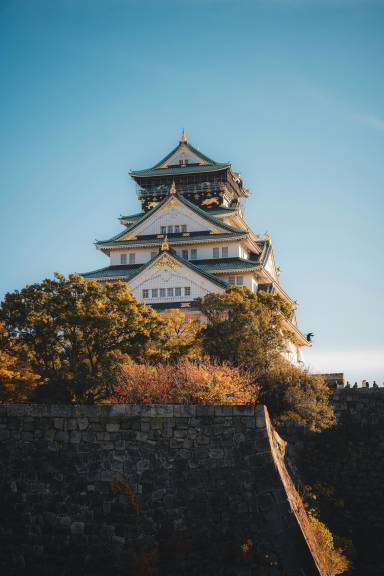
Osaka Castle is a good last sight because it is about power rather than contemplation, which after Kyoto and Nara is a change. The keep is a reconstruction but the seventeenth-century stonework beneath it is not — some base blocks weigh over a hundred tonnes and were floated across the Inland Sea — and the story on the museum floors, of a country unified by force and then closed for two and a half centuries, is the political backbone behind much of what you have already walked through this week.
Then eat. Osaka's own word for its appetite is kuidaore, eating yourself into ruin, and a backstreet food tour does in three hours what would take three days to find alone: takoyaki made for locals, kushikatsu with the no-double-dipping rule, and okonomiyaki mixed rather than layered — the Osaka way, and a fair comparison to make while yesterday's Hiroshima version is still fresh.
From Namba the Nankai Rapi:t reaches Kansai Airport in about thirty-eight minutes; the JR Haruka takes roughly fifty from Shin-Osaka. Be airside three hours before a long-haul departure.
If your flight home leaves from Tokyo rather than Kansai, do not come back to Osaka at all — go Hiroshima to Tokyo directly, about four hours by Shinkansen, and spend the saved time in Hiroshima this morning instead. Then price a rail pass, because that routing is the one case where it wins.
Planning this trip
Rail pass maths: nine days is where it gets interesting
On seven or eight days the nationwide Japan Rail Pass loses money outright. On nine, with Hiroshima in the plan, it becomes a real calculation. The legs here: Tokyo–Odawara about ¥3,700, Odawara–Kyoto about ¥11,000, Kyoto–Nara on the Kintetsu (not JR at all), Nara–Osaka about ¥600, Shin-Osaka–Hiroshima and back about ¥21,000. That comes to roughly ¥36,000, still short of the ¥50,000 seven-day pass — and a seven-day pass cannot cover nine days anyway. Two better options: buy point-to-point tickets through the smartEX app, or, if you want cover in the west, price a JR-West regional pass for the Kansai–Hiroshima area, which costs a fraction of the national pass and includes the Miyajima ferry. The one scenario where the nationwide pass wins is flying home from Tokyo, which means an extra four-hour leg back east from Hiroshima.
Takkyubin: send the case, carry a day bag
Yamato's TA-Q-BIN moves a suitcase from any hotel front desk to any other hotel front desk in Japan, usually overnight, for about ¥2,000–2,500 a large case. Hand it in before roughly 15:00 and hotel staff will fill in the form with you. On this itinerary use it twice: Tokyo to Kyoto on the morning of day three, so Hakone happens with an overnight bag, and Osaka to Hiroshima or straight to your day-nine hotel if you would rather not take a full case west for one night. It also solves the Shinkansen oversized-luggage rule, under which the seats with storage space behind them have to be reserved in advance.
One IC card, nine days, six cities
Suica, Pasmo and ICOCA are interchangeable nationwide. A single card covers Tokyo's subways, Kyoto's buses, the Kintetsu locals to Nara, the Osaka Metro, the JR run out to Miyajimaguchi and Hiroshima's trams. A digital Suica in Apple Wallet is the easiest route and can be created and topped up with a foreign card before you leave home; Android needs a Japanese-market handset, so Android users should buy a physical card at an airport machine. IC cards do not cover Shinkansen fares or the Kintetsu limited express reservation.
Hakone Free Pass and the Romancecar
The Hakone Free Pass covers the whole loop on one ticket — Tozan railway, cable car, Owakudani ropeway, Lake Ashi boats, local buses — and the two-day version from Shinjuku is the right one for an overnight stay. The Odakyu Romancecar is a separate reserved-seat supplement of about ¥1,200, direct from Shinjuku, and the front rows behind the driver's windscreen sell out first, so book with Odakyu a few days ahead.
Pacing, and where this itinerary is hardest
Five bases in nine nights is right, and adding a sixth is the mistake to avoid. The load here is deliberately uneven: days one, four and six are light, day seven is long (Nara from dawn, then a move to Osaka), and day eight is the biggest of the trip even with the overnight taking the pressure off. The overnight in Hiroshima is what separates nine days from ten — on ten days you can day-trip Hiroshima from Osaka and keep a relaxed last day, but on nine, sleeping in Hiroshima is what buys you Miyajima at dusk rather than a fourteen-hour round trip.
Seasons, and the weeks to avoid
Cherry blossom runs from late March into the first week of April, and it is as good as its reputation as well as the most crowded and expensive fortnight of the year outside the holidays. Autumn colour peaks in Kyoto mid to late November — clearer skies, cheaper flights, fewer people, and our pick for this route. Avoid Golden Week (late April to early May) and Obon (mid-August), when the whole country travels at once and both Shinkansen reservations and hotel rooms simply run out. Winter is cold, dry, cheap and by some distance the most reliable time to see Mount Fuji from Hakone.
Frequently Asked Questions
Is 9 days enough to include Hiroshima?
Yes, and it is roughly the minimum for doing it well. Nine days lets you sleep in Hiroshima, which turns a fourteen-hour round trip from Osaka into two comfortable days and gives you Miyajima in the late afternoon once the day crowds have gone. On seven or eight days, Hiroshima has to come out of Kyoto, which is a bad trade.
Should I do Hiroshima as a day trip or stay overnight?
On nine days, stay overnight. The Peace Park deserves an unhurried morning and Miyajima is at its best after four in the afternoon, and you cannot have both if you are watching the clock for a two-hour train back to Osaka. The day-trip version exists and works — it is what our ten-day plan uses, because ten days can absorb one very long day.
Do I need a JR Pass for 9 days in Japan?
Usually not. The legs on this route total roughly ¥36,000 against ¥50,000 for a seven-day nationwide pass that would not even span nine days. Buy point-to-point tickets through smartEX, and if you want pass cover for the western leg, price a JR-West regional pass for the Kansai–Hiroshima area instead. The nationwide pass only wins if you fly home from Tokyo and therefore add a four-hour return leg from Hiroshima.
Is Miyajima worth an extra night?
Miyajima is the reason to go west at all, so yes. The Peace Memorial Park is essential but heavy, and one to two hours is enough for most visitors; the island is what gives the day its other half. Staying overnight in Hiroshima is what lets you be on the island for the last of the light, which is when it is at its best.
Can I sleep on Miyajima itself instead of Hiroshima?
You can, and the island is genuinely lovely once the last ferry has gone. The trade-offs are real, though: fewer rooms, higher prices, and an extra ferry crossing with your luggage at both ends. For one night on a nine-day trip we would stay in Hiroshima near the station and keep the logistics simple.
How much does 9 days in Japan cost?
Excluding international flights, budget roughly ¥18,000–25,000 per person per day at mid-range level: ¥8,000–12,000 for a hotel room split two ways, ¥5,000–7,000 on food, and the rest on transport and entries. Long-distance rail on this route is around ¥36,000 per person. The Hakone ryokan with dinner and breakfast is the one deliberate splurge, at ¥25,000–50,000 per person.
Should I add Kanazawa or Takayama to nine days?
Not alongside Hiroshima. Nine days supports five bases comfortably and six badly — a sixth costs you a check-out, a check-in and half a day on trains, and the day it comes out of is always Kyoto. Choose either the western leg to Hiroshima or the mountain leg to Kanazawa and Takayama, and save the other for a second trip or a twelve-day version.
Which airport should I fly out of?
Kansai, on an open-jaw ticket in through Haneda or Narita. It usually costs little more than a return and it saves a full day of backtracking. If your airline forces a Tokyo departure, go directly from Hiroshima to Tokyo — about four hours by Shinkansen — rather than routing back through Osaka, and price a rail pass, because that is the one version of this trip where the pass pays.
Book the guided parts of this trip
Every tour above runs with a verified local operator.
Browse all Japan tours