10 Days in Japan: The Complete Tokyo to Hiroshima Itinerary
Ten days in Japan covers the Golden Route without hurrying: three nights Tokyo, one Hakone, three Kyoto, three Osaka, with Nara as a half-day and Hiroshima and Miyajima as a day trip. The third Tokyo and Kyoto nights are what the extra days buy. Even here the JR Pass does not pay off unless you fly home from Tokyo.
10 days in Japan at a glance
| Day | Based in | What you do | Getting there |
|---|---|---|---|
| 1 | Tokyo | Arrival, and an Easy First Evening in the Old East | Airport to central Tokyo: Haneda 30–45 min |
| 2 | Tokyo | One Line Drawn Across the City, Then Tokyo Lit Up | — |
| 3 | Tokyo | The Third Tokyo Day: Backstreets, Food Streets and No Landmarks | — |
| 4 | Hakone | Into the Caldera: Owakudani, Lake Ashi and a Ryokan Night | Tokyo → Hakone: Odakyu Romancecar from Shinjuku to Hakone-Yumoto in about 85 min |
| 5 | Kyoto | West Along the Tokaido, and Fushimi Inari With the Lights On | Hakone-Yumoto → Odawara 15 min |
| 6 | Kyoto | Kyoto Early and Kyoto Late, With the Afternoon Left Empty | — |
| 7 | Kyoto | The Kyoto Day Most Itineraries Never Get To | — |
| 8 | Osaka | Nara at Dawn, Osaka by Nightfall | Kyoto → Nara about 45 min on the Kintetsu limited express |
| 9 | Osaka | West to Hiroshima and the Floating Torii of Miyajima | Shin-Osaka → Hiroshima about 1h30 by Shinkansen (Nozomi |
| 10 | Osaka | Osaka Castle, One Last Meal, and Out Through Kansai | Osaka → Kansai International: Nankai Rapi:t from Namba about 38 min, or JR Haruka from Shin-Osaka about 50 min |
Ten days is the length at which a Japan trip stops being a sprint. Everything the seven-day version has to ration — a third Tokyo day, a third Kyoto day, an afternoon with nothing scheduled in it — fits without pushing anything out, and there is finally room for Hiroshima and Miyajima at the western end. It is also the point at which the arithmetic on a rail pass changes, which is worth several hundred dollars to get right.
The route is the classic Tokaido line and then a little further west: three nights in Tokyo, one in Hakone under Mount Fuji, three in Kyoto, then Nara on the way south and a base in Osaka for the last three, with a long day out to Hiroshima and Miyajima from there. Five bases in ten days. You could squeeze in a sixth — Kanazawa, Takayama, Nikko all tempt people — and we would advise against it, because the difference between a good Japan trip and an exhausting one is almost always one city too many.
What follows is written the way we would plan it for a friend, which means we say when a day is long, when a sight is better at dawn than at noon, and when the thing everyone recommends is not worth your afternoon. Two days in this plan are genuinely demanding — day eight, which covers Nara and moves you to Osaka, and day nine, which is a fourteen-hour round trip to the far west. We flag both, and we give you the shorter alternative for each.
Travellers with a full two weeks of leave minus the flying, or anyone who has decided that seeing four cities properly beats seeing seven from a train window — and who wants Hiroshima and Miyajima in the trip rather than saved for a return visit.
Arrival, and an Easy First Evening in the Old East
Plan almost nothing for today. Long-haul flights land in Tokyo in the afternoon, and by the time you have cleared immigration, sorted data and reached your hotel, you have a half day and a body that thinks it is four in the morning. From Haneda you are in the centre in thirty to forty-five minutes; from Narita, allow properly for it — the Keisei Skyliner takes about forty-one minutes to Ueno, the Narita Express roughly eighty-five to Shinjuku, and the limousine bus is slower but takes your suitcase to the hotel door.
The right first outing is Asakusa. Senso-ji has been the city's temple since long before it was Tokyo, the Nakamise arcade in front of it empties out after the coach groups leave, and the riverside walk to the Skytree view takes ten minutes. It is flat, compact, well-signed and forgiving of a brain running on aeroplane sleep. A guided half day earns its place on this specific afternoon simply because it removes every decision you would otherwise have to make badly.
Eat somewhere with a queue and a counter — soba, tonkatsu, a conveyor sushi place near your station — and go to bed early. Waking at four tomorrow is not a failure, it is the schedule, and it happens to be the one week of your life when being awake at dawn in Tokyo is a gift rather than a punishment.


Set up a Suica in Apple Wallet on the plane and load it with your own card — you walk straight out of the airport past the ticket machines, and the same card taps you onto Kyoto buses, the Osaka Metro and Hiroshima's trams later on.
One Line Drawn Across the City, Then Tokyo Lit Up
Tokyo defeats people who treat it as a list. It is not one city but a chain of centres — Asakusa, Ueno, Nihonbashi, Ginza, Shibuya, Shinjuku, Harajuku — and hopping between them by subway all day produces a lot of stations and very little sense of the place. Today is better spent as a single continuous route: the old low-rise east, the moat and pines of the Imperial Palace in the middle, then west into Meiji Shrine's planted forest and out the other side into Harajuku. Six hours with a guide who knows how the neighbourhoods join up will teach you more about how Tokyo is built than three days of independent hopping.
Eat lunch underground. The depachika food halls beneath the big department stores — Isetan in Shinjuku, Takashimaya in Nihonbashi — are the best cheap meal in central Tokyo and a genuine sight in their own right, and they solve the standing problem of what to do when it rains.
Then give the evening to the city at night, which is what Tokyo is actually famous for. A street go-kart run past Shibuya Crossing and under Tokyo Tower is not a cultural experience and we will not dress it up as one — it is loud and touristic and people love it. The quieter version, and the one we send couples on, is a two-hour night bike ride through Omotesando, Roppongi and the Aoyama cemetery, which threads the same neon at half the volume.


Street karting requires a Japanese licence or a 1949 Geneva Convention International Driving Permit, and the IDP has to be issued in your home country before you travel — it cannot be obtained in Japan. Sort it weeks in advance or book the night bike ride instead.
The Third Tokyo Day: Backstreets, Food Streets and No Landmarks
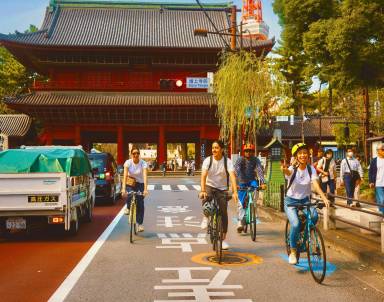
This day is the whole argument for ten days over seven. Everyone gets Shibuya and Senso-ji; almost nobody gets the Tokyo that people actually live in, because a shorter trip never has the room. Spend today below the landmark line. Yanaka and the shitamachi quarters north-east of Ueno survived the war largely intact — wooden houses, a cemetery full of cherry trees, cat-shaped everything, tiny galleries in converted bathhouses — and they are best covered by bike, because the distances are just long enough to be annoying on foot and the streets are far too small for buses.
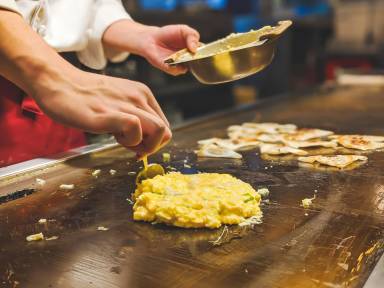
In the afternoon, go and eat down a shopping street. Togoshi Ginza in the south is the longest shotengai in Tokyo, about a kilometre and a half of croquette shops, standing bars, greengrocers and family kitchens, and it is barely on the tourist map despite sitting twelve minutes from Shibuya. A food walk here does something no landmark does: it shows you what an ordinary Tokyo evening looks like.
If you would rather use the day for a big excursion instead, the one we would pick is Nagano — the snow monkeys bathing in the hot spring at Jigokudani and the Zenko-ji temple complex, about ten hours door to door by Shinkansen. It is a real day out and genuinely worth it between December and March when the monkeys are actually in the water; in summer they mostly are not, and you would do better staying in the city.
If you swap today for the Nagano snow monkey trip, check the season first: the monkeys use the hot spring most reliably from December to March. Outside those months you are paying for a long train ride to watch macaques sit on a dry rock.
Into the Caldera: Owakudani, Lake Ashi and a Ryokan Night
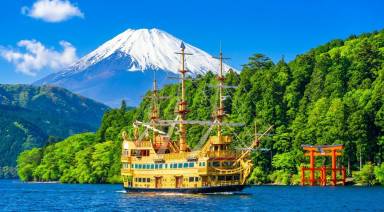
Hakone is a volcanic caldera ninety minutes from Shinjuku, and its loop is one of the great half-days of Japanese travel: the switchback Tozan railway climbing the valley, a cable car, a ropeway over the steaming sulphur vents of Owakudani, a boat across Lake Ashi, and the red torii of Hakone Shrine standing in the water at the far end. The loop takes four to six hours, so leave Tokyo mid-morning rather than at dawn — the light on the lake is better in the afternoon anyway.
The comfortable way in is the Odakyu Romancecar from Shinjuku, reserved seat, direct to Hakone-Yumoto in about eighty-five minutes, with a front row behind the driver's windscreen if you book early. The alternative is a Kodama or Hikari from Tokyo Station to Odawara in about thirty-five minutes and then fifteen minutes up the Tozan line. Whichever you pick, do not bring the big suitcase — see the tip, which is the most useful thing on this page.
Stay the night, and pick a ryokan with its own onsen. Hakone done as a Tokyo day trip is eleven hours of movement for the same sights and none of the point: a kaiseki dinner brought to your room, a bath outdoors in the dark, and the chance of Fuji clear and pink at first light tomorrow. The mountain is most often visible in the first two hours after sunrise, and — counter to what everyone assumes — it is far more reliably visible in the cold, dry air of December to February than in a humid July.

This morning, send your suitcase from the Tokyo hotel straight to your Kyoto hotel by takkyubin — about ¥2,000–2,500 for a large case, delivered next day. You then do the ropeways, the ryokan and the Shinkansen with an overnight bag, and the case is waiting at the Kyoto desk when you arrive tomorrow. Give it two days rather than one if you are ever sending to a mountain address.
West Along the Tokaido, and Fushimi Inari With the Lights On
Use the morning for the Hakone that the loop skips. The Open-Air Museum's sculpture lawns are the obvious choice; the better one, if you like making things, is a marquetry workshop in the hills, where the yosegi-zaiku inlay Hakone has produced for two centuries is still planed and cut by hand and you go home with a piece you made. Either way, one more bath before you leave.
Come down to Odawara and turn west. Odawara to Kyoto is about two hours on a Hikari — the Nozomi saves little on this stretch and the Kodama stops at everything. Sit on the right-hand side going west; Fuji appears roughly forty minutes out, and if the mountain hid itself all yesterday this is your second chance at it.
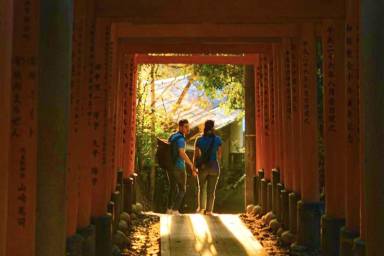
You will be in Kyoto by mid-afternoon, which is precisely the wrong time to start on temples: almost every major site in the city closes its gates between four and five, and arriving at Kiyomizu-dera at twenty to five is how people end up saying Kyoto underwhelmed them. Collect your forwarded suitcase, check in, and spend the evening on the one great Kyoto sight with no closing time. Fushimi Inari's tunnel of vermilion torii is open around the clock, free, lit by the shrine's own lamps, and after dark it is an entirely different place from the shoulder-to-shoulder photograph everyone brings home. Finish with a food walk through Nishiki or the lanes off Pontocho.

Reserve the Odawara–Kyoto seat the night before in the JR Central smartEX app instead of queuing at Odawara, and choose a D or E seat for the Fuji side heading west.
Kyoto Early and Kyoto Late, With the Afternoon Left Empty
Kyoto's real problem is not that it is crowded, it is that it is crowded between eleven and three. The bamboo groves at Arashiyama, the stone lanes of Ninenzaka and the approach to Kiyomizu-dera are calm and genuinely beautiful before eight in the morning and close to unwalkable by midday. So take the city at its edges. Out at first light, two or three sites done slowly while the coaches are still loading, back at the hotel by lunch having seen more than most people manage in a full day.
Then deliberately do nothing for a few hours. Sleep, or sit in a kissaten over a hand-drip coffee, or walk the Kamo riverbank, or browse the knife and tea shops on Teramachi. A ten-day trip is long enough that pacing is a real variable, and the afternoon you leave empty on day six is what keeps day nine survivable. Every over-packed itinerary you have read online would have you at a fourth temple right now.
In the evening the city reverses again. Gion Shirakawa's canal-side willows under lantern light, the alley kitchens of Pontocho, standing counters where the ordering is done for you — an evening food walk is the best possible use of a Kyoto night, and unlike the daytime sights it improves as it gets darker. If you would rather cover ground, an e-bike through the Higashiyama slopes reaches places the buses cannot at the hour when the streets finally empty.

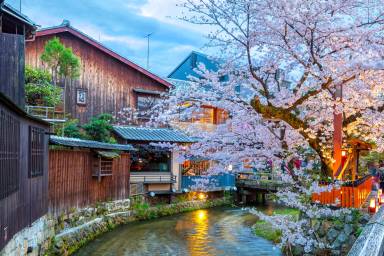
Kyoto's city buses are the slowest and most crowded way to cross Kyoto. Use the Karasuma and Tozai subways, the Keihan and Hankyu lines along the river, and take a taxi for the last kilometre — a cross-town fare is usually ¥1,000–1,500, which is nothing split two ways.
The Kyoto Day Most Itineraries Never Get To
Two days in Kyoto buys you the famous set: Fushimi Inari, Kiyomizu-dera, Arashiyama, Kinkaku-ji, Gion. A third day buys you Kyoto. This is the day for the north-west temples that nobody queues for — Daitoku-ji's sub-temples with their dry gardens, Ryoan-ji early enough to sit in front of the rocks alone — or for the Philosopher's Path walked slowly from Ginkaku-ji down to Nanzen-ji's aqueduct, which takes a morning and is the most pleasant hour of walking in the city.
It is also the day to make something rather than look at something, which after six days of sightseeing is a genuine relief. Kyoto's craft workshops are the best in Japan and most run two to three hours: woodblock printing in the ukiyo-e tradition, sashiko stitching, a sake tasting run by an actual sake sommelier rather than a bar with a tasting menu. These are the parts of a trip people describe in detail a year later, and they are the first thing a shorter itinerary cuts.
The alternative use of today, if you would rather see more than do more, is to cover the outlying sights by bike. A full-day e-bike loop with a guide reaches Arashiyama, the northern hills and the river paths in a way that the transport network genuinely does not — Kyoto's sights sit in a ring and its trains run through the middle, which is why so many visitors spend the day changing buses.

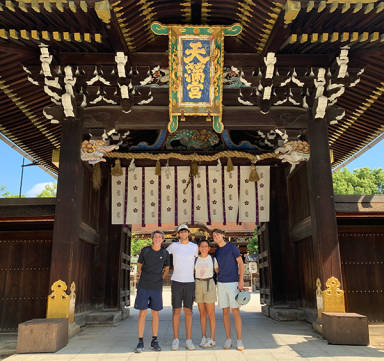
Book a craft workshop before you leave home. They take four to eight people, most run once or twice a day, and in cherry blossom and autumn seasons they are the one thing in Kyoto that is fully sold out weeks ahead while hotel rooms are still available.
Nara at Dawn, Osaka by Nightfall
Nara is a half-day, not an overnight, whatever the hotels there would prefer. Everything you came for sits in one walkable park: Todai-ji's Great Buddha, fifteen metres of eighth-century bronze inside the largest wooden building most people will ever enter; the thousands of stone and bronze lanterns lining the approach to Kasuga Taisha; Kofuku-ji's five-storey pagoda; and about twelve hundred deer that have had the run of the place for a millennium and will take a cracker out of your hand without asking.
Go early and mean it. The Kintetsu limited express from Kyoto takes roughly forty-five minutes and leaves you five minutes from the park, whereas the JR station is a long walk out. Deer Park at eight in the morning, with mist still on the grass and the Nandaimon gate empty, is one of the quiet high points of a Japan trip; the same spot at noon is a coach park with a queue. A guided morning is worth it here because the three sites are further apart than they look and the connecting story — why the deer are sacred, what the Naramachi merchant houses were — is the interesting half.
By early afternoon you are finished, and the Kintetsu runs south to Osaka Namba in about forty minutes. Osaka is louder, flatter and considerably less well-mannered than Kyoto, and after three days of gardens that is exactly what you want. Dotonbori's neon and the covered arcades north of Namba are a short walk from most hotels, and nothing needs booking.
This is a long day. If you are travelling with children, or tomorrow's fourteen-hour excursion worries you, cut Kasuga Taisha rather than Todai-ji and take an earlier train south.

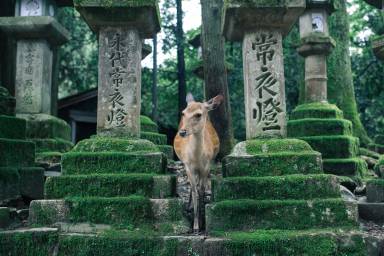
Put your suitcase in a coin locker at Kintetsu Nara station rather than leaving it in Kyoto. The station is at the park entrance, a large locker takes a cabin case for about ¥700, and you collect it on your way through to Osaka instead of backtracking.
West to Hiroshima and the Floating Torii of Miyajima
Be honest with yourself about today before you book it: from Osaka this is a fourteen-hour round trip, roughly two hours each way on the Shinkansen plus the ferry, and it is the hardest day of the ten. It is also, for a lot of people, the day they remember longest. The Peace Memorial Park is not a sightseeing stop — it is an hour or two that reorganises how you think about the twentieth century, and the museum's ground floor in particular is quiet in a way no other museum is. The A-Bomb Dome, left standing as it was found, is a two-minute walk away.
Give the park and museum the morning, ideally with a guide, because the geography matters enormously — where the hypocentre was, what stood where, which of the trees you are walking past survived. Then get out to the water. From Hiroshima Station it is about twenty-five minutes to Miyajimaguchi and a ten-minute ferry to the island, where the great vermilion torii of Itsukushima Shrine stands in the sea and the shrine itself is built on stilts over the tidal flat. Check the tide table before you go: at high tide the torii floats, at low tide you can walk out to it, and both are worth seeing but they are completely different experiences.
Stay on the island until the last of the light if you can. The day-trip crowds leave in the late afternoon, the deer come down onto the beach, and Daisho-in's temple stairway above the village is empty by five. Then it is the ferry, the train, and back into Osaka late.
If a fourteen-hour day is not for you, there is a straightforward alternative: sleep in Hiroshima tonight and come back to Osaka tomorrow morning. It costs you the relaxed final day, but it turns the hardest day of the trip into two easy ones. A packaged bullet-train day tour from Osaka is the other way to do it — someone else handles every connection, which on a day with this many of them is worth more than it sounds.
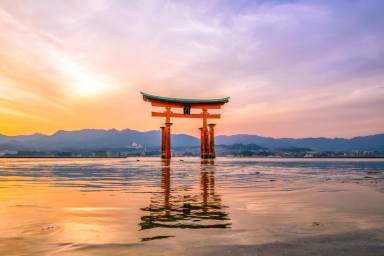
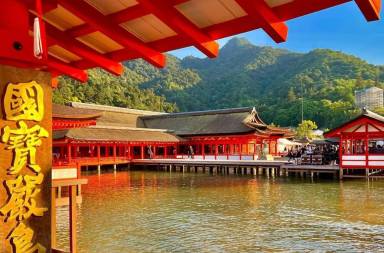
Look up the Miyajima tide times for your date before you commit to a departure. High tide gives you the torii standing in water; low tide lets you walk out to its base. There is no wrong answer, but arriving without knowing which you will get is how people are disappointed by the most photographed gate in Japan.
Osaka Castle, One Last Meal, and Out Through Kansai
Fly home from Kansai rather than Tokyo. An open-jaw ticket in through Haneda or Narita and out of KIX usually costs little or nothing extra, and it saves the two-and-a-half-hour backtrack up the Tokaido that would otherwise consume your last day. If your airline has already committed you to a Tokyo departure, do the castle first thing and treat the rest of today as a travel day.
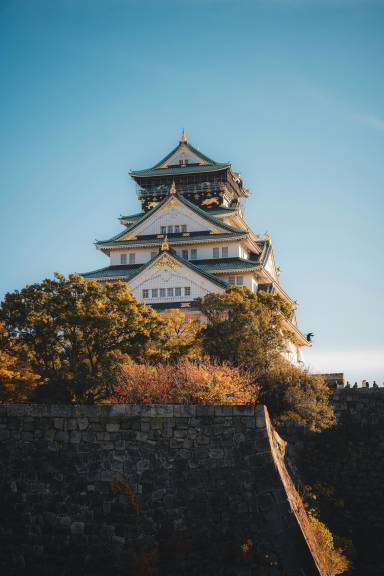
Osaka Castle is the right final sight and an unusually good one after nine days of temples, because it is about power rather than contemplation. The keep is a reconstruction, but it sits on genuine seventeenth-century stonework — some of the base blocks weigh over a hundred tonnes and were dragged here by sea — and the story told on the museum floors, of a country unified by force and then sealed shut for two and a half centuries, is the missing piece behind half of what you have already seen in Kyoto and Nara.
Then eat, properly, because this is the city for it. Osaka's own word for its appetite is kuidaore — eating yourself into ruin — and a backstreet food walk off Namba does in three hours what would take you three days to find alone: takoyaki cooked for locals rather than for photographs, kushikatsu with the no-double-dipping rule enforced by an unimpressed woman behind the counter, okonomiyaki made the Osaka way with everything mixed rather than layered. Take it as a late lunch and you will still comfortably make an evening flight.
From Namba the Nankai Rapi:t reaches Kansai Airport in about thirty-eight minutes; the JR Haruka takes roughly fifty from Shin-Osaka. Neither needs as much padding as you think, but KIX check-in queues are genuinely long — be airside three hours before a long-haul departure.
If you are flying out of Tokyo, send the suitcase from your Osaka hotel to your Tokyo airport hotel by takkyubin the day before. You ride the Shinkansen with a day bag, and you avoid the reserved oversized-luggage spaces behind row 20, which are now genuinely enforced.
Planning this trip
The JR Pass: the one itinerary where the maths gets close
Since the October 2023 price rise a seven-day nationwide Japan Rail Pass costs ¥50,000, and on the standard Tokyo–Kyoto–Osaka loop it loses money badly. On this ten-day route it gets close, but only in one specific case. Count the legs: Tokyo–Odawara around ¥3,700, Odawara–Kyoto around ¥11,000, Kyoto–Nara is Kintetsu and not covered at all, Kyoto or Osaka to Hiroshima and back around ¥21,000 for the return. That is roughly ¥36,000 — still under the pass. Add a return to Tokyo to fly home (about ¥14,500) and you are at ¥50,000, which is a dead heat, and a pass activated on day four would not cover both ends anyway. The better answer for almost everyone: buy point-to-point tickets in the smartEX app for the Tokaido legs, and if you want cover in the west, look at the JR-West regional passes for the Kansai–Hiroshima area, which cost a fraction of the national pass and cover exactly the Hiroshima and Miyajima legs including the ferry.
Takkyubin: the ¥2,000 that changes the trip
Yamato's TA-Q-BIN service collects a suitcase from any hotel front desk and delivers it to any other hotel front desk in Japan, generally next day, for about ¥2,000–2,500 per large case. Hand it in before about 15:00, fill in the form at reception with staff who do this fifty times a day, and travel with an overnight bag. On this itinerary you use it twice: Tokyo to Kyoto on the morning of day four so that Hakone is easy, and optionally Osaka to the airport on day ten. Almost no English-language itinerary explains this, and it is the difference between arriving in Kyoto relaxed and arriving having wrestled a 23kg case through Shinjuku at rush hour. Allow two days rather than one for deliveries to or from mountain addresses like Hakone.
IC cards, and what they do not cover
Suica, Pasmo and ICOCA are fully interchangeable nationwide. One card taps you through Tokyo's subways, Kyoto's buses, the Osaka Metro, the JR line to Miyajimaguchi, Hiroshima's trams and most convenience stores. A digital Suica in Apple Wallet is the simplest option and can be created and topped up with a foreign card before you fly; Android requires a Japanese-market handset, so Android users should buy a physical card at an airport machine on arrival. What IC cards do not cover is the Shinkansen fare itself, or the Kintetsu limited express reservation to Nara — both are separate tickets.
Hakone Free Pass and the Romancecar
The Hakone Free Pass puts the whole loop on one ticket — Tozan railway, cable car, Owakudani ropeway, Lake Ashi boats and the local buses — and since you are staying a night, the two-day version from Shinjuku is the right one. The Odakyu Romancecar is a separate reserved-seat supplement of about ¥1,200 and is the comfortable, direct way into the mountains; the front rows behind the driver's windscreen are the seats to want and the first to go, so book online with Odakyu several days ahead.
Pacing: where the ten days are actually spent
Five bases in ten nights is the right number, and the temptation you should resist is a sixth. Kanazawa, Takayama and Nikko all fit on paper and all cost you the same thing in practice: two half-days lost to trains and a hotel change you did not need. The load in this plan is deliberately uneven. Days one, six and ten are light. Days eight and nine are hard, back to back, which is the one structural weakness of a ten-day route with Hiroshima in it — there is no comfortable way to arrange it otherwise unless you sleep in Hiroshima on day nine. If you know you fade, that swap is the single best modification to make.
When to go, and the weeks to avoid
Cherry blossom lands in Kyoto and Tokyo from late March into the first week of April — genuinely spectacular, and the most expensive and crowded fortnight of the year outside the public holidays. Autumn colour peaks in Kyoto in mid to late November and is, for our money, the better bet: clearer skies, cheaper flights, fewer people. Avoid Golden Week from late April into early May and Obon in mid-August, when the entire country travels at once and Shinkansen reservations and hotel rooms simply run out. Winter is underrated for this route in particular: it is cold, dry, cheap, and by far the most reliable season for actually seeing Mount Fuji from Hakone.
Booking order, three months out to three days out
Three months ahead in spring and autumn (six weeks otherwise): Kyoto hotels, the Hakone ryokan, and your open-jaw flights. Four to six weeks ahead: private guides, the Kyoto craft workshops, which sell out well before hotels do, and the Odakyu Romancecar seats. A week ahead: teamLab in Tokyo, which is timed entry. A few days ahead is fine for every Shinkansen seat on this route, since trains run every ten minutes and smartEX works from your phone — the exception is the Nara Kintetsu limited express in blossom season and any travel date inside Golden Week or Obon, which you should treat as sold out until proven otherwise.
Frequently Asked Questions
Is 10 days enough for Japan?
It is enough to see Tokyo, Kyoto and the classic Kansai region properly, plus Hiroshima and Miyajima — which is what most first trips are for. It is not enough to add Hokkaido, Okinawa or the Japanese Alps, and trying to do so is how a good trip becomes a tiring one. Ten days done at this pace beats fourteen days done badly.
Do I need a JR Pass for a 10 day Japan itinerary?
Probably not, and this is worth several hundred dollars to get right. The legs on this route come to roughly ¥36,000 if you fly home from Osaka, against ¥50,000 for the seven-day nationwide pass — and the pass would not span both ends of a ten-day trip anyway. Buy point-to-point tickets through smartEX, and if you want a pass for the western leg, price a JR-West regional pass covering Kansai and Hiroshima instead.
Should I sleep in Hiroshima or day-trip from Osaka?
Day-tripping works and is about fourteen hours door to door. Staying the night is easier on your legs, lets you see Miyajima after the crowds have gone, and gives you the Peace Park early in the morning when it is at its quietest. If either of you tires easily, take the overnight and accept losing a relaxed last day in Osaka.
Is Miyajima worth it, or is Hiroshima enough?
Miyajima is the reason to make the trip west rather than just an add-on to it. The Peace Memorial Park is essential but heavy, and one to two hours there is enough for most people; the island gives the day its other half. If you only have time for one, and you are travelling with children, Miyajima is the one that works for all ages.
Which cities should I add if I have 12 or 14 days?
In this order: Kanazawa for the Kenrokuen garden and the samurai and geisha districts, reached in two and a half hours from Kyoto; then Takayama and the Shirakawa-go farmhouses for mountain Japan; then Nikko as an overnight from Tokyo. Add one per two extra days, not per extra day — every new base costs you half a day in transit and check-ins.
How much does 10 days in Japan cost?
Excluding international flights, budget roughly ¥18,000–25,000 per person per day at a mid-range level: ¥8,000–12,000 for a business hotel room split between two, ¥5,000–7,000 on food eating well, and the rest on transport and entries. Long-distance rail on this route is about ¥36,000 per person. The ryokan night in Hakone with dinner and breakfast runs ¥25,000–50,000 per person and is the one deliberate splurge here.
Tokyo first or Osaka first?
Tokyo first. Jet lag is worst on days one and two, and Tokyo is the more forgiving city to be tired in — more English signage, more late food, nothing that has to be done at dawn. Ending in Osaka also lets you fly out of Kansai, which saves a whole day of backtracking at the end.
What is the best time of year for this route?
Mid to late November is our pick: Kyoto's autumn colour, clear skies, and less pressure on hotels than the cherry blossom fortnight. Late March to early April is the more famous choice and is worth it if you accept the crowds and prices. December to February is the cheapest, quietest and the most reliable time to actually see Mount Fuji, at the cost of short daylight and cold evenings.
Book the guided parts of this trip
Every tour above runs with a verified local operator.
Browse all Japan tours