5 Days in the UAE
Five days is the first length where moving hotels pays for itself. Three nights in Dubai for Old Dubai, Downtown, the Marina and the desert, then two nights in Abu Dhabi for the Grand Mosque, Qasr Al Watan, the Louvre and Yas Island. Staying in Abu Dhabi gets you the mosque at sunrise and the palace lit at night, which no day trip reaches.
5 days in UAE at a glance
| Day | Based in | What you do | Getting there |
|---|---|---|---|
| 1 | Dubai | Old Dubai, the creek and the souks | — |
| 2 | Dubai | Downtown and the tower | — |
| 3 | Dubai | The Marina, the Palm and the desert | — |
| 4 | Abu Dhabi | The mosque, the palace and the Corniche | — |
| 5 | Abu Dhabi | Saadiyat or Yas — museums or parks | — |
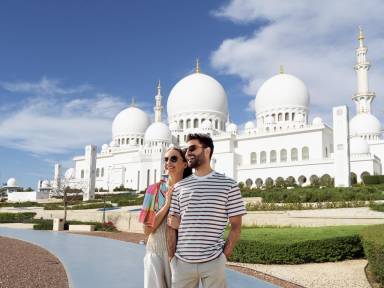
At five days the calculation changes. Up to four, one hotel in Dubai is right and Abu Dhabi is a day trip. At five, two nights in the capital buys you the two things a day trip cannot: the Grand Mosque early in the morning when it is cool and empty, and Qasr Al Watan floodlit with its projection show after dark. It also puts Yas Island within reach without a three-hour round trip.
Anyone who wants both cities properly rather than one city and a long drive.
Old Dubai, the creek and the souks
Al Fahidi in the morning, the abra across the creek, the gold and spice souks, and lunch in Deira. Afternoon at the Dubai Frame. An easy first day that beats jet lag and puts the city in context before you see any of the tall parts.

Downtown and the tower
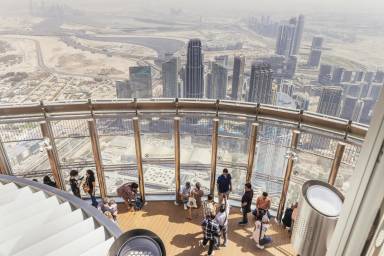
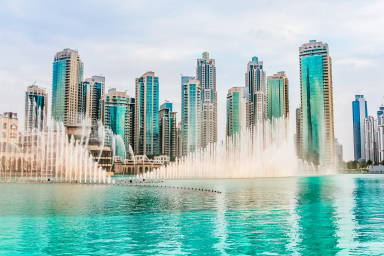
The aquarium and the mall in the morning, the Burj Khalifa before sunset, and the fountain from the lake afterwards. If it is a hot month, this is the day that is almost entirely indoors and it is worth putting where the forecast is worst.
The Marina, the Palm and the desert
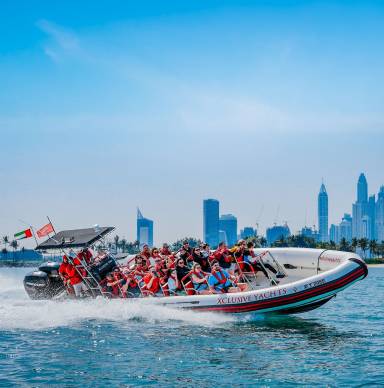
Water in the morning out of the Marina — speedboat for speed and photographs, yacht for shade and time. Beach and lunch at JBR. Desert safari from mid-afternoon: dune bashing, sunset, camp dinner and shows, back around nine.
Move hotels to Abu Dhabi tomorrow morning rather than tonight; the safari finishes late and nobody enjoys checking in at eleven.


The mosque, the palace and the Corniche
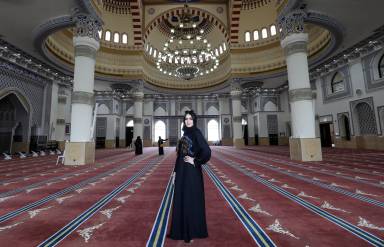
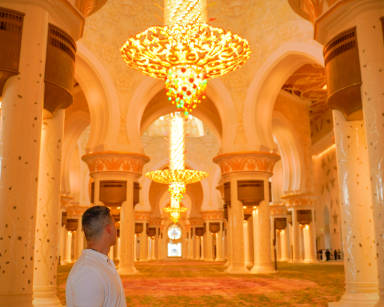
Drive down mid-morning and check in. The Grand Mosque in the afternoon, or first thing tomorrow if you would rather have it empty — this is the advantage of sleeping here.
Qasr Al Watan late in the day, timed so you are there as the floodlights come on and the projection show starts on the façade. Dinner along the Corniche, which is where the city actually goes in the evening.

Saadiyat or Yas — museums or parks
Two ways to spend the last day and they do not combine.
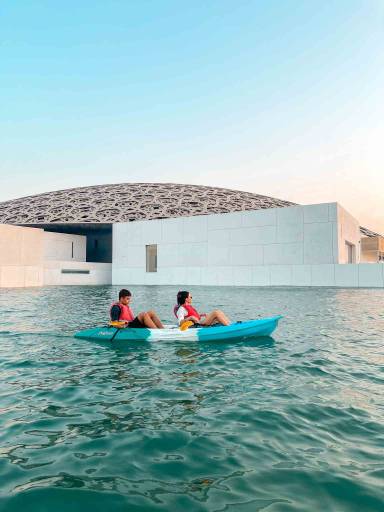
Saadiyat, if you want the Louvre — allow two to three hours, and go on a bright day for the rain of light through the dome. A kayak around the building beforehand shows you the side it was designed for and almost nobody sees.
Yas Island, if there are children or petrolheads in the group — Ferrari World, SeaWorld or Warner Bros. World, all within walking distance of each other, and a multi-park pass costs less than separate tickets.
The Louvre closes on Mondays. Plan the order around that.



Planning this trip
Getting around
Dubai runs about seventy kilometres along the coast and the two areas you most want — Downtown with the Burj Khalifa, and the Marina with the Palm — are half an hour apart on a good day. Plan each day around one end of the city rather than crossing repeatedly. The metro's Red Line follows Sheikh Zayed Road and connects the airport, Downtown, the Marina and Expo City; it is faster than a car at rush hour and needs a Nol card, sold at every station. Taxis are metered, plentiful and cheap by European standards, and Careem is the local ride app. For anything outside the city — the desert, Abu Dhabi, the east coast — book a vehicle with a driver rather than metering a taxi.
Abu Dhabi from Dubai
Ninety minutes each way by road. That is three hours of a day gone, which leaves about seven for the city — enough for three major sites, not five. If Abu Dhabi is genuinely the reason for the trip, stay there rather than day-tripping: the mosque at sunrise and the palace lit at night are the versions worth having, and no day trip reaches either.
Two closures that ruin plans
Sheikh Zayed Grand Mosque does not admit visitors on Friday mornings. Louvre Abu Dhabi is closed all day Monday. Between them these catch out an extraordinary number of visitors, because a day trip has no second chance. Qasr Al Watan adds a third, less predictable risk — it shuts at short notice for state functions, and that is not published in advance. Give us your dates and we check all three with the operator before you pay.
What to wear
In malls, souks and public areas, shoulders and knees covered is the norm and swimwear stays at the beach or pool. At the Grand Mosque the code is enforced on everyone including men: no shorts, nothing tight or sheer, and hair covered for women — an abaya is provided free at the door. Shoes come off inside prayer halls and the marble outside gets painfully hot by midday, so carry socks.
Heat, and how it shapes a trip
November to March is the season. Between June and September the temperature reaches the mid-forties with humidity off the Gulf, and anything outdoors between ten in the morning and five in the evening becomes an endurance test. The city is built for it — three of the four Yas Island parks, the aquarium, the Green Planet and every mall are fully air-conditioned — but a summer plan has to be front-loaded before nine and restarted at dusk.
Alcohol, Ramadan and the working week
Alcohol is served in licensed hotels, bars and restaurants and is not sold in ordinary supermarkets. Drinking in public is an offence. During Ramadan, eating, drinking and smoking in public during daylight is restricted, though hotels serve guests throughout the day and visitors are not expected to fast; iftar at sunset is the most sociable hour of the year and worth planning for rather than around. The working week is Monday to Friday with Saturday and Sunday the weekend, so attractions are busiest at weekends exactly as they are elsewhere.
Frequently Asked Questions
Is Dubai or Abu Dhabi the better base?
Dubai, for a first visit. It has more to do, better transport and a wider choice of hotels, and Abu Dhabi is a comfortable day trip from it. Base yourself in Abu Dhabi if the museums and the Grand Mosque are the actual reason for the trip, or if you are here for the Grand Prix.
How many days do I need in the UAE?
Three days covers Dubai's essentials. Five gets you Dubai properly plus a full Abu Dhabi day. Seven adds the east coast or a second Abu Dhabi day and is about the point of comfortable saturation — beyond that most visitors are better off adding Oman than staying put.
Do I need a visa?
Many nationalities receive a visa on arrival; others must apply in advance. Rules vary considerably by passport, so check the official UAE government guidance for yours rather than a summary. Passports generally need six months of validity remaining.
Is the UAE expensive?
It can be either. Hotels and alcohol are expensive; taxis, the metro, food outside the tourist strips and most attractions are reasonable. Eating where residents eat — Deira and Karama in Dubai, the older parts of Abu Dhabi — costs a fraction of a Downtown restaurant for better food.
Is it worth changing hotels for two nights in Abu Dhabi?
At five days or more, yes. It buys the Grand Mosque at sunrise and Qasr Al Watan lit at night, neither of which a day trip reaches, and it removes three hours of driving from two separate days. At four days or fewer it is not worth the packing.
Book the guided parts of this trip
Every tour above runs with a verified local operator.
Browse all UAE tours