5 Days in Thailand: Bangkok and Chiang Mai, Properly Paced
Five days in Thailand is three nights in Bangkok and two in Chiang Mai. Fly between them — it is about 75 minutes and usually cheap, while the overnight sleeper train costs you a day you do not have. Bangkok for the temples and the river, Chiang Mai for the old city, Doi Suthep and an ethical elephant morning.
5 days in Thailand at a glance
| Day | Based in | What you do | Getting there |
|---|---|---|---|
| 1 | Bangkok | Old city temples, then street food after dark | Suvarnabhumi to central Bangkok: 45–60 minutes by road, or about 30 minutes on the Airport Rail Link to Phaya Thai |
| 2 | Bangkok | Ayutthaya, and the version of Bangkok that came before Bangkok | Bangkok to Ayutthaya: about 1 |
| 3 | Bangkok | Canals, a cooking class, and a stadium night | — |
| 4 | Chiang Mai | North to Lanna: the walled old city on foot | Bangkok to Chiang Mai: about 1 hour 15 by air, mostly from Don Mueang |
| 5 | Chiang Mai (departure) | Elephants or the mountain — pick one, honestly | Chiang Mai back to Bangkok or onward: 1 hour 15 by air |
Five days is the first length where leaving Bangkok makes real sense, and Chiang Mai is where to go. The flight is about 1 hour 15 minutes and often costs less than a nice dinner, which means one move buys you a completely different country: a walled old town with the moat still around it, mountains behind the city, Lanna architecture rather than central-Thai, cooler evenings, and a food culture built on northern dishes most visitors have never eaten.
The split is three nights Bangkok, two nights Chiang Mai. Not the reverse, and not two-and-a-half each. Bangkok needs three because two of your days there will contain a full-day trip out of the city, and because your first day is your jet-lagged one. Chiang Mai works on two nights precisely because the old city is small and walkable and the good day activities are half-day activities. Anything you cannot fit in two Chiang Mai days is a mountain or a national park, and those are what the six-day version is for.
One warning about how these five days are usually written up. Nearly every published five-day Thailand itinerary tries to add an island, on the grounds that it is only another short flight. It is not another short flight; it is another half-day each way, another hotel, another packing cycle, and it turns a well-paced trip into a scramble. Two cities in five days is right. Three is not.
Travellers who want the two halves of Thailand — the capital and the north — without a beach, and who would rather arrive somewhere twice than four times.
Old city temples, then street food after dark
Grand Palace at 8:30am opening, then Wat Pho for the reclining Buddha, then across the river to Wat Arun in the late afternoon when the sun is low enough to light the prang properly. That is the classic sequence and it is classic because the timing works — the palace is unbearable at midday and Wat Arun is dull at midday too.
Do not fill the middle of the day. You have just flown, you are probably several time zones out, and the heat between 1pm and 3:30pm will take more out of you than you expect. An air-conditioned lunch and two hours horizontal is not a wasted afternoon; it is what makes days two and three work.
Come back out at dusk. Bangkok's street food is at its best from about 6pm, and the first night is when a guide is most useful — not because you cannot find food, but because the best stalls specialise in one dish, have no menu you can read, and are scattered across a neighbourhood you do not know yet.
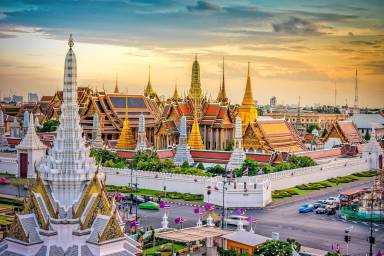

Shoulders and knees covered for the Grand Palace, enforced at the gate. Long trousers and a light scarf, and you will not be queuing for a rental sarong in the sun.
Ayutthaya, and the version of Bangkok that came before Bangkok
Ayutthaya was the capital of Siam for four centuries and, in the 1600s, one of the biggest cities on earth — a river island with Portuguese, Dutch, Japanese and Persian quarters. A Burmese army destroyed it in 1767 and the court moved downriver to found Bangkok. Everything you saw yesterday is, in a sense, the replacement for what you are seeing today.
It is 1.5 hours north and it is a full day — the ruins are spread over several kilometres of brick and grass with very little shade, so a trip that includes transport, a guide and a lunch stop is worth more here than in most places. Some itineraries return by boat down the Chao Phraya with a stop at Bang Pa-In, the royal summer palace, which is a genuinely odd collection of Thai, Chinese and European pavilions built by kings who were negotiating with Europe rather than being colonised by it.
Expect to be back around 5 or 6pm and expect to be tired. Plan dinner near your hotel.


If it is a weekend and you would rather skip the ruins entirely, Chatuchak market is Saturday and Sunday only — it does not exist as an option midweek, which catches a lot of people out.
Canals, a cooking class, and a stadium night
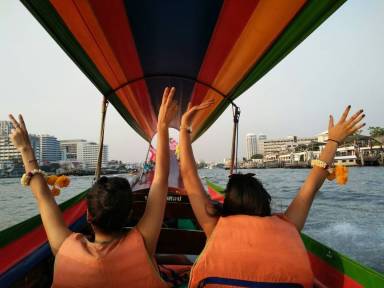
Start on the water. The Thonburi canals are what Bangkok was before it was paved — stilt houses, temple landings, boats selling coffee — and a longtail run through them takes a couple of hours rather than the whole morning.
Use the afternoon for a cooking class. It begins at a market, which is the part that matters: somebody walks you through galangal versus ginger, the three basils, palm sugar, and why the fish sauce you own at home is the wrong one. It is the single most portable souvenir available in Thailand.
For the last Bangkok evening, go to the Muay Thai. Rajadamnern is one of the two historic stadiums and a card runs through the evening from junior bouts up to the main fight, with the ringside orchestra and the betting section going properly loud in the later rounds. It is not a tourist show — it is the national sport at its actual home, and it is a far better last night than another rooftop bar.

Book tomorrow's Chiang Mai flight for late morning, not dawn. A 7am departure from Don Mueang means leaving your hotel at 4:30am and writing off the afternoon.
North to Lanna: the walled old city on foot
Fly up in the morning. It is about 1 hour 15 in the air, budget carriers run it constantly, and the whole move costs you a half-day at most. The overnight sleeper train is a genuinely good experience — a proper berth, 12 to 13 hours, rice fields at dawn — but on a five-day trip it is the wrong call. It does not save you a day and you arrive at 70 percent.
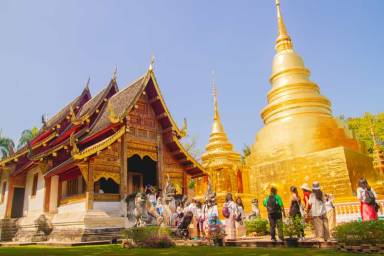
Chiang Mai's old city is a square, roughly 1.5km a side, with the moat and chunks of the brick wall still standing. Everything inside it is walkable, and there are more than thirty temples in that square alone — Wat Chedi Luang's half-collapsed 14th-century chedi, Wat Phra Singh, Wat Lok Moli's dark teak. A guided walk in the afternoon is the efficient way in, because the difference between Lanna and central Thai architecture is not something you will spot unaided and it is the whole point of being here.
In the evening, eat northern. Khao soi — a curried noodle soup with crisp noodles on top — sai ua sausage, and nam prik ong are all local to this region and largely absent from Bangkok menus. Either eat your way around the night markets, or take a guided Lanna food trail if you would rather be told what you are eating.

Chiang Mai airport is unusually close to town — a 15-minute ride. It is one of the few places in Thailand where a midday flight barely dents the day.
Elephants or the mountain — pick one, honestly
You have one day and two good options, and trying to do both is how this itinerary breaks. Option one is an ethical elephant sanctuary. Half-day feeding-and-observation programmes run about five hours including transfer out into the hills, which fits an evening flight. The rule is absolute: do not book anywhere that offers riding, anywhere at all on its site. An elephant's spine is not built for a saddle and the training that produces a rideable animal is coercive. 'Sanctuary' is not a protected word in Thailand, so judge by what is on offer, not what is on the sign.
Option two is Doi Suthep, the temple on the mountain above the city, reached by red songthaew up a winding road and then 300 steps flanked by naga serpents. From the terrace you can see the whole Chiang Mai plain. Many trips pair it with Wat Pha Lat, a small forest temple part-way up that almost nobody visits and which is, for a lot of people, the better of the two. That is a four-hour morning.
If you have the full day and want something bigger, Doi Inthanon — the highest point in Thailand, waterfalls, twin royal chedis, cloud forest — is a nine-hour day trip, and it does not fit a departure evening. Save it for the six-day version of this route.


The Sunday Walking Street on Ratchadamnoen is the best market in the city by a distance, and it only happens on Sunday afternoons. If your dates touch a Sunday, arrange the days so you are in Chiang Mai for it.
Planning this trip
Two monsoons, two coasts, two different seasons
This is the fact most Thailand itineraries get wrong, and it matters more than anything else on this page. Thailand does not have one rainy season. It has two, on two coasts, and they run at different times. The Andaman coast — Phuket, Krabi, Koh Lanta, Koh Phi Phi — is wettest roughly May to October, when the southwest monsoon pushes straight onto those beaches. The Gulf coast — Koh Samui, Koh Phangan, Koh Tao — is driest through much of that same period and takes its heaviest rain October to December. So a September trip that would be a washout in Krabi can be perfectly good on Samui, and a November trip that is glorious in Krabi can be grey and choppy on Samui. If a blog tells you to avoid Thailand in September, it is thinking about one coast and forgetting the other. Bangkok, Chiang Mai and Pattaya sit outside that split: they get most of their rain between May and October, usually as heavy late-afternoon downpours rather than all-day drizzle, and a wet-season afternoon in Bangkok costs you an hour, not a day.
When to come, and the one week to avoid unless you want it
November to February is the best overall window for this route: dry, cooler, and comfortable for walking around Bangkok's old city or Chiang Mai's moat. It is also the busiest and the most expensive, so book accommodation early. March to May is the hot season and April is genuinely brutal — mid-thirties Celsius with humidity, and sightseeing has to be reorganised around early mornings and late afternoons. Songkran, the Thai new year, falls around 13–15 April and turns the whole country into a multi-day water fight. It is one of the best things you can experience in Thailand if you go looking for it. It is also close to impossible to travel through if you did not plan for it — transport is full, many businesses close, and you will get soaked whether or not you consented. Decide which side of that you are on before you book April dates. One more thing worth knowing: northern Thailand, including Chiang Mai, has a burning season roughly February to early April when agricultural smoke pushes air quality down badly. If you are sensitive to that, weight your days towards Bangkok and the coast in those months.
Bangkok to Chiang Mai: fly, and be honest about the train
The flight is about 1 hour 15 minutes and is often startlingly cheap on Thai AirAsia, Thai Lion, Thai Vietjet or Nok Air. With bags and airport time it is a half-day at worst, and on a trip of five or six days that is the correct choice, full stop. Don Mueang handles most of the budget carriers and is the further of Bangkok's two airports from the centre; allow for that when you pick a departure time. The overnight sleeper train from Krung Thep Aphiwat to Chiang Mai is a genuinely good experience — around 12 to 13 hours, a proper berth in second-class air-conditioned, curtains, and morning light over rice fields as you come into the north. But it is not a free night's accommodation and it does not save you a day. You arrive tired, you lose the previous evening to boarding, and you will be operating at about 70 percent on arrival. On three or four Thailand days, do not take it. On five or six, take it only if the train itself is something you want to do, not as a logistics hack.
Elephants: how to not fund the bad version
Elephant tourism in Thailand is an ethical minefield, and Chiang Mai is the centre of it. The line to draw is simple: do not go anywhere that offers riding. An elephant's spine is not built to carry a saddle and riders, and the training that makes a wild-born animal accept one is coercive. Bathing programmes are a softer grey area — they are popular, but they mean elephants being repeatedly handled by strangers all day, and several genuinely good sanctuaries have quietly dropped them. What to look for instead: no riding offered at all, capped visitor numbers, observation and feeding rather than performance, and a place that will tell you where its elephants came from. If a booking page shows a tourist in a saddle anywhere, close the tab. Also be sceptical of the word 'sanctuary' on its own. It is not a regulated term in Thailand and plenty of riding camps have simply added it to their name.
Getting around Bangkok without losing the day to traffic
Bangkok traffic is as bad as its reputation. A journey that Google Maps calls twenty minutes can take an hour at 5pm. The BTS Skytrain and the MRT underground are the fix — they are air-conditioned, they run above and below the jams, and they cover most of the modern city. Buy a stored-value card or just tap a contactless bank card at the gates. The old city, where the Grand Palace and Wat Pho are, is the one area the trains do not serve well. Use the Chao Phraya Express Boat instead: the orange-flag boat is cheap, frequent, and drops you at Tha Chang for the palace and Tha Tien for Wat Pho, and it is faster than a taxi from Sathorn most of the day. For everything else, use Grab. It is the local ride-hailing app, it prices the trip up front, and it removes the meter negotiation that makes street taxis tiresome. Tuk-tuks are fun for a short hop and a photograph; they are not a sensible way to cross the city, and they are rarely cheaper than a Grab.
Pacing — the honest version
Most published Thailand itineraries are over-packed, and the giveaway is when a single day contains a floating market, the Grand Palace and a rooftop bar. In practice a Bangkok day trip out to the markets or Ayutthaya eats seven to nine hours door to door, and you will not want anything demanding afterwards. The working rule for a short trip is one anchor per day plus one light thing in the evening. That is not laziness — it is what the heat does to you. Between roughly 1pm and 3:30pm most of the year, walking around outdoors in Bangkok is unpleasant, and building an indoor block, a boat, a massage or a long lunch into that window is the single easiest upgrade to a Thailand itinerary. If you are choosing between adding a fifth activity and adding a genuinely unhurried evening meal, add the meal.
Frequently Asked Questions
Can I add an island to five days?
You can physically do it and you will regret it. Adding Krabi or Phuket means a second internal flight, a third hotel, and roughly a full day of the five spent in transit for two nights on a beach. Seven days is the first length where Bangkok, Chiang Mai and the coast all fit without the trip becoming a logistics exercise.
Should I take the overnight train to Chiang Mai instead of flying?
Only if you want the train for its own sake. It is a good experience — 12 to 13 hours, a real berth in second-class air-conditioned, and dawn over the northern rice fields. But it is not a free night's sleep and it does not save you a day: you lose the previous evening to boarding and arrive functioning at about 70 percent. On five days, fly. It is 1 hour 15 and often very cheap.
Is two nights enough for Chiang Mai?
For the old city, the food, and one half-day out of town — yes. What two nights cannot absorb is a full-day mountain trip like Doi Inthanon, an overnight trek, or a run up to Chiang Rai and the White Temple, which is 12 hours round trip. If any of those is a priority, you want three Chiang Mai nights, which is the six-day route.
How do I choose an elephant sanctuary I can feel okay about?
One hard rule and three soft ones. The hard rule: no riding, offered nowhere on the site. The soft ones: capped visitor numbers, feeding and observation rather than performance, and transparency about where the elephants came from. Be wary of bathing programmes — they are popular but they mean animals handled by strangers all day, and several good sanctuaries have dropped them.
When is the best time for Bangkok plus Chiang Mai?
November to February. Bangkok is dry and Chiang Mai is genuinely cool in the evenings, sometimes down to the low teens in December and January. Avoid late February to early April in the north: that is the agricultural burning season and Chiang Mai's air quality gets very poor.
Does the rainy season affect both cities the same way?
Roughly, yes — both Bangkok and Chiang Mai get most of their rain May to October, usually as heavy late-afternoon storms. Where it stops being one answer is the coast: the Andaman side (Phuket, Krabi) is wettest May to October, but the Gulf islands (Samui, Phangan) take their worst weather October to December. If you later extend this trip to a beach, which coast you pick changes the answer entirely.
Is Chiang Mai better than Bangkok?
They are not competing. Bangkok is a large, fast, hot capital with the country's best food range and its royal history; Chiang Mai is small, green, cooler, older in feel, and closer to the mountains. People who dislike Bangkok usually dislike heat and traffic, and people who find Chiang Mai boring usually wanted a city. Five days lets you find out which you are.
How much walking is in this itinerary?
Days one and two are long on your feet — several hours on hot stone at the palace and several kilometres of ruins at Ayutthaya. Days three to five are lighter. If mobility is a factor, the canal trip, the cooking class and the red-truck run to Doi Suthep are all low-effort, but the 300 steps at Doi Suthep are unavoidable unless you take the funicular.
Book the guided parts of this trip
Every tour above runs with a verified local operator.
Browse all Thailand tours