7 Days in Thailand: Bangkok, Chiang Mai and the Andaman Coast
Seven days in Thailand is the classic run: three nights Bangkok, two Chiang Mai, two Krabi. City, mountains and Andaman coast, with two short domestic flights. Krabi over Phuket for a first trip — limestone karsts, quieter beaches, Railay reachable only by boat. Check the coast's monsoon: the Andaman side is wettest May to October.
7 days in Thailand at a glance
| Day | Based in | What you do | Getting there |
|---|---|---|---|
| 1 | Bangkok | Arrival, the old city, and Chinatown after dark | Suvarnabhumi to central Bangkok: Airport Rail Link about 30 minutes to Phaya Thai, or 40-60 minutes by Grab depending on traffic |
| 2 | Bangkok | Ayutthaya, and a fight at Rajadamnern | Bangkok to Ayutthaya about 1 |
| 3 | Bangkok | A slower Bangkok day: markets, a cooking class, and the city from 314 metres | — |
| 4 | Chiang Mai | North to Chiang Mai: the old city, and the mountain above it | Bangkok to Chiang Mai by air, about 1 hour 15 minutes |
| 5 | Chiang Mai | Elephants in the morning, Doi Suthep in the afternoon | — |
| 6 | Krabi | South to the Andaman: karst, mangrove and a first look at Railay | Chiang Mai to Krabi direct by air, about 2 hours |
| 7 | Krabi | Four islands, and going home | Krabi to Bangkok by air, about 1 hour 25 minutes, if you are connecting to an onward international flight |
Seven days is the length at which a Thailand trip stops being a city break and starts being a country. It is also the length at which most published itineraries fall apart, because they try to fit Bangkok, the north, the Andaman coast and the Gulf islands into a week and leave you spending three of your seven days in transit. This route does three things properly instead of six things badly: three days in Bangkok, two in Chiang Mai, two on the Krabi coast, with two internal flights and no overnight buses.
The shape matters. Bangkok first, because that is where your long-haul flight lands and because arriving jet-lagged into a city with rail, air-conditioning and 24-hour food is easier than arriving jet-lagged onto an island. Chiang Mai second, for the temples, the food and the mountains, and because the flight north is 75 minutes and often costs less than a nice dinner. The coast last, because ending a trip on a beach is worth more than starting on one, and because the flight home is easy from either Krabi or Bangkok.
One thing to settle before you book anything: Thailand has two monsoons on two coasts, and they are not the same season. The Andaman side, where this itinerary ends, is wettest from May to October. The Gulf islands are wettest from October to December. Getting that backwards is the single most common mistake in Thailand trip planning, and it is the difference between a week of flat green water and a week of cancelled boats.
Travellers with one week of actual holiday who want a capital city, a northern culture stop and real beach time, and who would rather do three places well than tick off six.
Arrival, the old city, and Chinatown after dark
You will land tired, and the temptation is to write off day one. Do not: the jet-lag maths works in your favour if you push through to a normal Thai bedtime, and Bangkok's old city is at its best in the first few hours after opening. Drop your bags, get to Rattanakosin — the old royal island — and do the Grand Palace, Wat Phra Kaew, Wat Pho and Wat Arun as one continuous morning. They sit within a short walk and a two-minute ferry hop of each other, which is the entire reason to do them in one go rather than spread across the week. Wat Pho holds the reclining Buddha, 46 metres of gold leaf in a hall barely bigger than it is, and it is also the country's original school of Thai massage, still teaching, still taking walk-ins.
By early afternoon the heat will have won. Go back, sleep for two hours, and treat the evening as a separate trip. Chinatown — Yaowarat — does not really start until about 6pm, when the shophouse shutters go up and the street kitchens take over the pavement. Doing it by tuk-tuk with someone who knows which stall does what is the difference between eating well and eating whatever had the shortest queue.
If you arrive late in the evening rather than in the morning, flip this: sleep, and take the old city on the morning of day two, pushing Ayutthaya to day three. The order in this itinerary assumes a morning arrival, which is what most flights from Europe do.
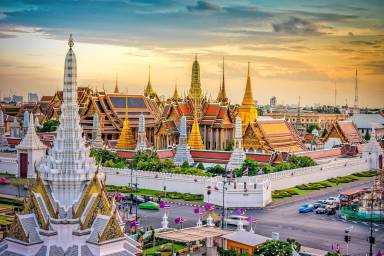

Do the old city in the morning. The Grand Palace opens at 08:30 and the difference between arriving at 08:40 and arriving at 11:00 is the difference between a walk and a scrum, in about eight degrees more heat.
Ayutthaya, and a fight at Rajadamnern
Ayutthaya is the standard Bangkok day trip and it earns it. For four hundred years it was the capital of Siam and one of the largest cities in the world, until a Burmese army burned it in 1767 and the court moved downriver to what became Bangkok. What is left is a flat plain of brick prangs and headless Buddhas about 1.5 hours north — genuine ruins, not restorations, and quiet enough in the early morning that you can hear the birds in them.
Go early. The site is unshaded and by noon in March or April it is genuinely punishing. A guided day trip solves the two hard parts: the transport, and the fact that the temples are spread over several kilometres and make no sense without someone explaining what happened here. Most trips return to Bangkok mid-to-late afternoon.
Evening: Muay Thai at Rajadamnern, which is the older of the two main stadiums and the one that feels least like a tourist show. The undercards are boys fighting for real money in front of a betting crowd, and the crowd is half the event. Fights typically run from about 6pm through the evening; the good ones are later on the card, so do not feel obliged to sit through all of it. This is a full day stacked on top of a full day — if you arrived late on day one, drop the stadium.


Take more water than you think and a hat with a brim. There is almost no shade at Wat Chaiwatthanaram or Wat Mahathat, and the tree with the Buddha head in its roots — the photograph everyone takes — is in full sun.
A slower Bangkok day: markets, a cooking class, and the city from 314 metres
Day three is deliberately lighter, and this is where this itinerary parts company with most seven-day plans. You have had two heavy days and you fly north tomorrow. A morning cooking class is the right shape for it: you start in a wet market being shown the difference between three things that all look like basil, then cook four dishes you will actually make again at home. It is also the single best-value few hours in Bangkok for understanding the food you have been eating on the street.
Spend the afternoon on whatever you have been walking past. Chatuchak, if it is a weekend — 15,000 stalls, and weekends only, so it either fits your dates or it does not. Jim Thompson's house if you want an hour of quiet. The Chao Phraya express boat up and down the river for the price of a coffee. Then take the Mahanakhon SkyWalk at sunset: it is the pixelated tower you have been seeing on the skyline, and the top floor has a glass floor 314 metres up and a view that finally makes the scale of Bangkok legible.
If you would rather have the floating markets than a slow day, Damnoen Saduak and the Maeklong railway market — where the awnings fold back as a train runs through the stalls — are a 7 to 8 hour trip and would replace everything above. It is a good day out, but it is a 5am start and a third consecutive early morning, and I would not do it before a travel day.


Book the SkyWalk for about 45 minutes before sunset. You want the city in daylight, the sunset itself and the lights coming on, and one ticket covers all three if you time the entry rather than turning up at dusk.
North to Chiang Mai: the old city, and the mountain above it
Take a morning flight. It is about 1 hour 15 minutes, the airport is fifteen minutes from the old city at the other end, and you can realistically be checked in and eating khao soi by 1pm. Khao soi is the thing to eat here and it exists nowhere else in Thailand in this form: northern curry noodles, coconut, crisp noodles on top, a wedge of lime and pickled mustard greens on the side.
Chiang Mai's old city is a square, about 1.5 km on each side, with the moat and stretches of the brick wall still standing. That geometry is the reason the city is pleasant to walk when Bangkok is not — everything of interest is inside or just outside a square you can cross on foot in twenty minutes. A guided walk through Wat Chedi Luang, Wat Phra Singh and the smaller wooden temples between them is a good first afternoon: enough context that the rest of your stay makes sense, and short enough that you are not on your feet in the heat all day.
Evening options split. Khan toke is the traditional northern dinner — low tables, a shared tray, Lanna dance — and it is unashamedly a show, but a well-made one. The alternative is simply the night bazaar and a plate of something on Chang Klan Road, which costs nothing and takes as long as you want.
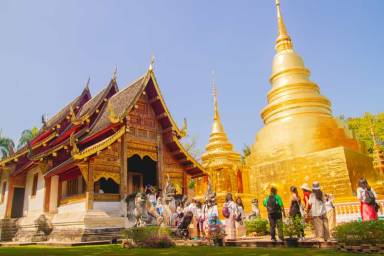

Fly out of Don Mueang rather than Suvarnabhumi if the price difference is meaningful, but add 30 minutes to your transfer time — it is the older airport, further out, and the traffic to it is worse.
Elephants in the morning, Doi Suthep in the afternoon
Chiang Mai is the centre of Thailand's elephant tourism and therefore of its elephant problem. The rule that keeps you on the right side of it is blunt: if a place offers riding, do not go, no matter what it calls itself. An elephant that is safe to sit on has been made safe to sit on. What a proper sanctuary offers instead is a morning of preparing food, feeding a herd at close range and watching them behave like elephants, which is more interesting than sitting on one for twenty minutes.
A half-day feeding programme gets you back to town by early afternoon, which leaves Doi Suthep. The temple sits 15 km up the mountain above the city, up a road of switchbacks, and the last stretch is a 300-step staircase flanked by naga serpents. The gold chedi at the top is the north's most important pilgrimage site, and the terrace looks straight back down over Chiang Mai. Going up in the late afternoon means cooler air and the city lighting up as you come back down. Wat Pha Lat, halfway up, is the one most people miss: a small forest temple beside a stream with none of the crowd.
This is two things in one day and it is honestly a little tight — you are back from the sanctuary around 1pm and heading up the mountain by 3pm. If you would rather do one thing well, keep the sanctuary and see Doi Suthep on the morning of day six before your flight, which works if that flight is after midday.


The red trucks — songthaew — are the local shared taxi and the standard way up Doi Suthep. Agree the fare before you get in, and agree whether it includes the wait and the ride back down, which is where the disagreement usually happens.
South to the Andaman: karst, mangrove and a first look at Railay
The direct Chiang Mai to Krabi flight takes about 2 hours, but the schedule is thin — often one or two a day — so this flight is the one to book first, before hotels. If the timing is wrong, the connection via Bangkok adds around three hours. Either way, aim to land by early afternoon rather than at dusk; arriving in Ao Nang in the dark wastes half of a two-night stay.
What changes when you land is the geology. The Andaman coast is drowned limestone: cliffs coming vertically out of the water, caves at sea level, and Railay, a peninsula cut off from the mainland by cliffs so it has no road at all and is reached only by longtail boat from Ao Nang, about fifteen minutes. Do not plan a big boat day today. A short paddle instead — Ao Thalane's mangrove canyons, where the water runs between cliff walls and the macaques come down to the shoreline — is about the right size for an afternoon that started at an airport.
Get dinner on the Ao Nang strip and look at tomorrow's sea state. Andaman weather changes fast, and boat operators make the call in the morning.


Stay in Ao Nang rather than Krabi Town for a two-night stop. Krabi Town is where people live and where the cheap food is, but every boat leaves from Ao Nang or Nopparat Thara, and the 25-minute transfer at 7am gets old fast.
Four islands, and going home
The four islands trip — Poda, Chicken Island, Tup and Phra Nang Cave beach — is the classic Krabi day and it deserves the reputation. The Tup-to-Mor sandbar surfaces at low tide and you can walk between two islands on it; Phra Nang beach sits under the Railay cliffs and has a cave shrine full of carved wooden phalluses left by fishermen asking for a safe return. The longtail version is slower and louder and better; the speedboat version fits more in and feels like a commute.
Timing this against your flight home is the only real decision. A full-day trip runs about 7 hours and gets you back mid-afternoon, which is fine for an evening departure and not fine for anything earlier. If your flight is late afternoon, take the half-day afternoon version instead, or skip the boat entirely and spend the morning on Railay East and Railay West on the public longtail, which costs almost nothing and you can leave whenever you need to.
And if the sea is up and the trip is cancelled, that is normal here rather than bad luck. Emerald Pool and the hot spring waterfall inland run whatever the sea is doing.
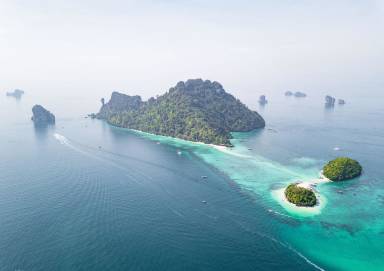
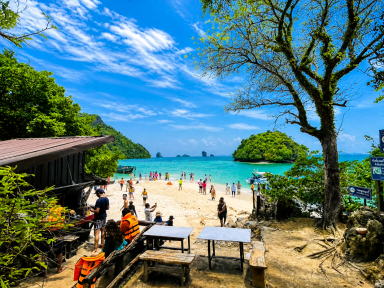
Do not book a boat trip on the same day as a flight out unless you have at least five hours of slack. Longtails come back on the tide, not the timetable, and the return is routinely 45 minutes later than advertised.
Planning this trip
Two monsoons, two coasts — the thing most itineraries get wrong
Thailand does not have one rainy season. The Andaman coast (Phuket, Krabi, Phi Phi) is wettest roughly May to October, when the southwest monsoon pushes swell onto those beaches and boat trips get cancelled at short notice. The Gulf coast (Koh Samui, Koh Phangan, Koh Tao) runs on a different clock and takes its heaviest rain roughly October to December, exactly when the Andaman side is drying out and coming good. Published itineraries routinely say "avoid Thailand in the rainy season" as if the country had one. It does not, and the two coasts are only about 200 km apart. The practical consequence for this route: it ends on the Andaman side, so it is at its best from November to April. If you are locked into travelling in November or early December and want beach time, you have the two coasts the right way round already. If you are travelling in June, July or August, either accept that a share of your island days will be weathered out, or swap the southern leg for the Gulf islands, which are usually fine then.
When to go, and the two dates to plan around
November to February is the best stretch of the year almost everywhere in Thailand: dry, and cool enough in the north that Chiang Mai mornings genuinely need a jacket. March to May is the hot season and April is brutal — high 30s and humid in Bangkok, with air quality in Chiang Mai often poor from agricultural burning in March. Two dates matter. Songkran, the Thai new year, falls around 13-15 April and turns whole streets into a nationwide water fight. It is one of the best things that happens in Thailand if you want to be in it, and close to impossible to travel through if you do not: soaked bags, packed transport, some businesses shut for days. Decide which of those two people you are before you book April flights. Loi Krathong, usually November, is the other one worth aiming at, and Chiang Mai is the place to see it.
Bangkok to Chiang Mai: fly, unless the train is the point
The flight is about 1 hour 15 minutes and is often one of the cheapest flights in the region, from Don Mueang or Suvarnabhumi. The overnight sleeper train is a real experience — second-class air-conditioned berths, curtains, a proper Thai railway breakfast — but be honest with yourself about the arithmetic: it is roughly 12 to 13 hours, it is frequently late, and on a trip of this length it costs you a working day at each end for a saving of maybe forty dollars. Take the train if riding it is one of the things you came to do. Otherwise fly, book it as soon as your dates are fixed, and spend the day you saved in the north.
Getting around Bangkok without losing half a day to traffic
Bangkok traffic is as bad as its reputation, and a 6 km taxi ride at 5pm can take fifty minutes. The BTS Skytrain and the MRT are the fix — air-conditioned, cheap, and immune to the jam beneath them. Between them they cover Sukhumvit, Silom, Siam, Chatuchak and the river interchange at Saphan Taksin, where the Chao Phraya express boats connect to Wat Pho, Wat Arun and the Grand Palace. Use Grab for anything the rail network misses; it is the local taxi app and it settles the fare in advance, which removes the meter argument entirely. Plan your Bangkok days around one geographic cluster each so you are not crossing the city twice a day: the old city and the river on one day, Sukhumvit and Silom on another.
Elephants: how to tell a sanctuary from a show
This is the one ethical decision on a Thailand itinerary that is genuinely yours to get right. An elephant that is safe to ride has been through a breaking process to make it so; the riding, the painting and the circus tricks all sit downstream of the same training. The clean test is simple: if riding is on the menu at all, walk away, whatever the place calls itself. What remains is still a good day out — feeding, preparing food, walking with a herd, and at some places bathing them in the river, though even bathing is now questioned by the stricter camps because it puts tourists in constant physical contact. The operators we list in Chiang Mai and Krabi are feeding-and-observation programmes without riding. Book them directly rather than through a hotel desk, which is where the commission pressure to send you somewhere else comes from.
What to book ahead, and what to leave open
Book in this order: international flights, then the internal flights (Bangkok-Chiang Mai and the leg south), then hotels, then day tours. From November to February the good small-group tours — cooking classes, the sanctuaries with capped numbers, the catamarans — sell out days ahead, and the first ones to go are the ones worth doing. Leave one evening in each city with nothing in it. Thailand is hot, days start early, and an itinerary with no gap in it is an itinerary you will start resenting on day four. One practical booking note: island day trips are weather-dependent and a cancelled boat is normal, not a disaster. Keep a spare afternoon in the south rather than a spare hour.
Frequently Asked Questions
Is 7 days enough for Thailand?
It is enough for three places done properly: Bangkok, one northern city and one coast. It is not enough for Bangkok plus the north plus the Andaman plus the Gulf islands, which is what a lot of seven-day itineraries claim. Every extra stop on a week-long trip costs you a travel morning and an afternoon of settling in, so the fourth stop usually removes more than it adds. If you also want Koh Samui or Koh Phangan, cut Chiang Mai rather than squeezing both in.
Should I take the overnight train to Chiang Mai instead of flying?
Only if riding the train is one of the things you want from the trip. It is a genuinely good experience — second-class air-conditioned sleeper berths, curtains, breakfast served at your seat — but it runs 12 to 13 hours, it is often late, and on a seven-day trip it costs you a usable day to save a fairly small amount of money. The flight is about 1 hour 15 minutes.
Krabi or Phuket for the beach part of a 7-day trip?
Krabi, for this route. It is quieter, the limestone scenery is the reason people photograph the Andaman coast, and Railay is reachable only by boat, which keeps it from feeling like a resort strip. Phuket is bigger, better connected and has the nightlife and the old town, and it is the better choice if you want more options and more infrastructure. Do not try to do both in two nights — they are 2 to 3 hours apart and the transfer eats a day.
What is the best month for this itinerary?
November to February. It is dry on both coasts, Bangkok is bearable, and the north is cool in the mornings. This route finishes on the Andaman coast, which is wettest May to October, so a June or July trip should either accept cancelled boat days or swap the southern leg for the Gulf islands, which are usually good then. April is the hot season peak and includes Songkran.
How much does a 7-day Thailand trip cost, excluding international flights?
The two internal flights are the biggest fixed cost and both are usually modest if booked in advance. Beyond that, Thailand flexes enormously: mid-range hotels, a couple of guided day trips and eating a mix of street food and restaurants is a comfortable middle. Budget separately for the day trips, which are where the value is on a short trip, and note that ATMs charge a fixed foreign-card fee of around 220 baht per withdrawal, so take out larger amounts less often.
Do I need to book tours in advance or can I arrange them when I arrive?
From November to February, book the ones with capped numbers ahead — cooking classes, elephant sanctuaries, small-group and catamaran boat trips. Those fill days out and the good ones go first. Big-boat island trips and market day trips can usually be arranged a day ahead. Book the internal flights before anything else, particularly Chiang Mai to Krabi, which has only one or two departures a day.
Is Ayutthaya better than Kanchanaburi as a Bangkok day trip?
For a seven-day trip, yes. Ayutthaya is about 1.5 hours each way and a 7-hour day; Kanchanaburi, for the Death Railway and Hellfire Pass, is a 12 to 14 hour day and is the more affecting of the two but leaves you with nothing left that evening. Take Ayutthaya on a week, and save Kanchanaburi for a trip where Bangkok gets four days.
What should I wear for the Grand Palace?
Shoulders and knees covered, for men and women, in non-sheer fabric. It is enforced at the gate. They rent cover-ups there but the queue in high season is long enough to be annoying. Loose long trousers or a long skirt and a light shirt with sleeves is comfortable in the heat and gets you into every temple on this itinerary without a second thought.
Book the guided parts of this trip
Every tour above runs with a verified local operator.
Browse all Thailand tours