8 Days in Thailand: Bangkok, Chiang Mai and Three Days on the Krabi Coast
Eight days is the seven-day route with a third night in Krabi, and that is the right place to spend it. Three nights Bangkok, two Chiang Mai, three Krabi. The extra day turns the islands from one rushed longtail trip into a proper day out plus a slow one — the most common regret on a seven-day trip.
8 days in Thailand at a glance
| Day | Based in | What you do | Getting there |
|---|---|---|---|
| 1 | Bangkok | Arrival, the old city, and Chinatown after dark | Suvarnabhumi to central Bangkok: Airport Rail Link about 30 minutes to Phaya Thai, or 40-60 minutes by Grab depending on traffic |
| 2 | Bangkok | Ayutthaya's ruins, and the river after dark | Bangkok to Ayutthaya about 1 |
| 3 | Bangkok | Markets, a wok, and the skyline at sunset | — |
| 4 | Chiang Mai | North: the walled city, and khao soi | Bangkok to Chiang Mai by air, about 1 hour 15 minutes |
| 5 | Chiang Mai | A sanctuary morning, and the temple on the mountain | — |
| 6 | Krabi | South to Ao Nang: mangroves and the first sight of the karst | Chiang Mai to Krabi direct, about 2 hours by air |
| 7 | Krabi | Four islands, a sandbar and Phra Nang | — |
| 8 | Krabi | Phi Phi, or the inland option, then home | Krabi to Bangkok by air, about 1 hour 25 minutes for an onward international connection |
Eight days is seven days with the beach fixed. The seven-day version of this route works, but it gives Krabi two days, and one of those is a travel day and the other has your flight home on the end of it — which means a single usable boat day and no margin if the sea is up. The eighth day goes entirely to the south, and it is the highest-value extra day on the whole ladder.
The structure is otherwise unchanged: three days in Bangkok for the old city, one big day trip and a slower day; two days in Chiang Mai for the walled old city, an elephant sanctuary and the mountain temple above the town; then three days on the Andaman coast with two internal flights and no overnight travel. Three coastal days means you can lose one to weather and still come home having done the islands.
Before you fix dates, the timing rule that decides whether the last three days work at all: Thailand's two coasts have different rainy seasons. The Andaman side, where this route ends, is wettest from May to October. The Gulf islands are wettest from October to December. Most itineraries treat rainy season as one national event and get this exactly backwards for half the country.
Travellers who want the standard Bangkok-north-coast route but with enough slack in the south that a cancelled boat day does not cost them the beach.
Arrival, the old city, and Chinatown after dark
Land, drop bags, and go straight to Rattanakosin, the old royal island. Doing the Grand Palace, Wat Phra Kaew, Wat Pho and Wat Arun as a single morning is not about efficiency for its own sake — they are within a short walk and a two-minute cross-river ferry of each other, and splitting them across days means crossing Bangkok twice for no reason. Wat Phra Kaew holds the Emerald Buddha, a 66 cm jade figure whose seasonal robes are changed by the king. Wat Pho holds the reclining Buddha, 46 metres of it, and the country's founding school of Thai massage, which still takes walk-ins.
The heat wins by about 2pm on any day of the year. Go back to the hotel, sleep, and treat the evening as a separate outing. Yaowarat, the Chinatown of Bangkok, wakes at about 6pm when the shutters roll up and the woks come out onto the pavement; a tuk-tuk food circuit through it is the fastest way to understand what Bangkok street food actually is, as opposed to what is served to tourists on Khao San Road.
If your flight lands in the evening instead, sleep it off and shift the old city to the morning of day two, with Ayutthaya moving to day three. Nothing later in the itinerary breaks.
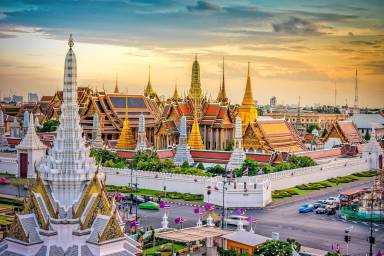

Do the old city in the morning. The Grand Palace opens at 08:30 and the difference between arriving at 08:40 and arriving at 11:00 is the difference between a walk and a scrum, in about eight degrees more heat.
Ayutthaya's ruins, and the river after dark
Ayutthaya was the capital of Siam for over four hundred years and, at its height, one of the largest cities on earth, trading with the Dutch, the Portuguese, the Persians and the Japanese. In 1767 a Burmese army sacked and burned it, and the court moved downriver to found Bangkok. The ruins sit about 1.5 hours north: brick prangs, rows of headless Buddhas, and the sandstone Buddha head grown into the roots of a bodhi tree at Wat Mahathat.
Start early. The site is flat, unshaded and spread over several kilometres, so it is both hot and hard to navigate on your own; a guided trip solves both and adds the thing photographs cannot, which is what happened here and why the Buddhas have no heads. The versions that include the river cruise back down the Chao Phraya are slower and considerably more pleasant than sitting in a minibus in Bangkok's evening traffic.
Get back mid-afternoon, rest, and take the evening on the water. The dinner cruises are unashamedly touristy but the sightline is the real thing: Wat Arun lit up from the river is the best view of it there is, and the buffet is beside the point.

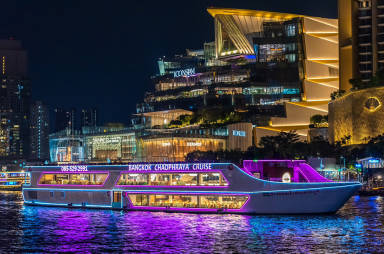
If you want Ayutthaya without the tour, the ordinary train from Hua Lamphong costs almost nothing and takes about 90 minutes — but you will then need to hire a tuk-tuk by the hour at the other end, and the ruins are too spread out to walk between in the heat.
Markets, a wok, and the skyline at sunset
Two heavy days is enough, so day three earns its keep differently. A cooking class that starts in a wet market is the best few hours in Bangkok for making sense of everything you have eaten so far: you get shown why there are three kinds of basil and what each one is for, then cook four dishes badly enough to learn something. Most classes run about three hours and finish with lunch, which is what you cooked.
The afternoon is for whatever your Bangkok is. Chatuchak weekend market if your dates land on a Saturday or Sunday — 15,000 stalls, weekends only, and genuinely overwhelming. The Chao Phraya express boat up and down the river if you would rather sit down. Jim Thompson's house, a teak compound built by the American who rebuilt the Thai silk industry and then vanished in the Malaysian jungle in 1967, if you want an hour of shade and a story.
End on the Mahanakhon SkyWalk. The pixelated tower with the chunks missing has a glass floor 314 metres up, and going at sunset gets you the city in daylight, the sunset, and the lights coming on for one ticket.
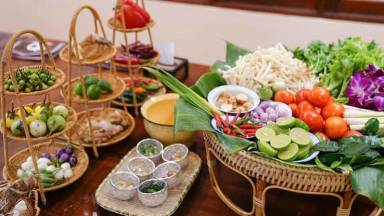

If you want the floating markets, this is the day for them — Damnoen Saduak plus the Maeklong railway market, where the stall awnings fold back as a train passes through, is a 7 to 8 hour trip. It is a 5am start, so it replaces this day rather than fitting into it.
North: the walled city, and khao soi
The flight is about 1 hour 15 minutes and the airport at the other end is fifteen minutes from the old city, so a morning departure has you eating lunch in Chiang Mai. Make that lunch khao soi — northern curry noodles under a nest of crisp fried noodles, with lime and pickled greens on the side. It is a Lanna dish, not a Thai one, and it barely exists south of here.
Chiang Mai's old city is a walled square about 1.5 km on a side, with the moat still running around it and fragments of the brick wall at each corner and gate. Everything inside is walkable, which after Bangkok feels like a different country. A guided walk gives you Wat Chedi Luang — a 600-year-old chedi partly collapsed by an earthquake in 1545 and left that way — plus Wat Phra Singh and the smaller teak temples in between, with enough Lanna history that the rest of your stay makes sense.
For the evening, khan toke is the northern set dinner: low tables, a shared round tray, Lanna dance. It is a show and it does not pretend otherwise. If that is not for you, the Sunday walking street on Ratchadamnoen is one of the best markets in the country and costs nothing at all.
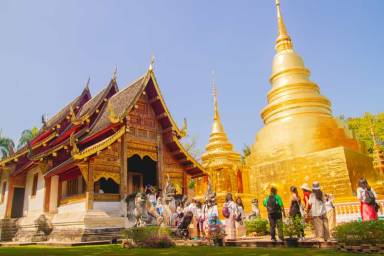

Book accommodation inside the moat or immediately east of it towards the river. Anywhere further out and you are dependent on red trucks for every meal, which is cheap but adds friction to a stay this short.
A sanctuary morning, and the temple on the mountain
Elephant tourism is the ethical decision that Chiang Mai forces on you, and the test is simple: if riding is offered at all, go somewhere else, regardless of what the place calls itself. Elephants that carry people have been through a breaking process to make that possible, and the painting and trick shows come from the same training. A feeding-and-observation programme with no riding gives you a morning of preparing food, feeding a herd within arm's reach, and watching them interact — which is more interesting than twenty minutes on a bench on an animal's spine.
A half-day programme puts you back in town by early afternoon. That leaves Doi Suthep, 15 km up the mountain on a road of switchbacks, with a 300-step naga staircase at the end of it. The gold chedi at the top is the most important pilgrimage site in northern Thailand, and the terrace looks straight down over the city. Late afternoon is the right time: cooler, and you come back down as the lights go on. Wat Pha Lat, the forest temple halfway up beside a stream, is the stop almost everyone skips and the quietest thing on this itinerary.
Stacking both into one day is a little tight — you are back around 1pm and heading uphill by 3pm. If that sounds like too much, keep the sanctuary and take Doi Suthep on the morning of day six, provided your southbound flight is after midday.


Agree the songthaew fare up the mountain before you get in, and agree explicitly whether it covers the wait and the ride back down. That second half is where the argument at the top usually starts.
South to Ao Nang: mangroves and the first sight of the karst
Chiang Mai to Krabi direct is about 2 hours, but there are often only one or two departures a day, which makes this the flight to book before you book anything else. If it does not work, the connection through Bangkok is roughly five hours door to door. Land by early afternoon if you can — arriving at Ao Nang after dark on the first of three coastal days is a waste of one of them.
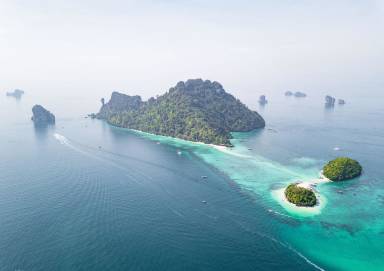
The Andaman coast is drowned limestone, and the change from the north is immediate: cliffs rising vertically from green water, sea caves at the waterline, and Railay, a peninsula whose cliffs cut it off from the mainland entirely so that it has no road and is reached only by longtail from Ao Nang, about fifteen minutes across.
Do not put a full boat day on an arrival day. Ao Thalane instead — a half-day kayak through mangrove channels between limestone walls, with macaques on the shoreline and almost no engine noise. It is the calmest thing you will do on this coast and it makes a good counterweight to the two island days coming.


Base yourself in Ao Nang rather than Krabi Town. Krabi Town is cheaper and more ordinary in a good way, but every boat departs from Ao Nang or Nopparat Thara, and doing that transfer at 7am on both island days is a poor trade.
Four islands, a sandbar and Phra Nang
The four islands trip is the Krabi day. Poda, Chicken Island, Tup and Phra Nang Cave beach, with the Tup-to-Mor sandbar surfacing at low tide so you can walk from one island to another through ankle-deep water. Phra Nang beach sits directly under the Railay cliffs and holds a cave shrine stacked with carved wooden phalluses, left by fishermen asking the spirit of the cave for a safe return.
Take the longtail version rather than the speedboat if you have the choice. It is slower, noisier and better: longtails go where speedboats cannot, they stop for longer, and the pace suits a coast whose whole appeal is that you are looking at cliffs. The speedboat versions fit in an extra island and turn the day into a schedule.
With three days here you also have room for the alternative: a sunset cruise with a plankton swim, where the bioluminescence lights up around you in the dark. If the four islands trip is running today and the forecast for tomorrow is poor, take the boat today and keep the flexible thing for tomorrow. Sea state, not the itinerary, decides the order.

Reef-safe sunscreen and a rash vest. The Andaman sun at midday on open water burns through ordinary SPF in about an hour, and several marine parks now check what you are carrying.
Phi Phi, or the inland option, then home
The last day is the one the eighth day bought you, and how you spend it depends on your flight and on the sea. If you have a full day and the water is flat, Phi Phi is the big one: Maya Bay, closed for years to let the reef recover and now reopened with a cap on numbers and no boats anchoring in the bay itself, plus the limestone amphitheatre around it. It is a long day, typically 8 to 9 hours, and it is busy — go on the earliest departure you can, because the difference between the 7am boat and the 9am boat at Maya Bay is enormous.
If your flight is earlier, or the wind is up, go inland instead. Emerald Pool is a spring-fed pool in the Khao Phra Bang Khram forest, the hot spring waterfall nearby runs at bath temperature over smooth rock, and the Tiger Cave Temple has 1,260 steps to a summit chedi with the whole karst plain laid out below it. That day runs whatever the sea is doing, which is exactly why it belongs on a departure day.
Whatever you choose, do not put a boat trip and a flight on the same day without five hours of slack between them.


The 1,260 steps at Tiger Cave Temple are steep, uneven and fully exposed. Go at 7am or not at all — people attempt it at midday every day and a meaningful number turn back partway.
Planning this trip
Two monsoons, two coasts — the thing most itineraries get wrong
Thailand does not have one rainy season. The Andaman coast (Phuket, Krabi, Phi Phi) is wettest roughly May to October, when the southwest monsoon pushes swell onto those beaches and boat trips get cancelled at short notice. The Gulf coast (Koh Samui, Koh Phangan, Koh Tao) runs on a different clock and takes its heaviest rain roughly October to December, exactly when the Andaman side is drying out and coming good. Published itineraries routinely say "avoid Thailand in the rainy season" as if the country had one. It does not, and the two coasts are only about 200 km apart. The practical consequence for this route: it ends on the Andaman side, so it is at its best from November to April. If you are locked into travelling in November or early December and want beach time, you have the two coasts the right way round already. If you are travelling in June, July or August, either accept that a share of your island days will be weathered out, or swap the southern leg for the Gulf islands, which are usually fine then.
When to go, and the two dates to plan around
November to February is the best stretch of the year almost everywhere in Thailand: dry, and cool enough in the north that Chiang Mai mornings genuinely need a jacket. March to May is the hot season and April is brutal — high 30s and humid in Bangkok, with air quality in Chiang Mai often poor from agricultural burning in March. Two dates matter. Songkran, the Thai new year, falls around 13-15 April and turns whole streets into a nationwide water fight. It is one of the best things that happens in Thailand if you want to be in it, and close to impossible to travel through if you do not: soaked bags, packed transport, some businesses shut for days. Decide which of those two people you are before you book April flights. Loi Krathong, usually November, is the other one worth aiming at, and Chiang Mai is the place to see it.
Bangkok to Chiang Mai: fly, unless the train is the point
The flight is about 1 hour 15 minutes and is often one of the cheapest flights in the region, from Don Mueang or Suvarnabhumi. The overnight sleeper train is a real experience — second-class air-conditioned berths, curtains, a proper Thai railway breakfast — but be honest with yourself about the arithmetic: it is roughly 12 to 13 hours, it is frequently late, and on a trip of this length it costs you a working day at each end for a saving of maybe forty dollars. Take the train if riding it is one of the things you came to do. Otherwise fly, book it as soon as your dates are fixed, and spend the day you saved in the north.
Getting south, and the flights that actually exist
Bangkok to Krabi is about 1 hour 25 minutes and runs many times a day. Chiang Mai to Krabi is flown direct in around 2 hours on the budget carriers, but the schedule is thin — often one or two departures a day — so fix that flight before you fix your hotels, not after. If the direct is sold out or badly timed, the connection through Bangkok adds about three hours door to door. Krabi to Phuket is about 2 to 3 hours by road, or by road-and-ferry via the islands; the short flight exists but with the airport transfers at both ends it rarely saves time. Whatever you book, do not schedule an island boat trip on the same day as a flight out. Boats come back late, and they come back later when the sea is up.
Elephants: how to tell a sanctuary from a show
This is the one ethical decision on a Thailand itinerary that is genuinely yours to get right. An elephant that is safe to ride has been through a breaking process to make it so; the riding, the painting and the circus tricks all sit downstream of the same training. The clean test is simple: if riding is on the menu at all, walk away, whatever the place calls itself. What remains is still a good day out — feeding, preparing food, walking with a herd, and at some places bathing them in the river, though even bathing is now questioned by the stricter camps because it puts tourists in constant physical contact. The operators we list in Chiang Mai and Krabi are feeding-and-observation programmes without riding. Book them directly rather than through a hotel desk, which is where the commission pressure to send you somewhere else comes from.
What to book ahead, and what to leave open
Book in this order: international flights, then the internal flights (Bangkok-Chiang Mai and the leg south), then hotels, then day tours. From November to February the good small-group tours — cooking classes, the sanctuaries with capped numbers, the catamarans — sell out days ahead, and the first ones to go are the ones worth doing. Leave one evening in each city with nothing in it. Thailand is hot, days start early, and an itinerary with no gap in it is an itinerary you will start resenting on day four. One practical booking note: island day trips are weather-dependent and a cancelled boat is normal, not a disaster. Keep a spare afternoon in the south rather than a spare hour.
Frequently Asked Questions
Is the eighth day better spent in Krabi or Chiang Mai?
Krabi, and it is not close. On a seven-day version of this route the coast gets one usable day, with no margin for a cancelled boat. Adding the day in the south turns that into two island days plus an arrival afternoon, which is the difference between seeing the Andaman coast and passing through it. Chiang Mai's third day is worth having too, but it is the ninth day, not the eighth.
Can I add Koh Samui or Koh Phangan to an 8-day trip?
Not without cutting something. Samui is on the Gulf coast, which means a separate flight and a different weather season from Krabi — it is wettest October to December, when the Andaman side is at its best. Adding it costs a travel day each way. If the Gulf islands are the priority, drop Krabi and fly Chiang Mai to Samui via Bangkok instead of running both coasts.
How far in advance should I book the Chiang Mai to Krabi flight?
As early as your dates are fixed, and before you book hotels. There are often only one or two direct departures a day and they sell out in high season, at which point the alternative is a connection through Bangkok that costs you roughly three extra hours. Everything else on this itinerary has daily alternatives; this leg does not.
Is Maya Bay open, and is Phi Phi worth a day?
Maya Bay reopened after a multi-year closure to let the coral recover, with visitor caps, restricted hours and no boats anchoring inside the bay — you land at a jetty on the other side and walk across. It is worth a day if you take the earliest boat available. On a mid-morning departure you arrive with everyone else, and the bay at capacity is a different experience from the bay at 8am.
What happens if my boat trip is cancelled for weather?
It is common on the Andaman coast, especially outside the November to April window, and operators generally reschedule or refund rather than sail. This is the main argument for three coastal days rather than two. Keep the inland options — Emerald Pool, the hot spring waterfall, Tiger Cave Temple — as your fallback, since none of them care about sea state.
Is Chiang Mai worth two days, or should I go straight south?
Two days is enough for the old city, an elephant sanctuary and Doi Suthep, which is the core of it. Skipping the north entirely and giving five days to the coast is a legitimate trip, but it makes for a narrower one: Chiang Mai is where the food, the temples and the mountains are genuinely different from the rest of the country, not just warmer.
When is the best time of year for this 8-day route?
November to February. The route ends on the Andaman coast, which is wettest May to October, so those months mean a real chance of losing boat days. March to May is the hot season, April worst of all, and Chiang Mai has poor air quality in March from agricultural burning. If April is your only option, plan around Songkran on roughly 13-15 April — either be in it deliberately or be somewhere you are happy to stay put.
Do I need a visa for Thailand?
Many nationalities receive a visa exemption stamp on arrival for a stay well beyond eight days, but the length and the list change, so check your own passport's current entitlement with the Thai embassy or a government source close to your travel date rather than relying on a travel article. You will also usually be asked for proof of onward travel at check-in.
Book the guided parts of this trip
Every tour above runs with a verified local operator.
Browse all Thailand tours