3 Days in Thailand: A Bangkok Itinerary That Doesn't Pretend
Three days in Thailand is Bangkok and one day trip. Give two days to the city — the Grand Palace and Wat Pho, then the river and a night market — and one to Ayutthaya, the capital the Burmese burned in 1767, about 90 minutes north. Adding Chiang Mai or an island at this length spends half your trip in transit.
3 days in Thailand at a glance
| Day | Based in | What you do | Getting there |
|---|---|---|---|
| 1 | Bangkok | The old royal city, then Chinatown after dark | Suvarnabhumi airport to central Bangkok: 45–60 minutes by taxi, or about 30 minutes on the Airport Rail Link to Phaya Thai and then the BTS |
| 2 | Bangkok | Ayutthaya — the capital the Burmese burned | Bangkok to Ayutthaya: about 1 |
| 3 | Bangkok | Canals in the morning, a cooking class, and out | Central Bangkok back to Suvarnabhumi: allow 60–90 minutes by road at peak, or 30 minutes on the Airport Rail Link from Phaya Thai |
Three days in Thailand means Bangkok. That is the whole honest answer. You will read itineraries that squeeze in Chiang Mai or a night on Phi Phi, and they work on paper because a domestic flight is only an hour. What they do not tell you is that each internal move costs you roughly half a day once you count check-out, airport transfer, security, the flight, and getting into town at the other end. Do that twice in 72 hours and you have spent a third of your trip in transit corridors.
So this route stays put. Bangkok as a base for three nights, one full day out to Ayutthaya, and the rest of the time spent going deep on a city that rewards it — a 200-year-old royal quarter, a canal network that still functions, one of the best street-food cultures on the planet, and a food scene at every price point from a 60-baht bowl of noodles to a Michelin table. Bangkok is not a stopover city that you tolerate before the beach. It is the reason a lot of people come back.
Three days is also enough time to make one real decision about what kind of traveller you are. The city rewards early mornings at the temples and late nights in Chinatown, and it punishes the middle of the day when the heat sits on you. Build around that and three days feels generous. Ignore it and you will spend the trip queuing in full sun and wondering why everyone raves about this place.
A long weekend, a stopover on a longer Asia trip, or a first visit where you would rather know one city properly than see three badly.
The old royal city, then Chinatown after dark
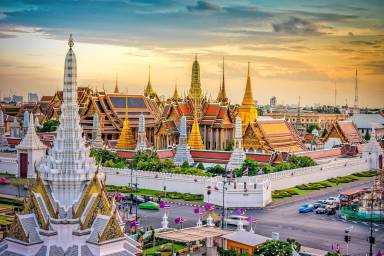
Start at the Grand Palace and go early — gates open at 8:30am and by 11 the courtyards are a crowd in full sun with no shade. Wat Phra Kaew, the Emerald Buddha temple, is inside the same complex and is the single most decorated space in the country. From there it is a ten-minute walk south to Wat Pho, where the 46-metre reclining Buddha lives and where Thailand's traditional massage school still teaches. Getting a massage in the temple grounds after two hours on marble floors is not a tourist gimmick; it is the correct order of operations.
Break for the hottest part of the afternoon. This is the day you are most jet-lagged and the day you are least acclimatised, and pushing through 2pm on day one is how people end up sick on day two. Get an air-conditioned lunch, go back to the hotel, do nothing for two hours.
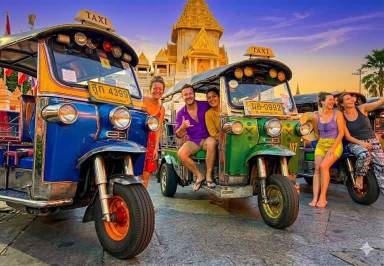
Come back out at dusk for Chinatown. Yaowarat Road only really starts around 6pm, when the shophouse shutters go up and the street kitchens set up on the pavement, and it runs late. A guided tuk-tuk food run is worth it on a first night specifically because the ordering is the hard part — the best stalls have no English menu, no seats, and a queue that knows exactly what it wants.
Wear long trousers or a long skirt and cover your shoulders. The Grand Palace enforces this at the gate and the rental cover-up queue can cost you the early start you got up for.
Ayutthaya — the capital the Burmese burned
Ayutthaya was the Siamese capital for 400 years and, at its height in the 1600s, one of the largest cities in the world — a river island of temples and foreign trading quarters that European visitors compared to Paris. In 1767 a Burmese army sacked it and it was never rebuilt. What is left is a spread-out field of brick prangs, headless Buddhas and one sandstone Buddha head grown into the roots of a fig tree. It is about 1.5 hours north of Bangkok and it is the standard Bangkok day trip for good reason.
Give it the whole day rather than trying to bolt something onto the evening. The site is genuinely large, the ruins are spread across several kilometres, and there is very little shade — this is a day where a guided trip with transport and a lunch stop earns its money over working out songthaews in 34-degree heat. Several versions come back down the Chao Phraya by boat with a stop at Bang Pa-In, the royal summer palace, which is a strange and lovely mix of Thai, Chinese and Italianate buildings.
Back in Bangkok, keep the evening light. You have walked a long way on hot brick.


Take twice the water you think you need and a hat. The ruins have almost no shade and the walk between the main temple groups is longer than the map suggests.
Canals in the morning, a cooking class, and out
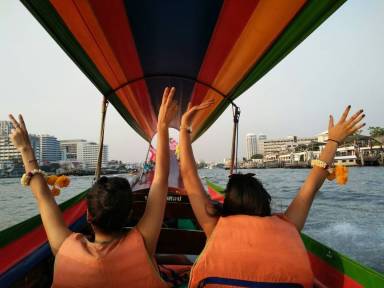
Bangkok was a canal city before it was a road city, and the khlongs on the Thonburi side of the river are still lived on — stilt houses, monitor lizards, temple landings, people doing their laundry two metres from your longtail boat. A short morning canal run gives you a version of the city that the Skytrain map does not admit exists, and it takes two hours rather than swallowing the day.
Then use the afternoon for a cooking class. This is the most useful thing you can do on a last day in Bangkok: most classes start at a wet market, where somebody finally explains the difference between the four kinds of basil and why your green curry at home tastes wrong, and you leave with something you will actually still be doing next year.
A note on the floating markets, since every three-day list puts them here: Damnoen Saduak and the Maeklong railway market are 7 to 9 hours round trip with an early start. They are worth doing, but not on a departure day, and honestly not instead of Ayutthaya on a three-day trip. If markets matter more to you than ruins, swap them for day 2 rather than trying to have both.

Most hotels will hold luggage after checkout without charging. Book a late-afternoon class, leave the bags, and go straight from the class to the airport.
Planning this trip
Two monsoons, two coasts, two different seasons
This is the fact most Thailand itineraries get wrong, and it matters more than anything else on this page. Thailand does not have one rainy season. It has two, on two coasts, and they run at different times. The Andaman coast — Phuket, Krabi, Koh Lanta, Koh Phi Phi — is wettest roughly May to October, when the southwest monsoon pushes straight onto those beaches. The Gulf coast — Koh Samui, Koh Phangan, Koh Tao — is driest through much of that same period and takes its heaviest rain October to December. So a September trip that would be a washout in Krabi can be perfectly good on Samui, and a November trip that is glorious in Krabi can be grey and choppy on Samui. If a blog tells you to avoid Thailand in September, it is thinking about one coast and forgetting the other. Bangkok, Chiang Mai and Pattaya sit outside that split: they get most of their rain between May and October, usually as heavy late-afternoon downpours rather than all-day drizzle, and a wet-season afternoon in Bangkok costs you an hour, not a day.
When to come, and the one week to avoid unless you want it
November to February is the best overall window for this route: dry, cooler, and comfortable for walking around Bangkok's old city or Chiang Mai's moat. It is also the busiest and the most expensive, so book accommodation early. March to May is the hot season and April is genuinely brutal — mid-thirties Celsius with humidity, and sightseeing has to be reorganised around early mornings and late afternoons. Songkran, the Thai new year, falls around 13–15 April and turns the whole country into a multi-day water fight. It is one of the best things you can experience in Thailand if you go looking for it. It is also close to impossible to travel through if you did not plan for it — transport is full, many businesses close, and you will get soaked whether or not you consented. Decide which side of that you are on before you book April dates. One more thing worth knowing: northern Thailand, including Chiang Mai, has a burning season roughly February to early April when agricultural smoke pushes air quality down badly. If you are sensitive to that, weight your days towards Bangkok and the coast in those months.
Getting around Bangkok without losing the day to traffic
Bangkok traffic is as bad as its reputation. A journey that Google Maps calls twenty minutes can take an hour at 5pm. The BTS Skytrain and the MRT underground are the fix — they are air-conditioned, they run above and below the jams, and they cover most of the modern city. Buy a stored-value card or just tap a contactless bank card at the gates. The old city, where the Grand Palace and Wat Pho are, is the one area the trains do not serve well. Use the Chao Phraya Express Boat instead: the orange-flag boat is cheap, frequent, and drops you at Tha Chang for the palace and Tha Tien for Wat Pho, and it is faster than a taxi from Sathorn most of the day. For everything else, use Grab. It is the local ride-hailing app, it prices the trip up front, and it removes the meter negotiation that makes street taxis tiresome. Tuk-tuks are fun for a short hop and a photograph; they are not a sensible way to cross the city, and they are rarely cheaper than a Grab.
Temple dress code — it is actually enforced
The Grand Palace and Wat Phra Kaew turn people away every single day. Shoulders and knees must be covered, for men and women both. No vests, no shorts, no short skirts, no see-through fabric, and shoes come off before you step into the ordination hall. There is a booth near the entrance that will lend or sell you a cover-up, but the queue for it is long and you will have paid for the privilege of being unprepared. Wear long trousers or a maxi skirt and bring a light scarf. Wat Pho and most other temples are more relaxed but the same principle applies, and covering up is simply the polite move. Go early — the Grand Palace opens at 8:30am and the difference between arriving at 8:30 and arriving at 11 is the difference between a manageable crowd and a scrum in full sun. One scam to know about: if someone outside the palace tells you it is closed today for a ceremony and offers to take you somewhere else by tuk-tuk, it is not closed. Walk to the gate and check for yourself.
Pacing — the honest version
Most published Thailand itineraries are over-packed, and the giveaway is when a single day contains a floating market, the Grand Palace and a rooftop bar. In practice a Bangkok day trip out to the markets or Ayutthaya eats seven to nine hours door to door, and you will not want anything demanding afterwards. The working rule for a short trip is one anchor per day plus one light thing in the evening. That is not laziness — it is what the heat does to you. Between roughly 1pm and 3:30pm most of the year, walking around outdoors in Bangkok is unpleasant, and building an indoor block, a boat, a massage or a long lunch into that window is the single easiest upgrade to a Thailand itinerary. If you are choosing between adding a fifth activity and adding a genuinely unhurried evening meal, add the meal.
What to book ahead and what to leave loose
Book in advance: domestic flights (prices climb steadily, they rarely fall), anything on a fixed date such as a cabaret show or a stadium Muay Thai card, small-group day trips in high season, and any elephant sanctuary — the good ones cap numbers and genuinely sell out. Leave loose: street food, markets, massages, temple entry, and most short city walking tours. Thailand's tourism infrastructure is deep and same-day availability is normal outside of the December–January peak. On a trip this short, the thing worth over-booking is the first full day. Jet lag plus an unplanned morning is how people lose a quarter of a four-day trip. Have day one fixed before you land, then let the rest breathe.
Frequently Asked Questions
Can I fit Chiang Mai or an island into 3 days?
Realistically, no. The flight to Chiang Mai is only 1 hour 15, but the door-to-door cost of the move is closer to half a day each way once you count checkout, Don Mueang, and the transfer at the other end. On a 72-hour trip you would be spending a full day of it travelling to get roughly one usable day in the north. Five days is the first length where Chiang Mai makes sense.
Is 3 days enough for Bangkok?
For a first visit, yes — three days covers the royal quarter, one day trip, the canals, and enough eating to understand what the fuss is about. What it does not cover is the modern city: the gallery and cafe scene around Ari and Charoenkrung, Chatuchak market, or the day-off rhythm that makes people move here. That is a second trip.
When is the best time to come?
November to February is dry and cooler and is the best window. March to May is the hot season and April is punishing. May to October brings the rain to Bangkok, usually as a heavy hour in the late afternoon rather than an all-day washout — it is a much more workable season than its reputation suggests, and the city is cheaper and less crowded.
Is Bangkok's rainy season the same as the islands'?
No, and this is the thing to get right. Thailand has two monsoons on two coasts. The Andaman side (Phuket, Krabi) is wettest May to October. The Gulf side (Koh Samui, Koh Phangan) takes its heaviest rain October to December. Bangkok's wet season broadly follows the Andaman pattern, May to October. So 'rainy season in Thailand' is never one answer — it depends entirely which coast you mean.
Do I need to cover up for the temples?
At the Grand Palace and Wat Phra Kaew, yes, and it is enforced at the gate for men and women alike: shoulders and knees covered, no see-through fabric, shoes off inside the halls. Most other temples are more relaxed but expect the same standard. Bringing a light scarf solves it.
How do I get around without wasting hours in traffic?
BTS Skytrain and MRT for the modern city, the Chao Phraya Express Boat for the old city and the riverside temples, and Grab for everything else. Bangkok's traffic is genuinely bad and a taxi at 5pm will take three times as long as the same trip at 10am.
Should I do the floating market instead of Ayutthaya?
You can, but pick one — both are full-day trips of seven hours or more. Ayutthaya is the stronger choice if you want history and space; the Damnoen Saduak and Maeklong railway market run is the better one if you want photographs and market chaos, and it starts very early.
Is three days enough to justify the flight?
If Bangkok is part of a longer Asia trip or a stopover, absolutely. If you are flying long-haul from Europe or North America purely for three days, you will spend two of them adjusting to a six-to-twelve-hour time difference. In that case, stretch to five and add Chiang Mai.
Book the guided parts of this trip
Every tour above runs with a verified local operator.
Browse all Thailand tours