4 Days in Thailand: Bangkok and the Coast at Pattaya
Four days works as two nights in Bangkok and two in Pattaya, chosen for the two-hour transfer rather than the scenery. Pattaya buys you Koh Larn's beaches and the Sanctuary of Truth without a domestic flight. If beaches are the point of the trip, wait for seven days and go to Krabi instead.
4 days in Thailand at a glance
| Day | Based in | What you do | Getting there |
|---|---|---|---|
| 1 | Bangkok | The royal quarter, then Chinatown | Suvarnabhumi to the centre: 45–60 minutes by road, or 30 minutes via the Airport Rail Link to Phaya Thai |
| 2 | Bangkok | Markets on rails and water — or the canals, if you would rather sleep in | Bangkok to the Maeklong and Damnoen Saduak markets: about 1 |
| 3 | Pattaya | South to the coast, a teak temple, and a cabaret | Bangkok to Pattaya: 2–2 |
| 4 | Flight home (or a final Bangkok night) | Koh Larn in the morning, airport in the afternoon | Pattaya to Suvarnabhumi airport: 1 |
Four days is the length where people start trying to get to a beach, and it is also the length where that usually goes wrong. Krabi and Phuket are both around an hour and a half by air from Bangkok, which sounds trivial until you add the transfer to Don Mueang, the check-in, the wait, and the hour from the island airport to wherever you are actually sleeping. Two flights across four days is most of a day gone, and you will have unpacked twice for two nights of sand.
Pattaya is the honest answer instead. It is roughly two hours by road from Bangkok, which means you move once, by car, without an airport in the story — and it sits on the way back to Suvarnabhumi, so the last leg is a straight run to your flight rather than a backtrack. Pattaya is not Krabi and this page is not going to pretend it is: the town itself is loud and the main beach is ordinary. What it has is Koh Larn, a genuinely good island forty minutes offshore with clear water, plus the Sanctuary of Truth, an all-teak carved temple still being built by hand, and the best-produced cabaret shows in the country.
So the shape here is two full Bangkok days, then two coastal days at a distance you can drive. If what you actually want is a limestone-karst, turquoise-water, Railay-beach kind of trip, do not do it in four days. Come for seven and go to Krabi properly.
A short break where you want a city and a swim without spending half of it in airports — and travellers coming from elsewhere in Asia rather than long-haul.
The royal quarter, then Chinatown
With only two Bangkok days you cannot afford a slow start. Take the first morning for the old city: the Grand Palace at opening time, Wat Phra Kaew inside the same walls, then Wat Pho ten minutes south for the reclining Buddha. Wat Arun is directly across the river and is best late in the afternoon when the light hits its porcelain-encrusted prang, so a guided route that saves it for last is doing you a favour rather than padding the itinerary.
Take the middle of the day off. Bangkok between 1pm and 3:30pm is a losing fight with the heat, and the single best structural change you can make to a Thailand itinerary is to stop scheduling walking into that window.
In the evening, go to Chinatown. Yaowarat wakes up around 6pm and the good stalls are the ones with a plastic-stool queue and no English menu — which is exactly why a guided food walk pays for itself on a short trip. You will eat better in three hours than you would working it out alone in three days.
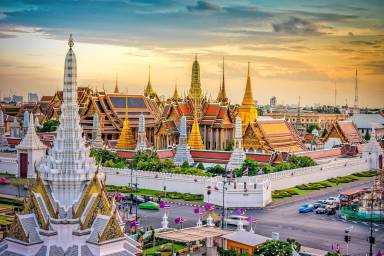

Take the orange-flag Chao Phraya Express Boat to the old city rather than a taxi. It is a few baht, it stops at Tha Chang for the palace, and it does not sit in traffic.
Markets on rails and water — or the canals, if you would rather sleep in
The Maeklong railway market is the one thing in Thailand that looks staged and is not. Stallholders lay their produce along a live railway track and, eight times a day, fold the awnings back as a train grinds through with centimetres to spare, then push everything out again the moment it has passed. It is usually combined with Damnoen Saduak, the floating market, where you take a paddle boat between vendors selling from canoes.
Be clear-eyed about it: this is a 7-to-9-hour day with an early departure, both markets are heavily touristed, and Damnoen Saduak in particular is more photogenic than authentic. It is still a good day out, but it is the whole day. Do not plan anything demanding for the evening.
If a 6am start on your second day sounds miserable, the alternative is to stay in the city: a half-day bike route through the Thonburi canals and back lanes covers a side of Bangkok most visitors never see, gets you back by lunchtime, and leaves the afternoon free to pack before the drive south.

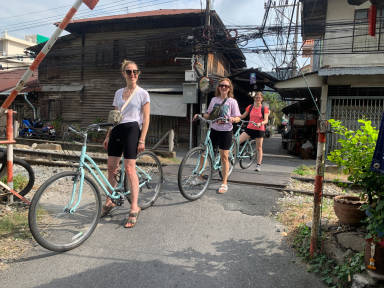
Pack for Pattaya tonight, not tomorrow morning. Leaving Bangkok around 10am puts you past the rush and on the beach for lunch; leaving at 8am puts you in traffic for an extra hour.
South to the coast, a teak temple, and a cabaret
Leave Bangkok mid-morning. The motorway southeast is quick once you clear the city and the drive is around two to two and a half hours, so you can be checked in and eating lunch by the water without having got up early.
Spend the afternoon at the Sanctuary of Truth, which is the most interesting thing in Pattaya by a distance and is not a temple in the usual sense. It is an enormous all-timber building on the headland at Naklua, entirely carved, held together with wooden pegs rather than nails, and it has been under construction since 1981 — the carvers are still working on it while you walk around, which is the point. You will smell the teak before you are inside it.
Then take the evening for cabaret. Pattaya's big theatres — Tiffany's and Alcazar — run genuinely well-produced ladyboy revues with full orchestral sound, costume changes and a 70-to-90-minute run time. It is camp and it is professional, and it is one of the few things Pattaya does better than anywhere else in the country.


Book a hotel at the Jomtien end or up at Naklua rather than on central Pattaya Beach Road. Same sea, ten minutes away, a fraction of the noise.
Koh Larn in the morning, airport in the afternoon
Koh Larn is the reason to be here. It is a forty-minute ferry or a fifteen-minute speedboat offshore and the water is a completely different proposition from Pattaya's own beach — clear, swimmable, with several separate bays so you can get away from the busiest one. Samae and Nual are quieter than Tawaen, which is where the day-trip boats land.
Here is the honest constraint: a full-day island trip runs about six hours and does not fit around an evening flight. Pattaya to Suvarnabhumi is 1.5 to 2 hours and you want an hour of buffer on top of that. If your flight is after 8pm you can do the island and go straight to the airport with bags in the car. If it is earlier, do a short morning — a sunset-and-viewpoint run the evening before instead, and a slow beach breakfast on the last day.
The one thing not to do is book a full-day boat and a 4pm flight and hope. Boats come back late, the motorway does not care about your booking, and this is the single most common way a four-day Thailand trip ends badly.

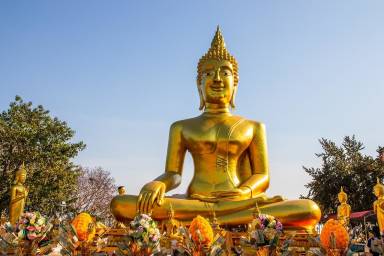
Do not backtrack into Bangkok to fly out. Pattaya has a direct road link to Suvarnabhumi, which is exactly why it works as the last stop on a short trip.
Planning this trip
Two monsoons, two coasts, two different seasons
This is the fact most Thailand itineraries get wrong, and it matters more than anything else on this page. Thailand does not have one rainy season. It has two, on two coasts, and they run at different times. The Andaman coast — Phuket, Krabi, Koh Lanta, Koh Phi Phi — is wettest roughly May to October, when the southwest monsoon pushes straight onto those beaches. The Gulf coast — Koh Samui, Koh Phangan, Koh Tao — is driest through much of that same period and takes its heaviest rain October to December. So a September trip that would be a washout in Krabi can be perfectly good on Samui, and a November trip that is glorious in Krabi can be grey and choppy on Samui. If a blog tells you to avoid Thailand in September, it is thinking about one coast and forgetting the other. Bangkok, Chiang Mai and Pattaya sit outside that split: they get most of their rain between May and October, usually as heavy late-afternoon downpours rather than all-day drizzle, and a wet-season afternoon in Bangkok costs you an hour, not a day.
When to come, and the one week to avoid unless you want it
November to February is the best overall window for this route: dry, cooler, and comfortable for walking around Bangkok's old city or Chiang Mai's moat. It is also the busiest and the most expensive, so book accommodation early. March to May is the hot season and April is genuinely brutal — mid-thirties Celsius with humidity, and sightseeing has to be reorganised around early mornings and late afternoons. Songkran, the Thai new year, falls around 13–15 April and turns the whole country into a multi-day water fight. It is one of the best things you can experience in Thailand if you go looking for it. It is also close to impossible to travel through if you did not plan for it — transport is full, many businesses close, and you will get soaked whether or not you consented. Decide which side of that you are on before you book April dates. One more thing worth knowing: northern Thailand, including Chiang Mai, has a burning season roughly February to early April when agricultural smoke pushes air quality down badly. If you are sensitive to that, weight your days towards Bangkok and the coast in those months.
Bangkok to Pattaya, and getting back to the airport
Pattaya sits about 150km southeast of Bangkok. A private car or Grab does it in roughly 2 to 2.5 hours depending on when you leave; the public bus from Ekkamai eastern bus terminal takes around 2.5 hours and runs frequently. The motorway route is genuinely quick once you are clear of Bangkok, so leaving mid-morning after the rush beats an early start. The detail people miss is the return. Pattaya to Suvarnabhumi airport is about 1.5 to 2 hours, and there is a direct bus, which means Pattaya can be your last stop without backtracking into Bangkok. Work backwards from your flight, add an hour of buffer for the motorway, and do not schedule a full-day island trip on departure day.
Getting around Bangkok without losing the day to traffic
Bangkok traffic is as bad as its reputation. A journey that Google Maps calls twenty minutes can take an hour at 5pm. The BTS Skytrain and the MRT underground are the fix — they are air-conditioned, they run above and below the jams, and they cover most of the modern city. Buy a stored-value card or just tap a contactless bank card at the gates. The old city, where the Grand Palace and Wat Pho are, is the one area the trains do not serve well. Use the Chao Phraya Express Boat instead: the orange-flag boat is cheap, frequent, and drops you at Tha Chang for the palace and Tha Tien for Wat Pho, and it is faster than a taxi from Sathorn most of the day. For everything else, use Grab. It is the local ride-hailing app, it prices the trip up front, and it removes the meter negotiation that makes street taxis tiresome. Tuk-tuks are fun for a short hop and a photograph; they are not a sensible way to cross the city, and they are rarely cheaper than a Grab.
Temple dress code — it is actually enforced
The Grand Palace and Wat Phra Kaew turn people away every single day. Shoulders and knees must be covered, for men and women both. No vests, no shorts, no short skirts, no see-through fabric, and shoes come off before you step into the ordination hall. There is a booth near the entrance that will lend or sell you a cover-up, but the queue for it is long and you will have paid for the privilege of being unprepared. Wear long trousers or a maxi skirt and bring a light scarf. Wat Pho and most other temples are more relaxed but the same principle applies, and covering up is simply the polite move. Go early — the Grand Palace opens at 8:30am and the difference between arriving at 8:30 and arriving at 11 is the difference between a manageable crowd and a scrum in full sun. One scam to know about: if someone outside the palace tells you it is closed today for a ceremony and offers to take you somewhere else by tuk-tuk, it is not closed. Walk to the gate and check for yourself.
What to book ahead and what to leave loose
Book in advance: domestic flights (prices climb steadily, they rarely fall), anything on a fixed date such as a cabaret show or a stadium Muay Thai card, small-group day trips in high season, and any elephant sanctuary — the good ones cap numbers and genuinely sell out. Leave loose: street food, markets, massages, temple entry, and most short city walking tours. Thailand's tourism infrastructure is deep and same-day availability is normal outside of the December–January peak. On a trip this short, the thing worth over-booking is the first full day. Jet lag plus an unplanned morning is how people lose a quarter of a four-day trip. Have day one fixed before you land, then let the rest breathe.
Frequently Asked Questions
Why Pattaya and not Krabi or Phuket?
Because of the maths, not the scenery. Krabi and Phuket are both about 1.5 hours by air from Bangkok, but the real cost of that move is closer to half a day each way with transfers and check-in. On four days that is a quarter of your trip. Pattaya is a two-hour drive with no airport involved, and it sits on the road back to Suvarnabhumi. If the karst-and-turquoise version of Thailand is what you actually want, do it on a seven-day trip and go to Krabi.
Is Pattaya's beach any good?
Pattaya Beach itself is unremarkable and the water is not what you came for. Koh Larn, forty minutes offshore, genuinely is — clear water and several bays, with the quieter ones away from where the tour boats land. Treat Pattaya as a base and the island as the beach.
Is Pattaya family-friendly?
Parts of it are and parts of it emphatically are not. Walking Street and the central beach road are the town's red-light reputation in physical form. Jomtien to the south and Naklua to the north are ordinary Thai seaside neighbourhoods, and that is where to stay with kids. The island, the gardens and the cabaret theatres are all fine.
When is the best time for this route?
November to February — dry, cooler, and the sea around Koh Larn is at its calmest. March to May is very hot and April brings Songkran, the nationwide water-fight new year around 13–15 April, which is either the highlight of your trip or completely impossible to travel through depending on how you feel about being soaked.
Does the rainy season ruin the beach days?
Less than people assume, and it depends where. Thailand has two monsoons: the Andaman coast (Phuket, Krabi) is wettest May to October, while the Gulf coast (Koh Samui, Koh Phangan) takes its worst weather October to December. Pattaya sits on the upper Gulf and gets most of its rain May to October, usually as short heavy afternoon storms. Boats to Koh Larn can be cancelled in rough weather, so keep the island day flexible rather than on your last morning.
Could I do Bangkok 3 and Pattaya 1 instead?
You could, but one night in Pattaya means you arrive mid-afternoon and leave the next morning, and the island trip stops fitting. If you only want one night by the sea, it is usually better to spend all four days in Bangkok and take a day trip — the elephant sanctuary in Chonburi or Khao Yai — than to move for the sake of it.
How do I get from Bangkok to Pattaya?
A private car or Grab takes 2 to 2.5 hours and is the simplest option with luggage. Public buses run frequently from Ekkamai eastern bus terminal and take about 2.5 hours for a fraction of the price. Leave mid-morning rather than early — you will clear Bangkok faster.
Is there anything worth seeing between Bangkok and Pattaya?
Chonburi province, which you drive through, has several elephant sanctuaries that run as day trips from either end. If elephants matter to you and you are not going north to Chiang Mai on this trip, that is the one worthwhile detour — just make sure it is a no-riding operation.
Book the guided parts of this trip
Every tour above runs with a verified local operator.
Browse all Thailand tours