9 Days in Thailand: Three Days Each in Bangkok, Chiang Mai and Krabi
Nine days in Thailand is three nights each in Bangkok, Chiang Mai and Krabi — the version where nothing is rushed. Chiang Mai gets the old city, Doi Suthep and a cooking class; Krabi gets the four islands, Railay and a day doing nothing. Two domestic flights, both about 75 to 85 minutes.
9 days in Thailand at a glance
| Day | Based in | What you do | Getting there |
|---|---|---|---|
| 1 | Bangkok | Arrival, the old city, and Chinatown after dark | Suvarnabhumi to central Bangkok: Airport Rail Link about 30 minutes to Phaya Thai, or 40-60 minutes by Grab depending on traffic |
| 2 | Bangkok | Ayutthaya, and a night at the stadium | Bangkok to Ayutthaya about 1 |
| 3 | Bangkok | Markets and a cooking class, then the city from above | — |
| 4 | Chiang Mai | North, and straight up the mountain | Bangkok to Chiang Mai by air, about 1 hour 15 minutes |
| 5 | Chiang Mai | A full day with elephants, and a wok | — |
| 6 | Chiang Mai | The old city on foot, or a mountain: your slow day or your long one | Optional: Chiang Mai to Doi Inthanon is about 1 hour 45 minutes each way |
| 7 | Krabi | To the Andaman coast, gently | Chiang Mai to Krabi direct, about 2 hours by air |
| 8 | Krabi | Four islands by longtail, and plankton after dark | — |
| 9 | Krabi | Phi Phi, the inland day, or nothing at all | Krabi to Bangkok by air, about 1 hour 25 minutes, for onward international connections |
Nine days is the most even version of this route: three days in Bangkok, three in Chiang Mai, three on the Andaman coast, two internal flights, nothing rushed. It is the first length at which the north gets a proper mountain day rather than a squeezed afternoon, and the first at which the south has enough slack that a day lost to weather does not cost you the islands.
The order is the same for the same reasons. Bangkok first because that is where you land and because a city with rail and air-conditioning is a kinder place to be jet-lagged than an island. Chiang Mai second because the flight is 75 minutes and cheap. The coast last because the sequence heat-culture-water is the right way round, and because ending on a beach beats starting on one.
What nine days buys in the north is worth being specific about. Two days in Chiang Mai gets you the walled old city, a sanctuary morning and Doi Suthep, and it does it slightly out of breath. The third day gets you a mountain — Doi Inthanon, the highest point in Thailand, or the long haul up to the white temple at Chiang Rai — or simply a slow day of temples, massage and a food trail, which after six days of moving is not a waste of anything.
Travellers with a full nine days who want an even split rather than a highlights reel, and who value one unhurried day in each city over a fourth destination.
Arrival, the old city, and Chinatown after dark
The temptation on arrival day is to write it off. Resist it — pushing through to a normal Thai bedtime resets you faster, and Bangkok's old city is at its best early. Head to Rattanakosin, the old royal island, and take the Grand Palace, Wat Phra Kaew, Wat Pho and Wat Arun as one continuous morning; they are within a short walk and a two-minute river ferry of each other, and separating them across days means crossing Bangkok twice for no gain. Wat Pho's reclining Buddha is 46 metres long in a hall built tight around it, and the temple is also the founding school of Thai massage, still teaching and still taking walk-ins — which, after a long-haul flight, is a defensible way to spend an hour.
The heat wins in the early afternoon whatever month you come. Sleep for two hours and treat the evening as its own trip. Yaowarat, Bangkok's Chinatown, only really starts around 6pm when the shutters go up and the kitchens come out onto the pavement. Working through it by tuk-tuk with someone who knows which stall does what is the difference between eating well and joining the longest queue.
If you land at night rather than in the morning, shift everything by half a day: sleep, do the old city on the morning of day two, and move Ayutthaya to day three. With nine days you have the room to absorb that.
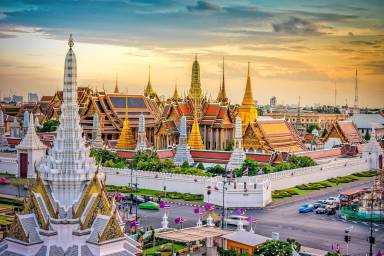

Do the old city in the morning. The Grand Palace opens at 08:30 and the difference between arriving at 08:40 and arriving at 11:00 is the difference between a walk and a scrum, in about eight degrees more heat.
Ayutthaya, and a night at the stadium
Ayutthaya spent over four hundred years as the capital of Siam and, at its peak, was one of the largest cities in the world — a river island trading with Dutch, Portuguese, Persian and Japanese merchants who each had their own quarter. A Burmese army destroyed it in 1767 and the court withdrew downriver to found Bangkok. What survives sits about 1.5 hours north: brick prangs, rows of Buddhas whose heads were struck off, and the famous sandstone head held in the roots of a bodhi tree at Wat Mahathat.
Start early. The site is flat, unshaded and spread across several kilometres, so the two hard parts are heat and navigation; a guided day handles both and supplies the context that turns a field of brick into a city. Trips typically return mid-to-late afternoon.
Evening: Muay Thai. Rajadamnern is the older stadium and the one that feels least staged — the early cards are young fighters in front of a betting crowd whose noise rises and falls with the odds, and that crowd is genuinely half of what you came for. Fights run through the evening and the better bouts are late, so there is no obligation to sit through the whole card.


Sit in the standing or second-tier area at the stadium rather than the ringside tourist seats if you want the atmosphere. The betting happens behind you, not beside the ring, and it is the part you cannot get on television.
Markets and a cooking class, then the city from above
Two full days is enough of the heavy stuff. Day three should start in a wet market with a cooking class — being shown why there are three basils and what each does, then cooking four dishes and eating them for lunch. It is the cheapest useful education in Thai food you will get, and it makes the rest of the trip taste different.
The afternoon is discretionary. Chatuchak if your dates cover a weekend, since it is weekends only and roughly 15,000 stalls. The Chao Phraya express boat if you would rather sit and watch the city from the water for the price of a coffee. Jim Thompson's house for shade and a genuinely strange story — the American who rebuilt the Thai silk industry and then disappeared in the Malaysian jungle in 1967, never found.
Finish on the Mahanakhon SkyWalk at sunset. The tower with the pixelated bite out of it has a glass floor 314 metres up, and one well-timed ticket covers daylight, sunset and the lights coming on.
If floating markets are on your list, Damnoen Saduak and the Maeklong railway market — where the awnings fold back as a train passes through the stalls — are a 7 to 8 hour trip with a 5am start, and they replace this whole day rather than fitting inside it.


Bangkok's malls are not a consolation prize in April. Air-conditioning is a genuine resource in the hot season, and an hour indoors in the middle of the day is what lets you be outside at 5pm.
North, and straight up the mountain
Fly in the morning: about 1 hour 15 minutes, with the airport fifteen minutes from the old city at the far end. Eat khao soi on arrival — northern curry noodles with a nest of crisp fried noodles on top, lime and pickled mustard greens alongside. It is Lanna food, and this is the region where it belongs.
With three days here you can afford to spend the first afternoon going up rather than around. Doi Suthep sits 15 km above the city up a switchback road, ending in a 300-step staircase flanked by naga serpents. The gold chedi at the top is the north's principal pilgrimage site, and the terrace looks down across the whole plain. Late afternoon is the right time to go: the air is cooler, the light is better, and you descend as the city switches on. Stop at Wat Pha Lat on the way — a small forest temple beside a stream, halfway up, which most visitors drive straight past.
Back in town, the night bazaar on Chang Klan Road runs every evening. It is touristy and perfectly good for an hour, a plate of something and a beer, which is about the right ambition for a travel day.


The monks' chat at Doi Suthep and at several old-city temples is exactly what it sounds like: novices practising English will sit and talk with visitors. It is free, it is not a performance, and it is the most interesting thirty minutes available in Chiang Mai.
A full day with elephants, and a wok
Chiang Mai is the centre of elephant tourism in Thailand, which makes it the place where the ethics have to be got right. The workable rule is absolute: if riding is offered, go elsewhere, whatever the operator calls itself. Elephants safe enough to sit on have been broken to make them so, and painting and trick shows come out of the same training. A no-riding sanctuary gives you food preparation, close feeding and time watching a herd behave normally, which turns out to be far more interesting.
With three days in the north you can take the full-day version rather than the half-day, and the combined sanctuary-and-cooking-class day is the best use of it: a morning with the herd, then a Thai cooking class in the same countryside setting, back in the city in the evening. That is 11 to 12 hours door to door and it is a genuinely long day — worth knowing before you book it, because it is the longest day on this itinerary.
If you would rather keep the evening, take a half-day feeding programme instead and spend the afternoon in the old city with a massage and a slow wander. Both are defensible. Only one of them gets you home before dark.
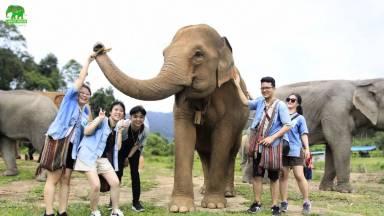
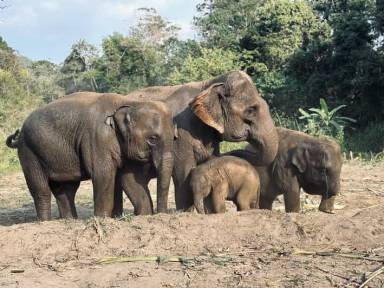
Wear clothes you are willing to ruin and bring a change. Between mud, river water and elephants that have opinions about personal space, nobody comes back from a sanctuary day clean.
The old city on foot, or a mountain: your slow day or your long one
This is the day the ninth day buys, and there are two honest ways to use it.
The slow version: walk the old city properly. It is a square about 1.5 km on a side with the moat intact and stretches of brick wall still standing at the corners, and everything worth seeing is inside it or just beyond. Wat Chedi Luang's chedi has stood partly collapsed since an earthquake in 1545 and was never rebuilt. Wat Phra Singh holds the north's most revered Buddha image. Between them are teak temples with almost nobody in them. Add an afternoon massage and an evening food trail through the lantern-lit temples and you have a day that leaves you better rested than you started.
The long version: go up. Doi Inthanon is the highest point in Thailand, with cloud forest, waterfalls, the twin royal chedis and rice terraces on the way, and it runs about 9 hours. Chiang Rai — the white temple, the blue temple and the black house — is the other option and it is a 12-hour day for around 3 hours in the car each way. Chiang Rai is remarkable and I would still not do it on a nine-day trip: it consumes a third of your northern time in a minibus. Doi Inthanon is the better long day from here.
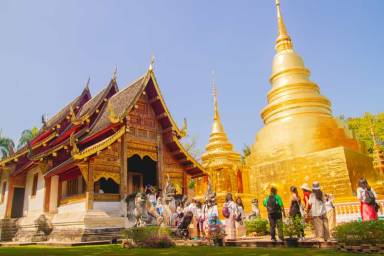

If you take Doi Inthanon, bring a fleece. The summit sits above 2,500 metres and in December and January it is genuinely cold up there — single digits at dawn — while Chiang Mai below is in the twenties.
To the Andaman coast, gently
Chiang Mai to Krabi direct takes about 2 hours, but there are often only one or two flights a day, so book this leg before you book hotels. Failing that, the connection through Bangkok runs about five hours door to door. Land by early afternoon if the schedule allows.
The landscape changes completely. This coast is drowned limestone: cliffs coming vertically out of green water, sea caves at the tideline, and Railay, a peninsula sealed off from the mainland by its own cliffs so that it has no road and is reached only by longtail boat from Ao Nang, about fifteen minutes.
Keep the arrival afternoon small. A mangrove kayak at Ao Thalane — silent channels between limestone walls, macaques on the banks — or the short paddle on the emerald water at Klong Root is the right size for a day that started at an airport. Save the boats for tomorrow, get dinner on the Ao Nang strip, and check the sea forecast while you eat, because that is what decides the shape of the next two days.


Ao Nang for the boats, Railay if you want the cliffs and quiet and do not mind that every arrival and departure involves a longtail and wading the last few metres with your bag.
Four islands by longtail, and plankton after dark
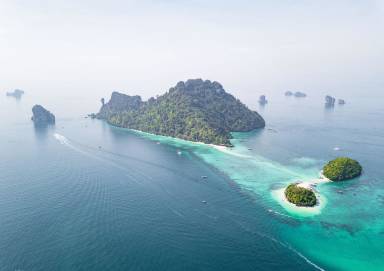
The four islands day is the one everybody comes to Krabi for: Poda, Chicken Island, Tup and Phra Nang Cave beach, with the sandbar between Tup and Mor surfacing at low tide so you can walk from one island to the next. Phra Nang sits directly beneath the Railay cliffs and holds a cave shrine filled with carved wooden phalluses left by fishermen asking for safe returns — it is a working shrine, not a curiosity, and worth a moment of respect.
Take a longtail over a speedboat where you can. Speedboats fit in an extra stop and turn the day into a timetable; longtails go into shallower water, sit longer, and match the pace of a coast whose appeal is that you spend the day looking upward at cliffs.
If you would rather split the day, the afternoon-and-sunset trips are the other good option here: out in the early afternoon, dinner on board, and a swim in bioluminescent plankton after dark, which lights up around your arms as you move. On a three-day stay you have room for a full day today and a half day tomorrow, and that is a better balance than two consecutive 8-hour boat days.

Bring cash in small notes for the national park fees, which are collected per island and are not always included in the trip price. Ask what is covered when you book, not at the jetty.
Phi Phi, the inland day, or nothing at all
The last day flexes to your flight. With a full day and a calm sea, Phi Phi is the big trip: Maya Bay, closed for years so the reef could recover and now reopened with capped numbers and no anchoring in the bay, approached from a jetty on the far side. It runs 8 to 9 hours and the earliest departure is meaningfully better than the mid-morning one.
If the wind is up or your flight is earlier, go inland. Emerald Pool sits spring-fed in the Khao Phra Bang Khram forest, the hot spring waterfall nearby falls at bath temperature over smoothed rock, and Tiger Cave Temple's 1,260 steps end at a summit chedi with the karst plain spread out beneath. None of it depends on sea state, which is exactly why it belongs on a departure day.
And there is a third option that no itinerary ever prints: do nothing. Nine days in, having crossed the country twice, a morning on Railay East with a book and a longtail back at lunchtime is a legitimate use of your last day, and you will remember it as well as any boat.


Leave five hours between the advertised return of any boat trip and your check-in time. Longtails return on the tide and the sea, and 45 minutes late is ordinary rather than exceptional.
Planning this trip
Two monsoons, two coasts — the thing most itineraries get wrong
Thailand does not have one rainy season. The Andaman coast (Phuket, Krabi, Phi Phi) is wettest roughly May to October, when the southwest monsoon pushes swell onto those beaches and boat trips get cancelled at short notice. The Gulf coast (Koh Samui, Koh Phangan, Koh Tao) runs on a different clock and takes its heaviest rain roughly October to December, exactly when the Andaman side is drying out and coming good. Published itineraries routinely say "avoid Thailand in the rainy season" as if the country had one. It does not, and the two coasts are only about 200 km apart. The practical consequence for this route: it ends on the Andaman side, so it is at its best from November to April. If you are locked into travelling in November or early December and want beach time, you have the two coasts the right way round already. If you are travelling in June, July or August, either accept that a share of your island days will be weathered out, or swap the southern leg for the Gulf islands, which are usually fine then.
When to go, and the two dates to plan around
November to February is the best stretch of the year almost everywhere in Thailand: dry, and cool enough in the north that Chiang Mai mornings genuinely need a jacket. March to May is the hot season and April is brutal — high 30s and humid in Bangkok, with air quality in Chiang Mai often poor from agricultural burning in March. Two dates matter. Songkran, the Thai new year, falls around 13-15 April and turns whole streets into a nationwide water fight. It is one of the best things that happens in Thailand if you want to be in it, and close to impossible to travel through if you do not: soaked bags, packed transport, some businesses shut for days. Decide which of those two people you are before you book April flights. Loi Krathong, usually November, is the other one worth aiming at, and Chiang Mai is the place to see it.
Bangkok to Chiang Mai: fly, unless the train is the point
The flight is about 1 hour 15 minutes and is often one of the cheapest flights in the region, from Don Mueang or Suvarnabhumi. The overnight sleeper train is a real experience — second-class air-conditioned berths, curtains, a proper Thai railway breakfast — but be honest with yourself about the arithmetic: it is roughly 12 to 13 hours, it is frequently late, and on a trip of this length it costs you a working day at each end for a saving of maybe forty dollars. Take the train if riding it is one of the things you came to do. Otherwise fly, book it as soon as your dates are fixed, and spend the day you saved in the north.
Getting south, and the flights that actually exist
Bangkok to Krabi is about 1 hour 25 minutes and runs many times a day. Chiang Mai to Krabi is flown direct in around 2 hours on the budget carriers, but the schedule is thin — often one or two departures a day — so fix that flight before you fix your hotels, not after. If the direct is sold out or badly timed, the connection through Bangkok adds about three hours door to door. Krabi to Phuket is about 2 to 3 hours by road, or by road-and-ferry via the islands; the short flight exists but with the airport transfers at both ends it rarely saves time. Whatever you book, do not schedule an island boat trip on the same day as a flight out. Boats come back late, and they come back later when the sea is up.
Elephants: how to tell a sanctuary from a show
This is the one ethical decision on a Thailand itinerary that is genuinely yours to get right. An elephant that is safe to ride has been through a breaking process to make it so; the riding, the painting and the circus tricks all sit downstream of the same training. The clean test is simple: if riding is on the menu at all, walk away, whatever the place calls itself. What remains is still a good day out — feeding, preparing food, walking with a herd, and at some places bathing them in the river, though even bathing is now questioned by the stricter camps because it puts tourists in constant physical contact. The operators we list in Chiang Mai and Krabi are feeding-and-observation programmes without riding. Book them directly rather than through a hotel desk, which is where the commission pressure to send you somewhere else comes from.
Temple dress code, and the scam at the palace gate
The Grand Palace and Wat Phra Kaew enforce a dress code and they enforce it properly: shoulders covered, knees covered, no sheer fabric, for men as well as women. They will rent you a cover-up at the gate, but the queue for it in high season is its own event, so wear the right clothes and skip it. Wat Pho, next door, is more relaxed but still expects covered shoulders and knees. Related: if someone outside the palace tells you it is closed today for a ceremony and offers a tuk-tuk tour of other temples instead, it is not closed. That approach is the oldest scam in Bangkok, and it ends at a gem shop. Walk past and check the gate yourself.
Frequently Asked Questions
Is 9 days better spent adding a fourth destination?
Usually not. A fourth stop costs a travel morning, an arrival afternoon and a departure morning — close to a day and a half of the nine — and the obvious candidates (Phuket, Koh Samui, Sukhothai) each duplicate something you already have. The exception is if you specifically want the Gulf islands, which have a completely different look and a different weather season, and in that case you should cut a coast rather than add one.
Should the extra day go to Chiang Mai or Krabi?
This route gives the eighth day to Krabi and the ninth to Chiang Mai, which is the right order. Two coastal days leaves no room for a weather cancellation, so that gets fixed first. Once the coast has three days, the north is where the extra day does most: it is the difference between rushing Doi Suthep and the sanctuary into one afternoon and having a proper mountain day at Doi Inthanon.
Is Chiang Rai worth the day trip from Chiang Mai?
The white temple at Wat Rong Khun is genuinely unlike anything else in Thailand, and the blue temple and black house nearby are worth seeing. But it is about 3 hours each way and a 12-hour day, which is a third of your northern time spent in a minibus. On nine days, Doi Inthanon gives you a better day for less driving. Save Chiang Rai for a trip where the north gets four or five days, or stay overnight there instead of doing it as a return run.
When is the best time of year to do this route?
November to February, without much argument. It is dry on both coasts, Bangkok is tolerable and Chiang Mai mornings are cool. This itinerary ends on the Andaman coast, which is wettest May to October — the opposite of the Gulf islands, which take their worst weather October to December. March brings burning-season haze to the north, and April is the hot season peak plus Songkran around the 13th to 15th.
Can I do this itinerary in reverse, ending in Bangkok?
Yes, and it makes sense if your outbound long-haul flight leaves from Bangkok and you would rather not backtrack under time pressure. The downside is jet lag: your first two days are your worst, and spending them on a boat schedule in Krabi is less forgiving than spending them in a city where you can nap and start again at 5pm. If you reverse it, give yourself a soft first day.
How much walking is involved?
More than most people expect, and almost all of it in heat. Ayutthaya covers several kilometres of open ground, Doi Suthep ends in 300 steps, Tiger Cave Temple is 1,260, and Chiang Mai's old city is best done on foot. None of it is technical, but bring shoes you can walk in all day and treat the midday hours as rest time rather than sightseeing time.
Do I need to book internal flights before hotels?
Book Chiang Mai to Krabi first, always. It often runs only once or twice a day and it dictates whether day seven is a half day or a whole day lost. Bangkok to Chiang Mai has departures all day and can be booked around your other plans. Hotels in all three cities have plenty of supply outside the peak weeks of December and January.
Is it safe to drink the tap water?
No — bottled or filtered water is standard for everyone, including Thais, and it is cheap everywhere. Ice in restaurants and street stalls is commercially produced and generally fine; the tubular ice with a hole through it is the industrial kind and is the one to look for. Street food is one of the safest and best things about the country as long as you eat where there is turnover.
Book the guided parts of this trip
Every tour above runs with a verified local operator.
Browse all Thailand tours