10 Days in Thailand: Bangkok, Chiang Mai, Krabi and Phuket
Ten days lets you add Phuket to the Bangkok, Chiang Mai and Krabi route: three nights Bangkok, three Chiang Mai, two Krabi, two Phuket. Krabi and Phuket are two to three hours apart by road and ferry. They are genuinely different — Krabi for karst scenery, Phuket for connections and nightlife — so seeing both is the point.
10 days in Thailand at a glance
| Day | Based in | What you do | Getting there |
|---|---|---|---|
| 1 | Bangkok | Arrival, the old city, and Chinatown after dark | Suvarnabhumi to central Bangkok: Airport Rail Link about 30 minutes to Phaya Thai, or 40-60 minutes by Grab depending on traffic |
| 2 | Bangkok | Ayutthaya's ruins, and Muay Thai at Rajadamnern | Bangkok to Ayutthaya about 1 |
| 3 | Bangkok | A market, a wok, and Bangkok from 314 metres | — |
| 4 | Chiang Mai | North to Chiang Mai, and up to Doi Suthep | Bangkok to Chiang Mai by air, about 1 hour 15 minutes |
| 5 | Chiang Mai | A full day with elephants | — |
| 6 | Chiang Mai | The old city on foot, or Doi Inthanon | Optional day trip: Chiang Mai to Doi Inthanon about 1 hour 45 minutes each way |
| 7 | Krabi | South to the Andaman coast | Chiang Mai to Krabi direct by air, about 2 hours |
| 8 | Krabi | Four islands, Railay and Phra Nang | — |
| 9 | Phuket | Across to Phuket, and an old town nobody expects | Krabi to Phuket about 2-3 hours by road, or road and ferry via the islands |
| 10 | Phuket | Phang Nga Bay, and the flight home | Phuket to Bangkok about 1 hour 25 minutes by air, if you are connecting rather than flying out of Phuket directly |
Ten days is the first length at which Thailand stops feeling like a sampler. Three days in Bangkok, three in Chiang Mai and four on the Andaman coast gives every stop a full day that is not a travel day — which is the actual test of whether an itinerary works. This version splits the coastal time between Krabi and Phuket, which is what most ten-day plans do, and there is one honest argument to have about that before you book anything.
Krabi and Phuket are 2 to 3 hours apart and they are genuinely different. Krabi is limestone: karst cliffs, Railay peninsula with no road to it, green water and a coast built around boats. Phuket is an island the size of Singapore with an international airport, a Sino-Portuguese old town, big hotels and the nightlife. Splitting the four days between them gives you both, at the cost of most of one day in transit and two hotel check-ins. Spending all four in Krabi gives you a deeper stay and one fewer packing day. This page lays out the split version, because the departure from Phuket's international airport suits a lot of long-haul routings — but if your flight home leaves from Bangkok anyway, staying put in Krabi is the better trip and I would say so to your face.
One planning fact outranks all of this. Thailand has two monsoons on two coasts and they run on different calendars. The Andaman side — Phuket, Krabi, Phi Phi, where six of these ten days are spent — is wettest May to October. The Gulf islands are wettest October to December. Almost every published Thailand itinerary treats the rainy season as one national event, which is wrong for half the country in any given month, and it is the reason people arrive in Phuket in July wondering why their boat trips keep being cancelled.
Travellers with a full ten days who want the capital, the north and real Andaman beach time, and who want Phuket's old town and infrastructure as well as Krabi's cliffs.
Arrival, the old city, and Chinatown after dark
Land, drop your bags, and go straight to Rattanakosin — the old royal island — rather than writing off arrival day. The jet-lag arithmetic rewards staying up to a normal Thai bedtime, and the old city is at its best in the first hours after opening. Take the Grand Palace, Wat Phra Kaew, Wat Pho and Wat Arun as one continuous morning: they sit within a short walk and a two-minute cross-river ferry of one another, and splitting them across days means crossing Bangkok twice for nothing. Wat Phra Kaew holds the Emerald Buddha, a 66 cm jade figure whose robes are changed seasonally by the king himself. Wat Pho holds a 46-metre reclining Buddha in a hall built tight around it, and is the founding school of Thai massage, which still teaches and still takes walk-ins.
The heat wins by early afternoon in every month. Go back, sleep two hours, and treat the evening as a separate trip. Yaowarat, the Chinatown, does not start until about 6pm, when the shophouse shutters go up and the street kitchens spread onto the pavement. Going through it by tuk-tuk with someone who knows the stalls is the difference between eating well and eating whatever had the shortest queue.
If your flight lands in the evening instead, sleep it off, take the old city on the morning of day two and push Ayutthaya to day three. On ten days there is room to absorb that without losing anything later.
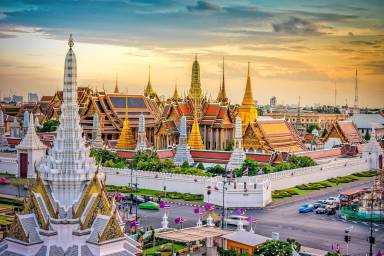

Do the old city in the morning. The Grand Palace opens at 08:30 and the difference between arriving at 08:40 and arriving at 11:00 is the difference between a walk and a scrum, in about eight degrees more heat.
Ayutthaya's ruins, and Muay Thai at Rajadamnern
For more than four centuries Ayutthaya was the capital of Siam and one of the largest cities on earth — a river island where Dutch, Portuguese, Persian and Japanese merchants each held their own quarter. In 1767 a Burmese army sacked and burned it, and the court retreated downriver to found Bangkok. What remains sits about 1.5 hours north: brick prangs, avenues of headless Buddhas, and the sandstone head at Wat Mahathat that a bodhi tree has grown around over two centuries.
Go early. The site is flat and unshaded and spreads over several kilometres, so heat and navigation are the two hard parts, and a guided day fixes both while supplying the thing photographs cannot — what happened here, and why so few of the Buddhas have heads. Most trips are back in Bangkok mid-to-late afternoon.
Spend the evening at Rajadamnern, the older of Bangkok's two main Muay Thai stadiums and the one that feels least arranged for visitors. The early bouts are young fighters in front of a betting crowd whose roar tracks the odds rather than the punches, and that crowd is half the reason to go. The card runs through the evening with the better fights late, so leave when you have had enough.


Take more water than you think you need and a brimmed hat. There is essentially no shade at Wat Chaiwatthanaram or Wat Mahathat, and the walk between the main temple groups is longer than the map suggests.
A market, a wok, and Bangkok from 314 metres
Two heavy days is enough. Day three should start in a wet market with a cooking class — a guide walking you through why there are three kinds of basil and what each is for, then a kitchen where you cook four dishes and eat them for lunch. Three hours, and it changes how everything you eat for the rest of the trip tastes.
The afternoon is yours. Chatuchak if your dates cover a weekend — roughly 15,000 stalls, weekends only, and either it fits or it does not. The Chao Phraya express boat, which for the price of a coffee runs the length of the city and is the only pleasant transport in Bangkok that is not underground. Jim Thompson's house, a teak compound assembled by the American who rebuilt the Thai silk industry and then walked into the Malaysian jungle in 1967 and was never found.
End on the Mahanakhon SkyWalk. The tower with the pixelated bite out of its side has a glass floor 314 metres up and a rooftop bar above that, and a ticket timed for 45 minutes before sunset gets you daylight, sunset and the lights coming on.
If floating markets matter to you, Damnoen Saduak with the Maeklong railway market — where the stall awnings fold back as a train grinds through the market and close again behind it — is a 7 to 8 hour trip with a 5am start, and it replaces this day rather than joining it.


Cluster your Bangkok days geographically — old city and river on one day, Sukhumvit and Silom on another. Crossing the city twice in a day at ground level can cost you two hours, and the BTS and MRT only help where the lines actually go.
North to Chiang Mai, and up to Doi Suthep
Fly in the morning: about 1 hour 15 minutes, and the airport at the other end is fifteen minutes from the old city, so lunch in Chiang Mai is realistic. Make it khao soi — northern curry noodles under a nest of crisp fried noodles, with lime and pickled mustard greens on the side. It is Lanna food. The Lanna kingdom ran the north as a separate state for six hundred years and the food, the temple architecture and the dialect all still show it.
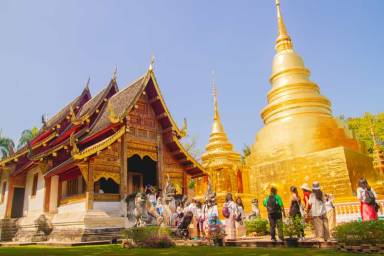
With three days here, spend the first afternoon going up rather than around. Doi Suthep is 15 km above the city up a switchback road, ending in a 300-step staircase between two long naga serpents. The gold chedi at the top is the most important pilgrimage site in the north; the terrace looks straight back down over Chiang Mai and the plain. Late afternoon is the time to go — cooler air, better light, and the city switching on as you come back down. Stop at Wat Pha Lat halfway up, a forest temple beside a stream that almost everyone drives past.
The night bazaar on Chang Klan Road runs every evening and is a perfectly reasonable place to end a travel day: a plate of something, a beer, and an early night before a long day tomorrow.


If you want to walk up to Wat Pha Lat rather than drive, the Monk's Trail leaves from behind Chiang Mai University and takes about 45 minutes through forest. Go early; it is shaded but steep and humid.
A full day with elephants
Chiang Mai is the centre of Thailand's elephant tourism, which makes this the day the trip's ethics actually get decided. The rule that works is simple and absolute: if riding is offered at all, go somewhere else. An elephant safe enough to sit on has been broken to make it so, and the painting, the football and the trick shows come from the same training. Camps rebrand constantly — the word sanctuary means nothing on its own — so check the activity list, not the name.
What a no-riding programme actually gives you is a better day anyway: cutting and preparing food, feeding a herd from a metre away, walking with them, and watching how much of their communication is happening below your hearing. With three days in the north you can take the full-day version, and the combined sanctuary-and-cooking-class day is the best use of it — a morning with the herd and a Thai cooking class in the same countryside setting afterwards. It runs 11 to 12 hours door to door and it is comfortably the longest day on this itinerary. That is worth knowing rather than discovering.
If you would rather keep your evening, take a half-day feeding programme and spend the afternoon in the old city instead. Both are fine; only one gets you back before dark.


Wear clothes you would throw away and pack a full change. Mud, river water and elephants with no sense of personal space mean nobody returns from a sanctuary day clean or dry.
The old city on foot, or Doi Inthanon
Two ways to use the third northern day, and they suit different people.
Slow: walk the old city. It is a square roughly 1.5 km on a side, the moat still runs all the way around it, and the brick corners of the wall are still standing. Wat Chedi Luang's great chedi has been partly collapsed since a 1545 earthquake and was deliberately never rebuilt; Wat Phra Singh holds the most revered Buddha image in the north; between them are teak temples with nobody in them. Add a Lanna massage in the afternoon and an evening food trail through the lit temples, and you get a day that leaves you with more energy than it took.
Long: go up. Doi Inthanon is the highest mountain in Thailand — cloud forest, waterfalls, the twin royal chedis and rice terraces on the way up — and runs about 9 hours. It is the better of the two long day trips from Chiang Mai. Chiang Rai, for the white temple and the blue temple, is about 3 hours each way and a 12-hour day, and on a ten-day trip that is a lot of minibus for a route that already has two flights in it.
Whichever you pick, pack tonight. Tomorrow is a travel day and the flight south is the tightest connection on the itinerary.

Take a fleece for Doi Inthanon. The summit is above 2,500 metres and December and January mornings there are in single digits while the city below is in the twenties — people arrive in shorts every day and regret it.
South to the Andaman coast
Chiang Mai to Krabi direct is about 2 hours, but the schedule is thin — often one or two departures a day — which makes this the first flight to book and the one to build the rest of your plans around. If the direct does not work, connecting through Bangkok is roughly five hours door to door. Land by early afternoon if you possibly can.
The landscape changes the moment you are on the ground. This is drowned limestone country: cliffs rising vertically out of green water, caves at the tideline, and Railay, a peninsula whose own cliffs cut it off from the mainland so completely that it has no road and is reached only by longtail from Ao Nang, fifteen minutes across the bay.
Keep this afternoon deliberately small. A mangrove kayak at Ao Thalane — quiet water between limestone walls, macaques coming down to the shoreline — is the right size for a day that began at an airport, and it sets up the boat days without exhausting you first. Have dinner on the Ao Nang strip and check the sea forecast, which is what actually determines the shape of the next three days.


Since you move on to Phuket on day nine, stay in Ao Nang rather than on Railay. Railay is the more beautiful base but every arrival and departure involves a longtail and wading the last few metres, which is a poor way to move luggage.
Four islands, Railay and Phra Nang
This is why you came to Krabi. The four islands trip takes in Poda, Chicken Island, Tup and Phra Nang Cave beach, and at low tide the sandbar between Tup and Mor surfaces so you can walk from one island to another in ankle-deep water. Phra Nang beach sits directly under the Railay cliffs and holds a cave shrine stacked with carved wooden phalluses, left by generations of fishermen asking the cave spirit for a safe return. It is a working shrine, not a novelty.
Take a longtail rather than a speedboat if you have the choice. The speedboat versions add another island and turn the day into a schedule; longtails go into shallow water, stay put longer, and match the pace of a coast whose entire appeal is looking up at cliffs from sea level.
When the boat drops you back, walk the ten minutes from Ao Nang to the Railay longtail pier and go across for the evening. Railay West at sunset, with the climbers coming down off the walls and the tide out, is the memory people bring home from Krabi, and it costs the price of a boat ticket. Last boats back run into the evening but not late — check the time before you settle in.
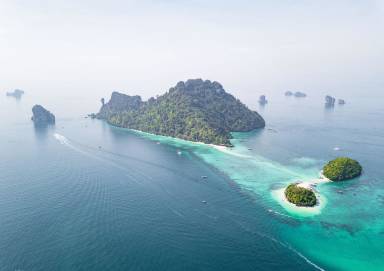
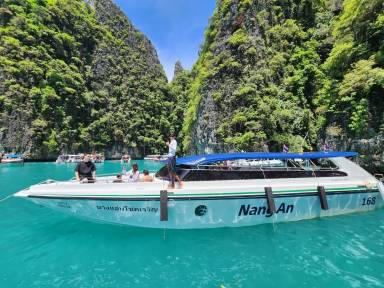
Carry small notes for the national marine park fees, charged per island and often not included in the trip price. Ask exactly what is covered at the time of booking, not at the jetty at 8am.
Across to Phuket, and an old town nobody expects
The transfer is 2 to 3 hours by road, either around the head of Phang Nga Bay by minibus or by the road-and-ferry combination through the islands. There is a short flight, but with two airport transfers it rarely saves real time. Leave in the morning: a mid-afternoon departure turns this into a wasted day, and you only have two here.
What Phuket has that Krabi does not is a town with a history. Phuket Old Town was built on tin money in the nineteenth century by Chinese and Peranakan merchants, and the result is streets of Sino-Portuguese shophouses — pastel facades, shuttered arcades, ornate tilework — plus Hokkien-influenced southern Thai food that is different from anything you have eaten so far on this trip. Half a day of walking Thalang Road and Soi Romanee, with a workshop or a food tour to give it structure, is the best thing on the island and is nothing like the Phuket of the brochures.
What you do with the evening splits people. Patong is the nightlife — Bangla Road, loud, relentless, and honest about what it is. Kata and Karon are the quieter beaches. Choose your hotel accordingly, because the two are half an hour apart and you cannot casually swap between them.


Pick your beach before you pick your hotel. Patong for nightlife and everything being open; Kata or Karon for swimming and sleeping; Old Town if the town itself is what you came for, accepting that you are then 30-40 minutes from any beach.
Phang Nga Bay, and the flight home
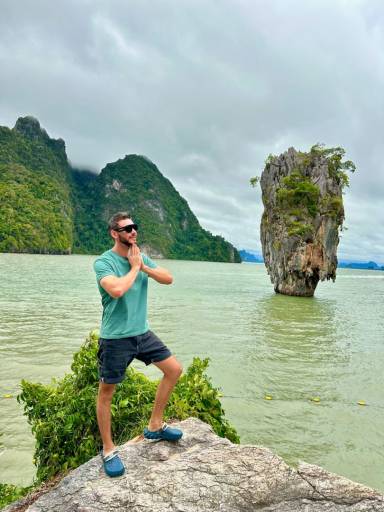
Phuket's best day on the water is not the beach; it is Phang Nga Bay, north of the island — a drowned karst landscape of hundreds of limestone towers standing straight out of shallow green water. James Bond Island got its name from The Man with the Golden Gun and is the busiest stop; the better parts are the hongs, sea caves that open into collapsed roofless chambers inside the islands, which you enter lying flat in a canoe at the right state of tide. Koh Panyi, a Muslim fishing village built on stilts over the water with a football pitch floating beside it, is on most itineraries and is worth the stop.
Day trips run about 6 to 8 hours. Which means the same warning as everywhere else on this coast, only sharper on the last day: if your flight is in the evening and the trip is advertised back mid-afternoon, that works. If your flight is mid-afternoon, it does not, and the alternative — the Big Buddha, Wat Chalong and a last walk through the old town — is a good half-day that ends when you decide it does.
Phuket International is the reason many people build the trip this way round: it takes long-haul and regional flights directly, so you do not have to return to Bangkok to leave. If your ticket does route through Bangkok, the hop back is about 1 hour 25 minutes.
Do not book a bay trip on a day with an afternoon flight. Speedboats in Phang Nga return late routinely, and the road from the northern piers back to the airport can take an hour on its own.
Planning this trip
Two monsoons, two coasts — the thing most itineraries get wrong
Thailand does not have one rainy season. The Andaman coast (Phuket, Krabi, Phi Phi) is wettest roughly May to October, when the southwest monsoon pushes swell onto those beaches and boat trips get cancelled at short notice. The Gulf coast (Koh Samui, Koh Phangan, Koh Tao) runs on a different clock and takes its heaviest rain roughly October to December, exactly when the Andaman side is drying out and coming good. Published itineraries routinely say "avoid Thailand in the rainy season" as if the country had one. It does not, and the two coasts are only about 200 km apart. The practical consequence for this route: it ends on the Andaman side, so it is at its best from November to April. If you are locked into travelling in November or early December and want beach time, you have the two coasts the right way round already. If you are travelling in June, July or August, either accept that a share of your island days will be weathered out, or swap the southern leg for the Gulf islands, which are usually fine then.
When to go, and the two dates to plan around
November to February is the best stretch of the year almost everywhere in Thailand: dry, and cool enough in the north that Chiang Mai mornings genuinely need a jacket. March to May is the hot season and April is brutal — high 30s and humid in Bangkok, with air quality in Chiang Mai often poor from agricultural burning in March. Two dates matter. Songkran, the Thai new year, falls around 13-15 April and turns whole streets into a nationwide water fight. It is one of the best things that happens in Thailand if you want to be in it, and close to impossible to travel through if you do not: soaked bags, packed transport, some businesses shut for days. Decide which of those two people you are before you book April flights. Loi Krathong, usually November, is the other one worth aiming at, and Chiang Mai is the place to see it.
Bangkok to Chiang Mai: fly, unless the train is the point
The flight is about 1 hour 15 minutes and is often one of the cheapest flights in the region, from Don Mueang or Suvarnabhumi. The overnight sleeper train is a real experience — second-class air-conditioned berths, curtains, a proper Thai railway breakfast — but be honest with yourself about the arithmetic: it is roughly 12 to 13 hours, it is frequently late, and on a trip of this length it costs you a working day at each end for a saving of maybe forty dollars. Take the train if riding it is one of the things you came to do. Otherwise fly, book it as soon as your dates are fixed, and spend the day you saved in the north.
Getting south, and the flights that actually exist
Bangkok to Krabi is about 1 hour 25 minutes and runs many times a day. Chiang Mai to Krabi is flown direct in around 2 hours on the budget carriers, but the schedule is thin — often one or two departures a day — so fix that flight before you fix your hotels, not after. If the direct is sold out or badly timed, the connection through Bangkok adds about three hours door to door. Krabi to Phuket is about 2 to 3 hours by road, or by road-and-ferry via the islands; the short flight exists but with the airport transfers at both ends it rarely saves time. Whatever you book, do not schedule an island boat trip on the same day as a flight out. Boats come back late, and they come back later when the sea is up.
Krabi or Phuket — pick one on a short trip
They are 2 to 3 hours apart and they are not interchangeable. Krabi is limestone: vertical karst cliffs, green water, Railay peninsula, which has no road and is reached only by longtail boat. Ao Nang is its main strip, walkable, low-rise, and quiet by 11pm. Phuket is an island the size of Singapore with an international airport, hospitals, big hotels, a genuinely interesting old town of Sino-Portuguese shophouses, and Patong, which is the nightlife. Phuket is better connected and better if you want choice; Krabi is better if what you came for is the scenery. On a week-long trip, choose one and stay put. The three hours you spend moving between them buys you nothing that either place could not have given you.
Elephants: how to tell a sanctuary from a show
This is the one ethical decision on a Thailand itinerary that is genuinely yours to get right. An elephant that is safe to ride has been through a breaking process to make it so; the riding, the painting and the circus tricks all sit downstream of the same training. The clean test is simple: if riding is on the menu at all, walk away, whatever the place calls itself. What remains is still a good day out — feeding, preparing food, walking with a herd, and at some places bathing them in the river, though even bathing is now questioned by the stricter camps because it puts tourists in constant physical contact. The operators we list in Chiang Mai and Krabi are feeding-and-observation programmes without riding. Book them directly rather than through a hotel desk, which is where the commission pressure to send you somewhere else comes from.
What to book ahead, and what to leave open
Book in this order: international flights, then the internal flights (Bangkok-Chiang Mai and the leg south), then hotels, then day tours. From November to February the good small-group tours — cooking classes, the sanctuaries with capped numbers, the catamarans — sell out days ahead, and the first ones to go are the ones worth doing. Leave one evening in each city with nothing in it. Thailand is hot, days start early, and an itinerary with no gap in it is an itinerary you will start resenting on day four. One practical booking note: island day trips are weather-dependent and a cancelled boat is normal, not a disaster. Keep a spare afternoon in the south rather than a spare hour.
Money, SIMs and the small friction
Thailand still runs on cash outside the malls and the big hotels. ATMs charge a fixed foreign-card fee of around 220 baht per withdrawal regardless of amount, so take out more at a time rather than topping up daily. Currency exchange booths in Bangkok — the orange SuperRich-style ones — beat both the airport and your bank; bring clean, unfolded notes. A tourist SIM from any airport carrier counter costs very little for a week of data and makes Grab, maps and boat operators' WhatsApp messages work from the moment you land. Tipping is not obligatory and not expected in the way it is in the US; rounding up a taxi fare and leaving small notes for a guide is normal.
Frequently Asked Questions
Is 10 days enough for Thailand?
Ten days is enough to do the capital, the north and the Andaman coast properly, which is what this route does. It is not enough to add the Gulf islands as well — Koh Samui and Koh Phangan are on the other coast with their own flights and their own weather season, and reaching them costs a day each way. Ten days done as four places is a good trip. Ten days done as seven places is a series of airport transfers with sightseeing between them.
Should I do both Krabi and Phuket, or stay in one?
Honestly, most people should stay in one. They are 2 to 3 hours apart, and moving between them costs most of a day plus a second check-in, for two places on the same coast with the same weather and much of the same scenery — Phang Nga Bay and Phi Phi are reachable from either. Split them if you want Phuket's old town and nightlife, or if flying home from Phuket International saves you a Bangkok connection. Stay in Krabi if what you want is cliffs, quiet and boats, and give the extra two days to Railay and Phi Phi instead.
What is the difference between Krabi and Phuket?
Krabi is mainland limestone country: karst cliffs, green water, Ao Nang as a low-rise base, and Railay peninsula cut off by cliffs so it can only be reached by longtail. It is quieter and it is the scenery people photograph. Phuket is a large island with an international airport, hospitals, a nineteenth-century Sino-Portuguese old town built on tin money, big resorts and Patong's nightlife. Phuket has more of everything; Krabi has more of the thing you probably came for.
When is the best time for a 10-day Thailand trip?
November to February. Six of these ten days are on the Andaman coast, which is wettest from May to October — the opposite season to the Gulf islands, which take their heaviest rain October to December. Travelling in June to September means real odds of cancelled boat days in Krabi and Phuket. March to May is the hot season and April is the worst of it, with Songkran, the nationwide water fight, around 13-15 April.
How do I get from Krabi to Phuket?
About 2 to 3 hours by road, on a shared minibus or a private transfer around the head of Phang Nga Bay, or by a road-and-ferry combination through the islands, which is slower and more scenic. A short flight exists but with transfers at both airports it rarely saves time. Travel in the morning — an afternoon transfer effectively removes one of your two Phuket days.
Is three days enough for Chiang Mai?
Yes, for the core of it: the walled old city, Doi Suthep, a full day at an elephant sanctuary and either a mountain day at Doi Inthanon or a slow day of temples and food. What three days does not stretch to is Pai, the mountain village four winding hours north, or an overnight trek. Both need a longer northern leg, and neither should be attempted as a day trip.
Do I need to book internal flights in advance?
Book Chiang Mai to Krabi first, before hotels. It frequently runs only once or twice a day and it determines whether day seven is a half day or a write-off. Bangkok to Chiang Mai runs all day from two airports and is easy. All Thai domestic fares rise sharply close to departure and in the peak weeks around Christmas and New Year.
How much luggage is a problem on this route?
Three flights, one road transfer and four hotels means you handle your bags on five of ten days. Budget airlines here sell hold baggage by weight, and the allowance you buy at booking is much cheaper than the one you buy at the counter. On the coast, a soft bag is easier than a hard case: longtails at Railay and several of the smaller piers involve wading the last few metres.
Book the guided parts of this trip
Every tour above runs with a verified local operator.
Browse all Thailand tours